
721 UPREIT PROS / DEPRECIATION HISTORY
What happens to depreciation recapture after a 721 contribution?
A qualifying Section 721 contribution generally does not make the property's prior depreciation history disappear. Preserve the asset-level basis and depreciation schedules, contribution-date records, Section 704(c) layers and documents for any later taxable event so the partnership and the investor's tax professional can determine the actual character and timing.
Prepared by 721 UPREIT Pros · Published October 11, 2026 · General education

This guide owns one narrow question: which depreciation and property-history records should follow real estate into an operating partnership and then into a later taxable-event review? It does not calculate depreciation recapture, decide whether Section 721 applies, predict a property sale, or determine the tax treatment of an OP-unit redemption, REIT-share conversion or sale.
For the annual built-in-gain rollforward, use the separate Section 704(c) record checklist. For the notice and statement package after a partnership property sale, use the contributed-property sale handoff. This page fills the distinct gap between them: preserving the underlying asset and depreciation history that those later records may depend on.
TALK TO A 721 UPREIT ADVISOR
Talk to a 721 UPREIT advisor
Request a callback to discuss the questions raised by this article, your timing and what to ask before you commit. Share your name, email and phone below to start the conversation.
No investment commitment or financial documents required. A callback request does not book an appointment or establish an advisory relationship.
Does a Section 721 contribution trigger depreciation recapture?
Not automatically. Section 721 addresses nonrecognition for a qualifying contribution of property to a partnership in exchange for a partnership interest. It does not erase the property's adjusted basis, depreciation deductions or tax character. A later sale, exchange, distribution or other transaction may require a separate analysis under the rules that apply to the actual asset and event.
IRS Publication 541, revised December 2025, states that a partnership's basis for depreciation, gain or loss on contributed property generally carries over from the contributing partner, increased by gain recognized at contribution. It also explains that cost-recovery allocations for contributed property take built-in gain or loss into account and that built-in gain or loss is allocated to the contributing partner when the partnership sells contributed property.
Treasury Regulation Section 1.704-3 likewise requires depreciation and other cost-recovery allocations for Section 704(c) property to account for the book-tax difference. That continuing link is why the pre-contribution depreciation schedule matters after closing.
Do not use “tax deferred” as a record-retention rule
A contribution described as tax deferred is not proof that Section 721 applies, that no gain was recognized, or that every future transaction will receive nonrecognition treatment. Keep the source records and the professional conclusions that apply to the actual transaction.
Why is “depreciation recapture” not one tax bucket?
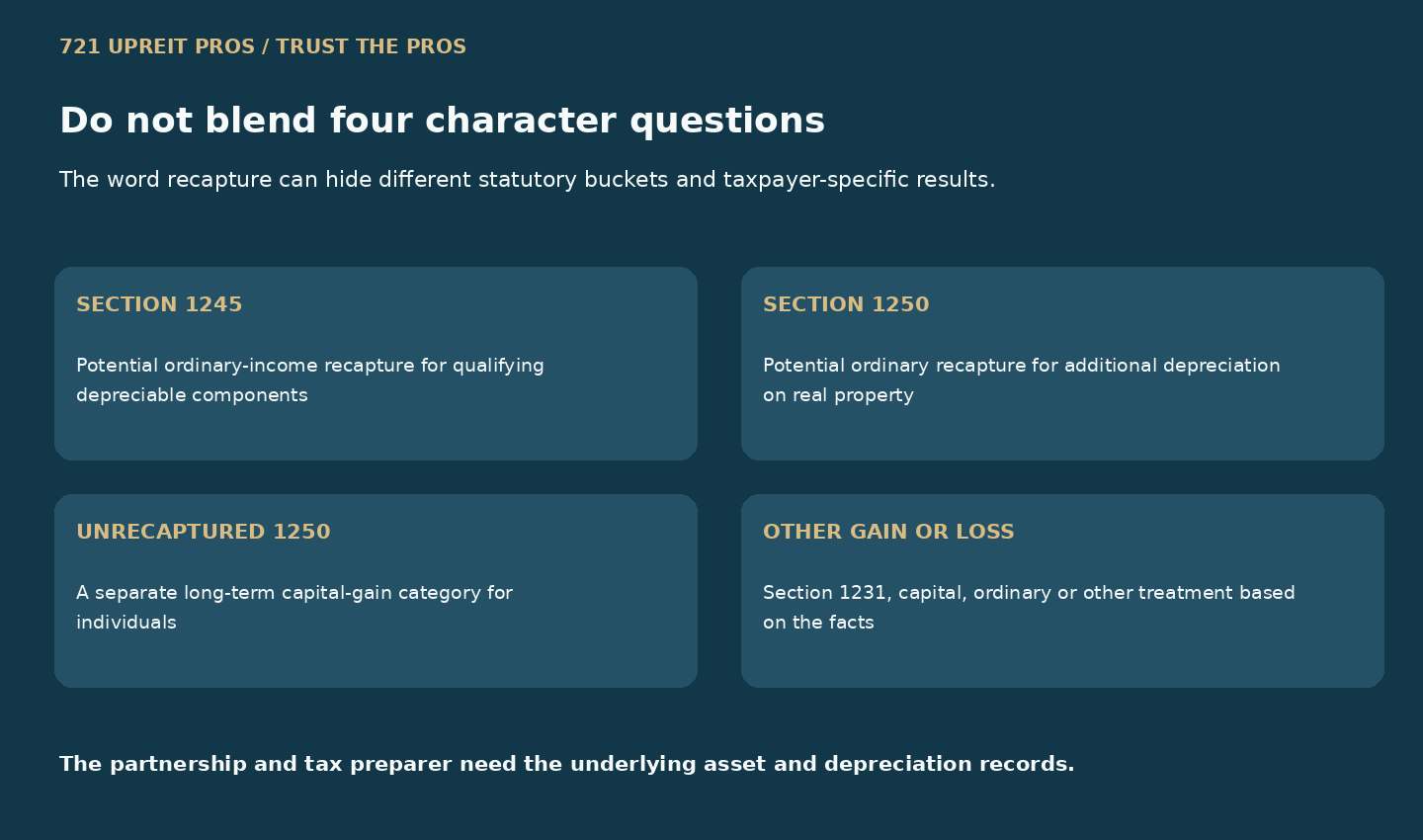
IRS Publication 544 for 2025 returns separates several concepts that are often compressed into the phrase depreciation recapture:
- Section 1245 property. Certain depreciable personal property and qualifying components can produce ordinary income up to the lesser of depreciation or amortization allowed or allowable and gain realized, subject to the applicable rules and limits.
- Section 1250 ordinary-income recapture. For Section 1250 real property, ordinary-income treatment generally concerns additional depreciation above straight line. Many post-1986 real property schedules use straight-line depreciation, so it is inaccurate to call every dollar of real-property depreciation ordinary Section 1250 recapture.
- Unrecaptured Section 1250 gain. Publication 544 describes this as a category of long-term capital gain attributable to depreciation on Section 1250 property, subject to its own limits. It is not the same thing as Section 1250 ordinary recapture.
- Other gain or loss. Remaining amounts may involve Section 1231, capital, ordinary or other treatment depending on the taxpayer, asset, holding period, transaction and prior records.
The common shorthand “25% recapture tax” can therefore be misleading. A maximum rate category is not a universal effective rate, and it does not identify which asset, taxpayer or transaction produced the amount. The preparer needs the underlying schedule and event statements.
Which four ledgers should remain connected?
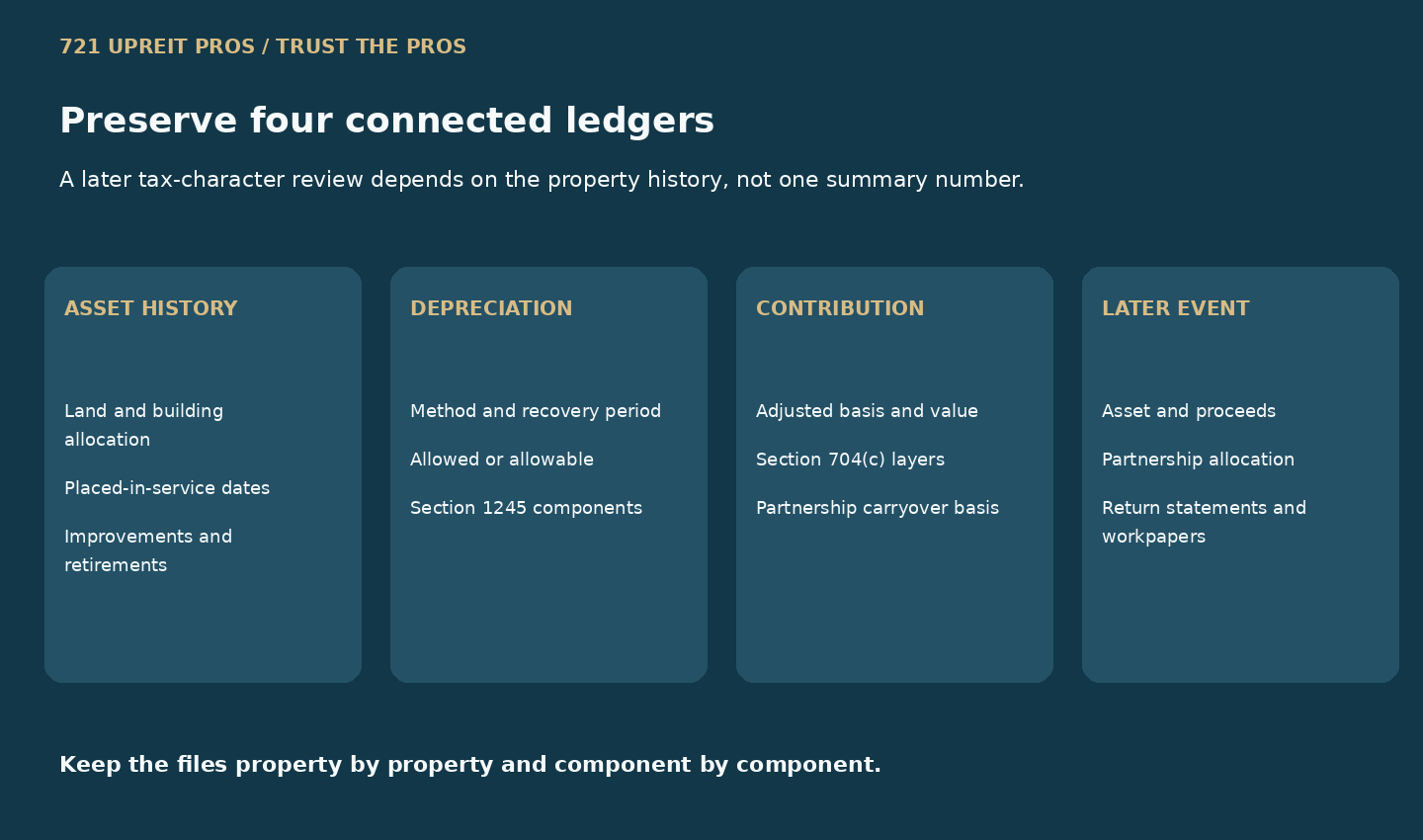
| Ledger | Keep | Why it matters |
|---|---|---|
| 1. Asset history | Acquisition statement, land and building allocation, placed-in-service dates, capital improvements, partial dispositions, retirements and cost-segregation studies | Identifies the actual assets and components rather than treating a property as one undifferentiated number |
| 2. Depreciation | Method, recovery period, convention, Section 179, bonus depreciation, allowed or allowable depreciation and adjusted basis by asset through contribution | Supports the carryover basis and later Section 1245 or Section 1250 analysis |
| 3. Contribution bridge | Contribution agreement, final valuation, adjusted basis statement, recognized gain if any, partnership carryover basis, Section 704(c) method and property-level layers | Connects the contributor's closing file to the partnership's tax records |
| 4. Later event | Event date, affected property or interest, proceeds, liabilities, sale statement, partnership gain and character schedules, Section 704(c) allocation, K-1 attachments and preparer workpapers | Shows what was actually sold, exchanged, distributed or converted and how the reported amount was derived |
Publication 544 generally uses depreciation allowed or allowable when determining Section 1245 ordinary income. A schedule that records only the depreciation actually claimed can be incomplete. Ask the tax professional to resolve missing returns, impermissible methods or other discrepancies rather than filling the gap with an estimate.
Which later event are you analyzing?
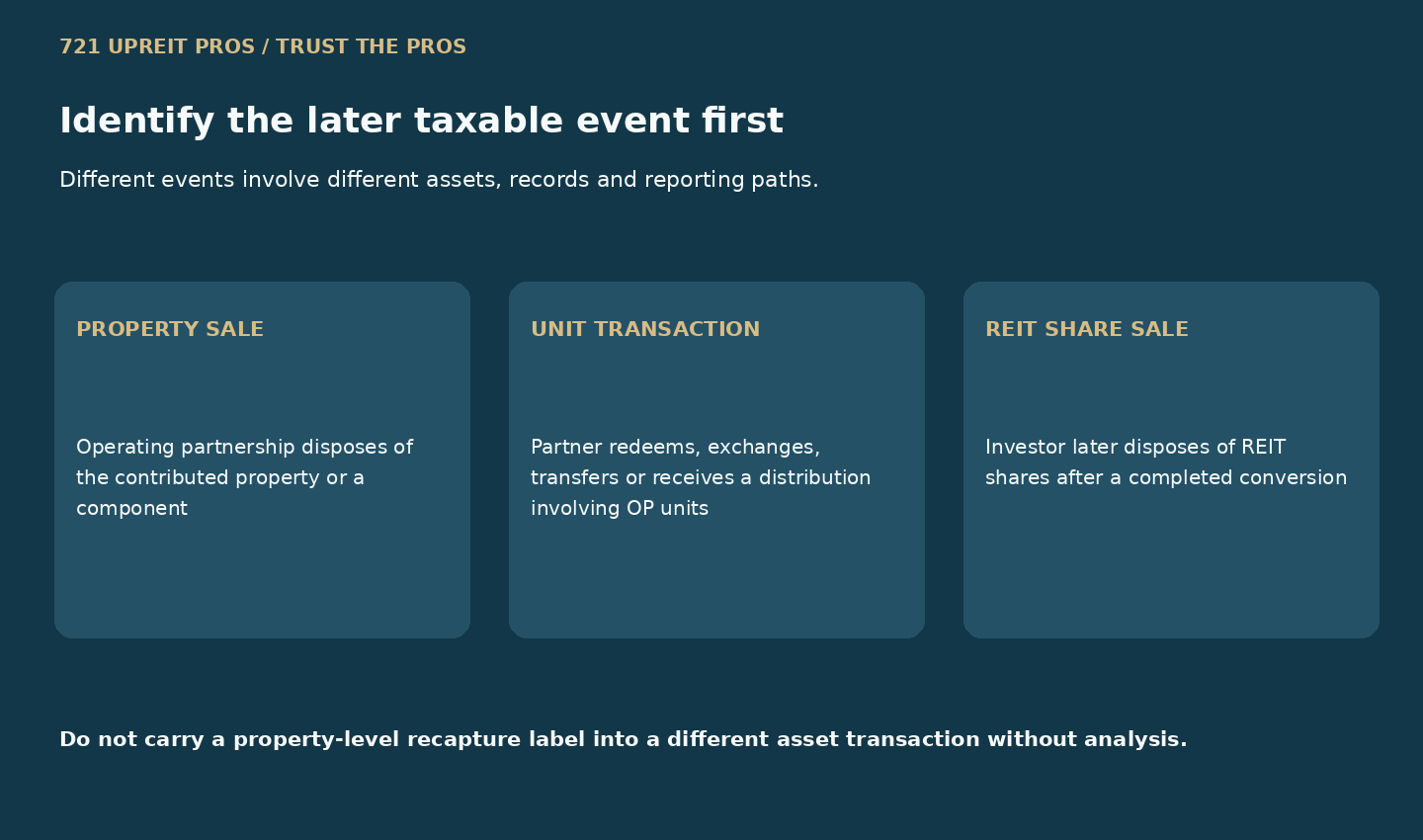
Start by naming the asset and event. These paths are not interchangeable:
- The operating partnership sells contributed property or a component. Request the property sale statement, asset-level proceeds allocation, adjusted-basis schedule, depreciation schedule, partnership gain and character workpaper, Section 704(c) allocation statement and complete K-1 package.
- The partner has an OP-unit transaction. A redemption, exchange, transfer or distribution involving a partnership interest can require interest-level basis, liability, agreement and hot-asset records. Do not assume the property-level recapture schedule alone answers the unit transaction.
- The investor later sells REIT shares. Once an investor holds corporate shares, the asset being sold is generally the shares, not the underlying real estate. Preserve the conversion and share-basis bridge, but do not label the share sale as a direct property sale without professional analysis.
The separate post-contribution ownership-stage guide helps identify which asset the investor owns at each stage. This record page then helps preserve the depreciation history when it remains relevant to partnership reporting.
Fictional example: preserve inputs instead of calculating a tax bill
This example organizes records. It does not determine a return position, allocation or tax. Assume a property was acquired for $4,000,000, with $800,000 assigned to land and $3,200,000 to depreciable building and components. By the contribution date, the records show $900,000 of cumulative depreciation and a $3,100,000 adjusted basis. A final valuation supports a $6,000,000 contribution-date fair market value, creating a $2,900,000 book-tax difference before considering other facts.
A cost-segregation file separately identifies $250,000 of qualifying components, with $180,000 of cumulative depreciation included in the $900,000 total. The remaining depreciation schedule relates to building and improvement assets. Years later, the operating partnership reports a property disposition for $6,800,000 before assumed selling costs in this simplified example.
| Record | Known in the example | Still requires analysis |
|---|---|---|
| Original asset file | $800,000 land and $3,200,000 depreciable assets | Component identities, later improvements and dispositions |
| Contribution bridge | $3,100,000 adjusted basis and $6,000,000 value | Recognized gain, liabilities, Section 704(c) method and layers |
| Potential Section 1245 file | $250,000 identified components and $180,000 cumulative depreciation | Whether each component is Section 1245 property and the applicable ordinary-income amount |
| Real-property file | Remaining building and improvement depreciation schedules | Section 1250 ordinary recapture, unrecaptured Section 1250 gain and other character |
| Later sale | $6,800,000 stated gross amount before assumed costs | Final proceeds, asset allocation, partnership gain, partner allocation and taxpayer-level result |
The $2,900,000 book-tax difference is not a depreciation-recapture calculation. The $900,000 cumulative depreciation is not automatically one tax bucket. The $6,800,000 sale amount does not tell the investor what will appear on a return. The useful output is a complete, reconciled evidence package for the partnership and preparer.
What should the investor request before a later event?
- The final pre-contribution depreciation schedule in machine-readable and PDF form, including asset IDs.
- Acquisition, cost-segregation, improvement, partial-disposition and retirement records.
- The contribution-date adjusted-basis statement, valuation and property description.
- The partnership's tax-basis rollforward and Section 704(c) method and layer detail.
- Every annual K-1 package, including Item M, Item N, Box 20 statements and corrections when applicable.
- The later-event notice and closing statement with the exact property, component or interest affected.
- The partnership's gain, character and partner-allocation statements, including Forms 4797 or other supporting schedules when provided.
- A dated preparer decision log that identifies missing information, assumptions, conclusions and unresolved questions.
Use the contribution-closing evidence checklist to prove what transferred and what was issued. For investment-side questions, talk to a 721 UPREIT advisor. Tax-character and return conclusions belong with the partnership's tax team and the investor's own qualified tax professional.
For broader context on Section 721 and DST-to-UPREIT structures, see the independent educational overview at DST 1031 Experts. It does not replace the property-specific records described here.
Watch the record-chain briefing and download the checklist
The original one-minute captioned video summarizes the four ledgers, separate character questions and later-event paths. It is a silent visual explainer, not tax advice or a calculation.
Read video transcript
0:00 · A contribution does not erase the history
Preserve basis and depreciation by asset. Keep the contribution bridge.
0:12 · Maintain four connected ledgers
Asset, depreciation, contribution and later-event files stay linked. Do not rely on one K-1 field.
0:24 · Separate the character buckets
Section 1245 and Section 1250 are not interchangeable. Unrecaptured Section 1250 gain is different again.
0:36 · Name the actual later event
A property sale, unit transaction and share sale are different. Use the governing documents.
0:48 · Hand the full history to the preparer
Keep schedules, statements, notices and workpapers. Do not calculate from a headline label.
Download the depreciation and property-history checklist. Use it to preserve asset-level schedules, the contribution bridge and later-event records.
Primary sources and review limits
Sources checked October 11, 2026. Use the instructions and law that apply to the actual tax year and transaction. This educational record guide has not received a named advisor, CPA or attorney review.
- IRS Publication 541, Partnerships, revised December 2025: partnership carryover basis, contributed-property cost recovery and built-in gain or loss allocations.
- Treasury Regulation Section 1.704-3, eCFR current when checked October 11, 2026: contributed-property book-tax differences and cost-recovery allocations.
- IRS Publication 544 for 2025 returns: adjusted basis, Section 1245, Section 1250, allowed or allowable depreciation, unrecaptured Section 1250 gain and disposition reporting.
- IRS Publication 946 for 2025 returns: depreciation methods, property records and cross-reference to disposition recapture rules.
- 2025 Partner's Instructions for Schedule K-1: partner-level reporting records that may accompany Section 704(c) items.
Property values and investment income can fall. A contribution may fail to qualify for Section 721, and a later transaction can create taxable gain with different character and timing than expected. No deferral, recapture amount, tax rate, basis, allocation, liquidity or investment result is guaranteed.
BEFORE YOUR ADVISOR CONVERSATION
Three questions before you commit
This companion briefing covers the professional's identity, compensation and how restrictions fit your cash needs. Use it alongside this article's specific document checks.
Loading the video connects to YouTube. Watch on YouTube · 721 UPREIT Pros channel · Read the full advisor checklist.
Read video transcript
Before you hire a seven twenty-one UPREIT advisor, ask these three questions.
First: who exactly am I hiring? Get the professional's legal name, firm and registration information. Check the record through Investor dot gov and read the firm's relationship summary where applicable. Ask whether this conversation involves brokerage services, investment advice, or both. A marketing title alone does not answer that question.
Second: who gets paid, and how much? Request a written cost breakdown in dollars. Identify the payer, calculation base, payment timing and ongoing charges. Include product expenses and embedded compensation. No separate advisor invoice does not mean there are no costs.
Third: how does this fit my cash needs? Review the actual agreements. Ask who controls a possible conversion and what happens if it does not occur. Separate permission to request redemption from approval, pricing and payment. Do not assume a fixed cash-out date.
Then agree on responsibilities. Your investment professional, CPA, attorney and qualified intermediary can have different roles. Put continuing service and unresolved questions in writing.
Read the complete advisor checklist using the article link in the description. Seven twenty-one UPREIT Pros. Trust the Pros. Educational only. Investments involve risk and may be illiquid. Tax treatment depends on your circumstances.
Educational only. Investments involve risk and may be illiquid. Footage is illustrative; narration is synthetic.
TALK TO A 721 UPREIT ADVISOR
Ready to discuss your 721 options?
Request a callback to discuss the questions raised by this article, your timing and what to ask before you commit. Share your name, email and phone below to start the conversation.
No investment commitment or financial documents required. A callback request does not book an appointment or establish an advisory relationship.