
721 UPREIT PROS / FEES AND DECISIONS
721 UPREIT fees: what happens when a waiver ends?
When a 721 UPREIT fee waiver ends, a reduced charge may return to its contractual rate. Separately, some expense-support agreements allow later reimbursement. Identify the exact class, covered costs, ending trigger and repayment terms before comparing proposals. A temporary discount does not remove other fees, investment risk or restrictions on access to cash.
Prepared by 721 UPREIT Pros · October 16, 2026 · Original fee-change worksheet
Key takeaways
- Separate temporary fee waivers, expense support, deferrals and permanent reductions.
- Check the class, calculation base, ending trigger and any repayment provision.
- Compare discounted and later periods using the same disclosed assumptions.
- A fee change does not guarantee a payment change or create a cash exit.
A lower first-year cost can help an investor, but it can also make two proposals look more alike than they are. Ask what the investment costs during the concession and afterward. Keep the sponsor's investment-level expenses separate from the compensation charged by the professional helping you evaluate it.

This guide addresses a temporary cost change. Use the full-life fee ledger for all transaction stages and the 721 UPREIT guide for the ownership structure. If you are preparing to sell, coordinate the broker, qualified intermediary and tax professionals before closing; a fee concession does not establish exchange eligibility.
TALK TO A 721 UPREIT ADVISOR
Talk to a 721 UPREIT advisor
Request a callback to discuss the questions raised by this article, your timing and what to ask before you commit. Share your name, email and phone below to start the conversation.
No investment commitment or financial documents required. A callback request does not book an appointment or establish an advisory relationship.
What exactly is being reduced?
Begin with the legal issuer, operating partnership and exact unit or share class. OP units are partnership interests; REIT shares are different securities. A reduced charge for one class or stage does not automatically follow a property owner through a DST investment, a possible separate Section 721 contribution and a later share conversion. Read each governing package. For the earlier DST stage, use this breakdown of DST fees and expenses to separate acquisition, ongoing and exit costs.
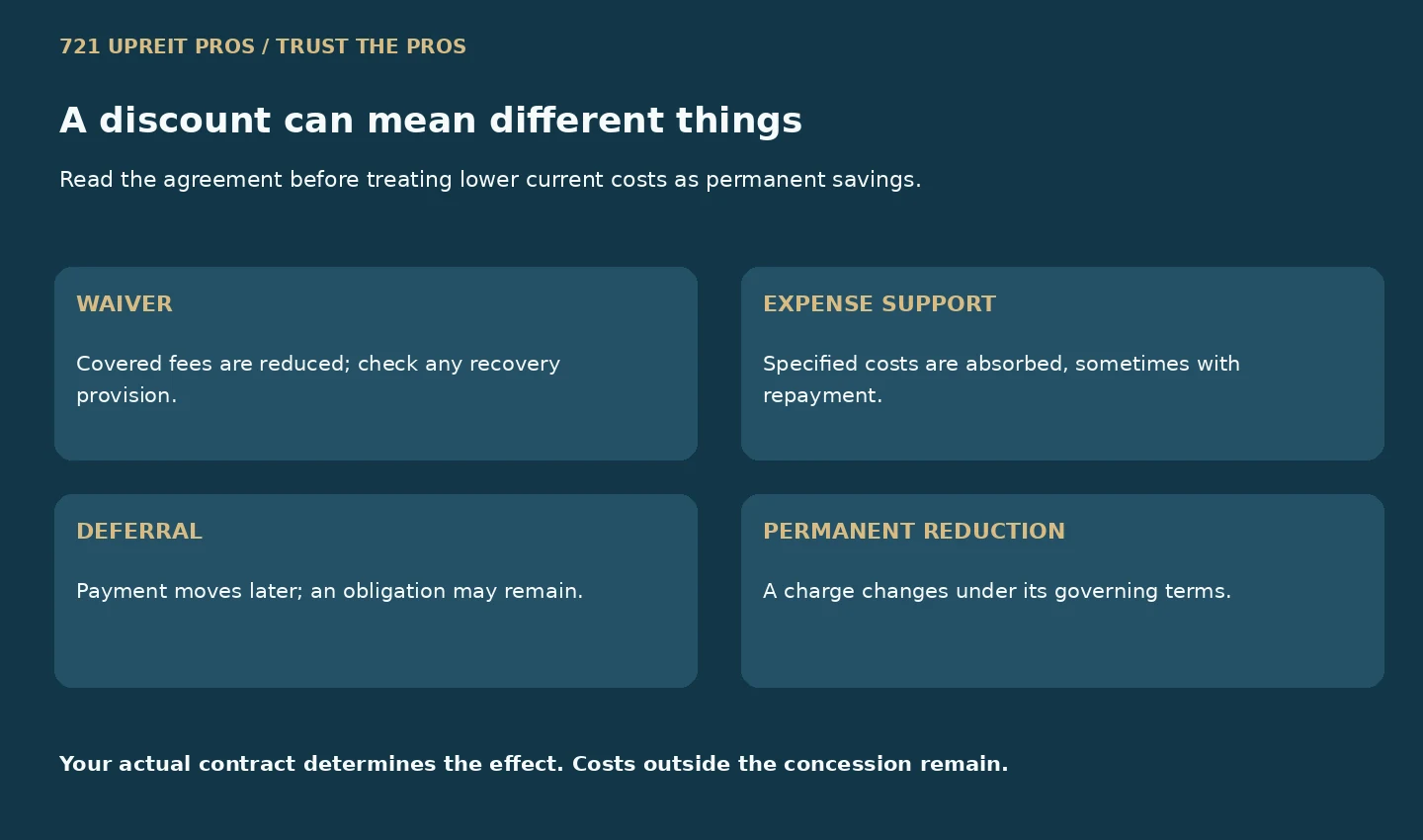
Then name the arrangement. A waived fee, deferred payment, expense cap and permanent price reduction can produce similar current cash figures while creating different future obligations. Do not rely on the word “discount.” Ask which agreement creates it, who receives the benefit, who bears the expense and whether any unpaid amount remains recoverable.
| Arrangement | Present effect | Question after the concession |
|---|---|---|
| Fee waiver | A covered contractual charge is reduced or forgone. | When does the normal rate resume, and can waived amounts ever be recovered? |
| Expense limitation or support | Someone absorbs specified expenses under a formula. | Which expenses are excluded, and is reimbursement permitted? |
| Payment deferral | Payment occurs later rather than now. | What amount remains due, and what event makes it payable? |
| Permanent reduction | The applicable charge changes under the governing terms. | What amendment or termination rights could change it again? |
These are reading categories, not universal contract definitions. One agreement may combine them. An expense cap can exclude management charges, performance allocations, financing or property expenses. A lower capped expense figure should never be presented as the investment's complete cost without examining those exclusions.
What do real filings show?
A dated example illustrates a waiver without later recovery. JLL Income Property Trust's April 17, 2026 registration filing describes a 20% reduction of a fixed advisory-fee component for specified classes, from 1.25% to 1.00% of applicable NAV during the stated period. It says the waived fees will not be sought later, the period ends December 31, 2026 without extension, and that component then returns to 1.25%. Its March 31, 2026 quarterly report also describes the scheduled rate change.
A different arrangement appears in Cohen & Steers Income Opportunities REIT's June 30, 2026 quarterly report, Note 7. Its specified-expense limitation ends at the earlier stated date or NAV trigger. Reimbursement can be requested within a three-year window subject to the disclosed expense threshold. Several major expense categories are excluded from that limit. This is evidence that “support” can have conditional repayment terms, not that every waiver does.
These are examples from dated public filings, checked October 16. They are not current offering quotes, evidence of availability or a statement that a particular investor qualifies for those classes. Later supplements, agreements or account terms may change the analysis. Request the complete current package and identify any amendments before using an example in a personal comparison.
How much could the ending change cost?
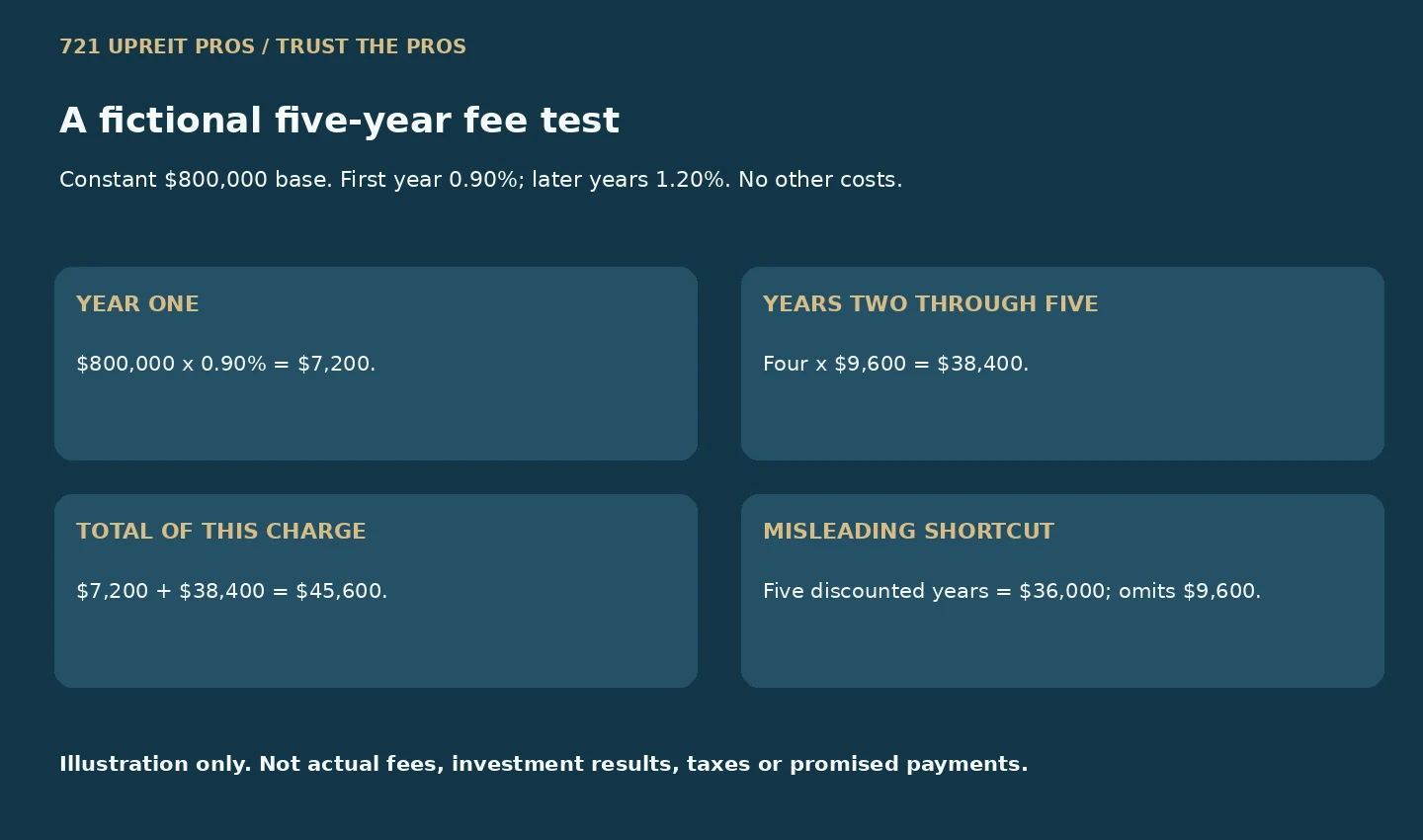
The useful calculation starts with a common base and a defined period. In this fictional example, assume a constant $800,000 fee base, a 1.20% normal annual charge and a 0.30-percentage-point waiver for the first year only. Assume a five-year comparison, no growth, no compounding, no other costs and no repayment. These invented inputs are not market rates or offering terms.
| Period or comparison | Calculation | Amount |
|---|---|---|
| Year one with waiver | $800,000 × 0.90% | $7,200 |
| Each of years two through five | $800,000 × 1.20% | $9,600 |
| Five years, actual assumed schedule | $7,200 + four × $9,600 | $45,600 |
| Incorrect five-year extension of first-year rate | Five × $7,200 | $36,000 |
| Cost omitted by that shortcut | $45,600 − $36,000 | $9,600 |
The concession saves $2,400 against five years at the unreduced rate, but incorrectly carrying the discounted rate through every year understates this assumed cost by $9,600. Both statements can be true. Neither predicts investment return, cash distributions or an investor's account value.
If a separate fictional support balance of $3,000 were fully repayable and became payable during the comparison, this cost-only total would be $48,600. That additional assumption must be supported by the actual agreement before inclusion. Do not automatically add all support as debt, assume all of it will be repaid, or count the same expense twice.
Which date or event actually ends the benefit?
Record the contractual expiration date and any earlier trigger. A benefit might depend on a calendar date, class, asset threshold or another documented condition. Keep the last covered accrual period separate from the date a statement or invoice first shows the higher charge. “It is renewed every year” is not evidence of an executed renewal.
Request a comparison for three cases: the concession continues under a signed extension, it ends as written, and any permitted reimbursement is requested. Mark an extension as uncertain until documented. For a partial-year change, apply the actual accrual method and changing base; multiplying one year-end balance by an annual rate may be insufficient.
Does a higher fee mean the distribution must fall?
Not necessarily, and an unchanged distribution does not prove the cost stayed the same. Fees, operating cash, declared payments and valuation are different measurements. The SEC's REIT investor guidance explains that non-traded REIT distributions can use sources other than operating income and that selling interests may be difficult.
Review the issuer's reconciliation rather than subtracting a fee increase mechanically from a promised payment. Ask how the change affects expenses and the relevant financial measures. Then stress-test household spending using a lower or interrupted payment. The distribution and total-return comparison keeps these concepts separate, while cash-or-reinvestment planning addresses the payment election.
What should you do before committing or responding?
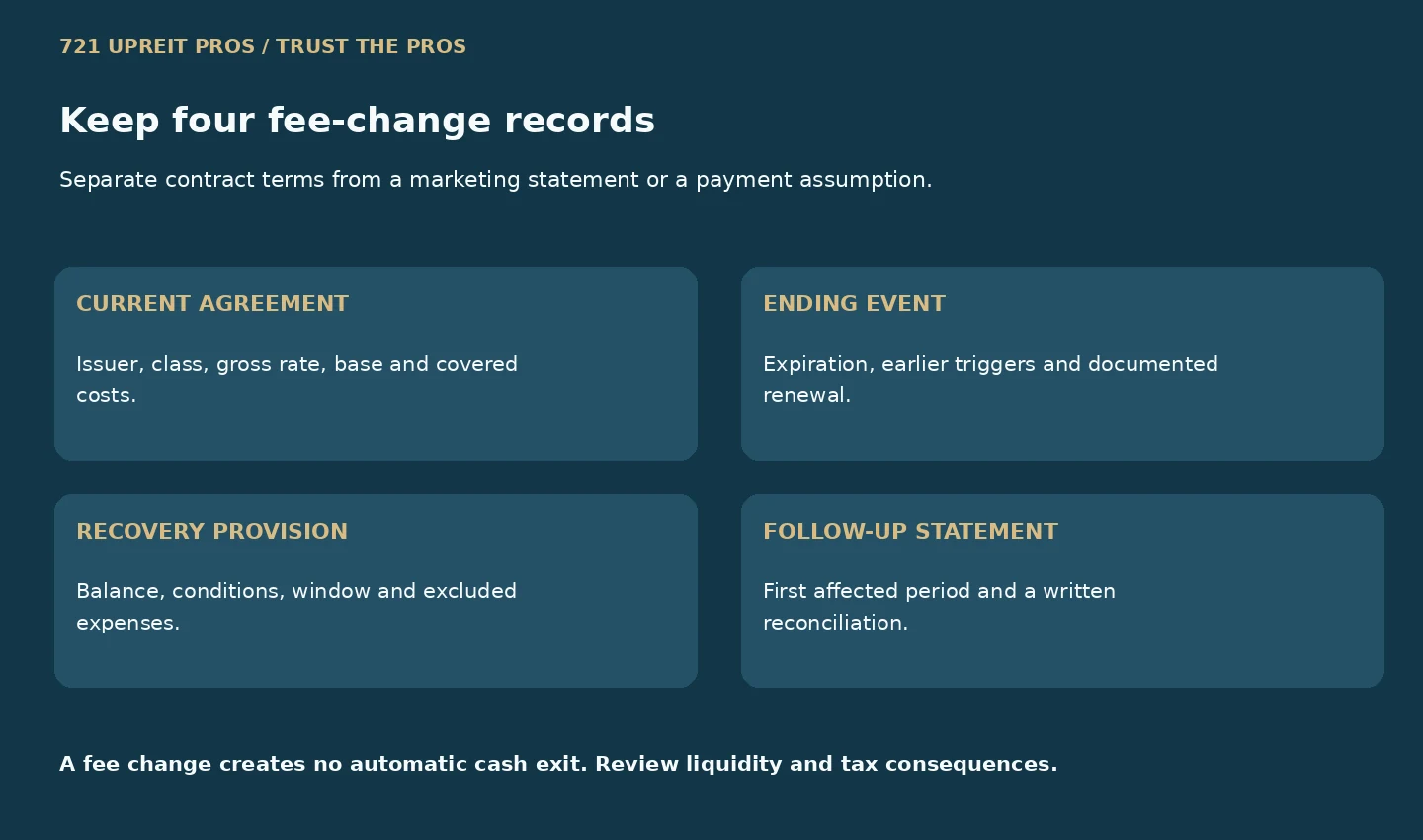
- Identify the exact investment. Record issuer, ownership type, class, current documents and amendment dates.
- Rebuild the charge. List gross rate, calculation base, reduction, covered period and costs outside it.
- Resolve future obligations. Find ending triggers, renewal authority, recovery limits and any separate deferred balance.
- Compare consistent periods. Calculate the concession period and later periods separately, with assumptions visible.
- Check practical alternatives. Discuss keeping the position, changing future purchases or any permitted exit with professionals. A waiver ending does not create a redemption right or make a transfer tax-free.
- Set a follow-up date. Obtain written answers and reconcile the first affected statement against them.
Bring this worksheet to a 721 UPREIT advisor conversation, using the advisor compensation questions to clarify separate account charges. For a related perspective, DST Experts' income-and-return framework explains why distributions alone are incomplete. Keep broader 721 investment risks in view.
Download and watch
Download the fee-waiver review worksheet
This original one-minute silent briefing has timed English captions and a complete transcript below.
Read video transcript
0:00 · 721 UPREIT fee waiver ending?
Identify the charge and the exact class. Do not assume a first-year reduction lasts.
0:12 · Name the arrangement
Waiver, support and deferral differ. Check whether repayment is permitted.
0:24 · Compare the same periods
Fictional five-year cost: $45,600. Extending the discount would omit $9,600.
0:36 · Read the ending trigger
Confirm expiry, renewal and any recovery window. Reconcile the first affected statement.
0:48 · Keep the whole decision in view
Other costs and investment risks remain. A fee change does not create a cash exit.
Sources and limits
Primary filings and SEC investor guidance linked above were reviewed October 16, 2026. The IRS's Publication 541 explains partnership contribution rules and exceptions; a fee reduction establishes no tax result. This worksheet evaluates cost changes, not a sponsor's suitability or an individual's tax return. Published filing examples are dated, not certified as the latest governing terms for an account.
Educational only, not tax, legal or investment advice. Investment value, distributions, conversion, liquidity and tax outcomes are not guaranteed.
Frequently asked questions
Does a fee waiver mean a 721 UPREIT has no fees?
No. It changes only the covered charge under its terms. Identify other investment, property, financing, servicing and separate account costs. A temporary concession should not be presented as a complete cost schedule.
Will an expired waiver automatically be renewed?
Do not assume renewal. Read the expiration and earlier triggers, then request an executed amendment or other controlling evidence. A verbal expectation or a prior extension is not proof of another extension.
Must an investor repay every waived fee?
No universal rule applies. Some waivers expressly exclude future recovery; other agreements permit conditional reimbursement. Identify the payer, amount, conditions and recovery window in the actual documents.
Is an expense cap the same as a cap on all costs?
Not necessarily. The agreement defines which expenses count and which are excluded. Read those exclusions before treating a stated percentage as an all-in expense figure.
Should I redeem just because a waiver ends?
A fee increase belongs in a broader suitability and cost review. It does not establish that redemption is available or sensible. Review timing, value, taxes, alternatives and household liquidity with your professionals.
What documents should I request first?
Start with your exact issuer and class, current fee and support agreements, amendments, expiration terms, any recovery balance and the first affected statement. Ask the professional to reconcile inconsistencies in writing.
TALK TO A 721 UPREIT ADVISOR
Ready to discuss your 721 options?
Request a callback to discuss the questions raised by this article, your timing and what to ask before you commit. Share your name, email and phone below to start the conversation.
No investment commitment or financial documents required. A callback request does not book an appointment or establish an advisory relationship.