
721 UPREIT PROS / DST CONTRIBUTION ELIGIBILITY
721 UPREIT Eligibility: Can Every DST Be Contributed?
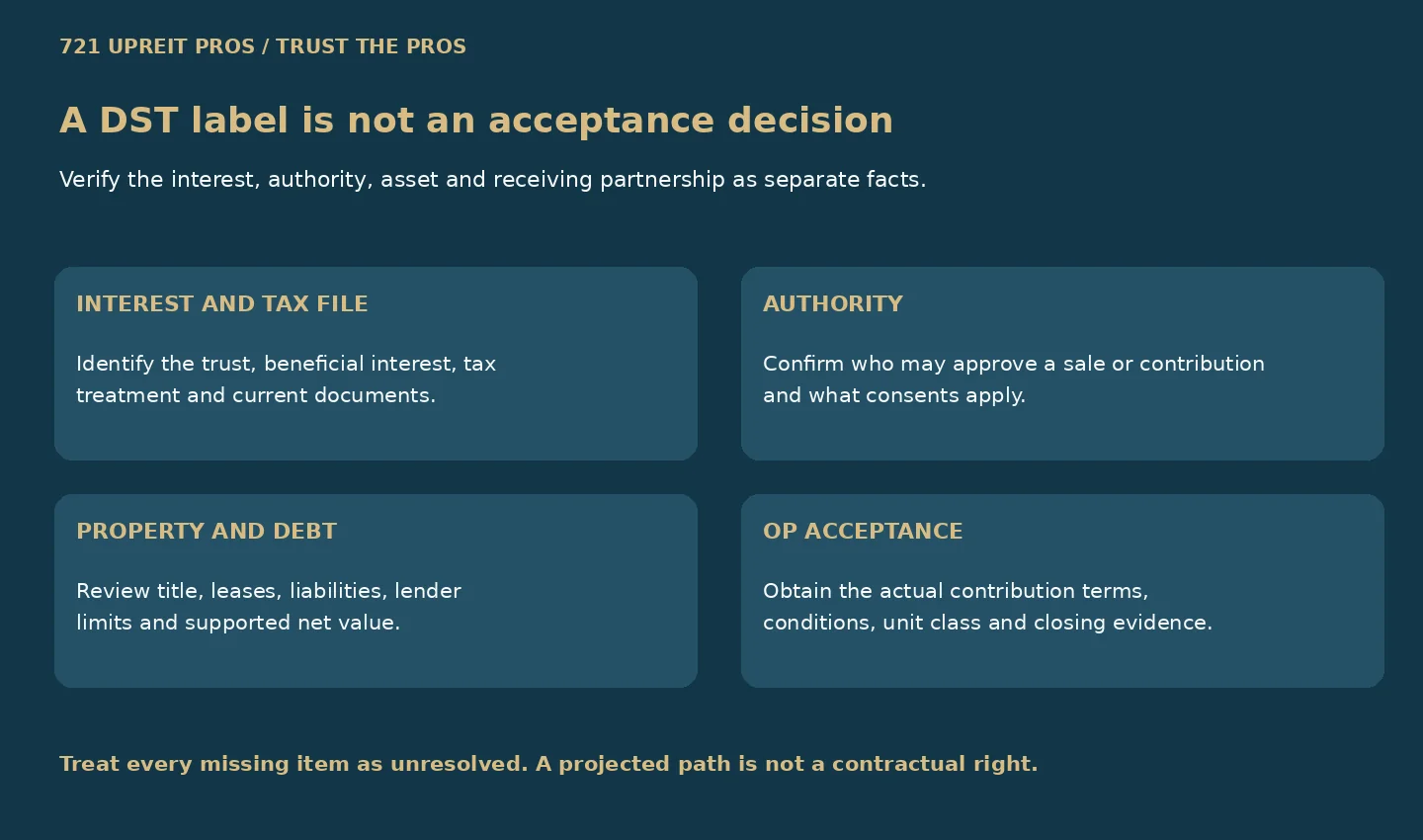
No. A DST label, completed 1031 exchange or projected “721 path” does not make every beneficial interest eligible for a later 721 UPREIT contribution. Verify the exact interest, decision authority, property and debt, valuation, receiving operating partnership, contribution terms and closing conditions before treating the path as available.
By 721 UPREIT Pros · Published October 22, 2026 · Updated October 24, 2026 · Original eligibility matrix and evidence checklist
Key takeaways
- A DST label or projected exit does not establish later operating-partnership acceptance.
- Verify the exact interest, authority, property, debt, valuation and contribution terms.
- Record whether the path is not contemplated, possible, offered or completed.
- Keep the earlier 1031 exchange and later Section 721 contribution in separate evidence files.
Start by separating three events. A property owner may complete a Section 1031 exchange into a qualifying Delaware statutory trust interest. The DST may then hold and operate real estate. A later contribution of property to an operating partnership for partnership units is a separate Section 721 transaction. Each stage has its own parties, documents and conditions.
Revenue Ruling 2004-86 describes a particular trust arrangement in which beneficial owners were treated as owning interests in real property for federal tax purposes. It does not say that every DST interest qualifies for a 1031 exchange, and it does not require a REIT operating partnership to accept that interest or the underlying property later.
TALK TO A 721 UPREIT ADVISOR
Talk to a 721 UPREIT advisor
Request a callback to discuss the questions raised by this article, your timing and what to ask before you commit. Share your name, email and phone below to start the conversation.
No investment commitment or financial documents required. A callback request does not book an appointment or establish an advisory relationship.

Separate operational acceptance from the tax conclusion. Ask for a current asset schedule and planned-step review tied to the receiving partnership, then have your tax professionals address the Section 721(b) investment-company exception. A willingness to accept the DST does not establish that every tax exception has been resolved.
What does “eligible” mean in a DST-to-721 UPREIT plan?
Eligibility is not one yes-or-no label. It is a chain of supported conclusions: the investor owns the identified interest; the governing documents permit the contemplated action; the person directing it has authority; any required lender or investor consents are obtained; the receiving operating partnership is willing to accept the specified property or interest; the parties agree on liabilities and value; and the final contribution documents satisfy the applicable tax and closing conditions.
Section 721(a) generally provides nonrecognition for a contribution of property to a partnership in exchange for a partnership interest. The statute describes a tax rule, not a duty to accept property. Section 721(b) also contains an investment-company exception. Your CPA and attorney should determine how the statute and regulations apply to the exact property, parties and consideration. Do not turn the general rule into a guaranteed tax result.
| Question | Evidence to review | Do not assume |
|---|---|---|
| What does the investor own? | Current trust agreement, subscription records, assignments and tax file | A sponsor name identifies the legal interest |
| Who can approve the transaction? | Trustee powers, governing agreement, investor rights and amendments | An individual owner can demand conversion |
| What property would enter the OP? | Title, leases, property entities, environmental and operating records | The beneficial interest and real estate can be treated interchangeably |
| What happens to debt? | Loan documents, lender consents, payoff or assumption terms and liability schedule | Existing financing transfers automatically |
| Will the operating partnership accept it? | Current proposal, contribution agreement, due diligence and approvals | A marketing description creates an acceptance obligation |
| What units and value apply? | Valuation support, agreed adjustments, unit-class schedule and closing statement | A brochure estimate fixes unit value or economics |
Which DST documents should you read first?
Begin with the executed documents for the interest actually owned, not a current brochure for a different trust. The private placement memorandum, trust agreement, subscription agreement, amendments, loan documents and investor reports may identify powers, restrictions and anticipated disposition choices. The DST-to-721 document checklist organizes seven document groups without treating any single document as proof of conversion.
Look for precise verbs. “May,” “expects,” “intends,” “targets” and “is permitted to” do not mean the same thing as an executed offer or completed contribution. Record whether the documents merely contemplate a possible transaction, give the sponsor or trustee discretion, establish conditions, require consents, or grant an investor a specific election. The conversion-rights review helps distinguish sponsor authority from an individual investor right.
Why can property, debt and authority change the answer?
The receiving operating partnership may underwrite the real estate rather than rely on the earlier DST offering analysis. Property condition, tenant credit, leases, title, environmental findings, reserves, operating history and portfolio fit can all affect the business decision. A property can be suitable for one buyer or time period and unacceptable to another. No tax rule requires an operating partnership to accept an asset that fails its underwriting or closing conditions.
Debt deserves a separate schedule. Determine the borrower, lender, collateral, outstanding principal, prepayment terms, covenants and required consents. Then compare the proposed payoff, assumption or replacement financing with the contribution agreement. Liability shifts can affect economics and may have tax consequences. Avoid concluding that a transaction is tax-deferred until the CPA has reviewed liabilities and all consideration.
Authority can also be decisive. A DST is governed through its trust documents and trustee powers. The investor may have limited control over a disposition or contribution. If approval rests with a trustee, sponsor, lender, board or other party, write that party and the relevant condition into the review ledger. A hoped-for transaction is not an investor-controlled exit.
How do you record the strength of a proposed 721 UPREIT path?
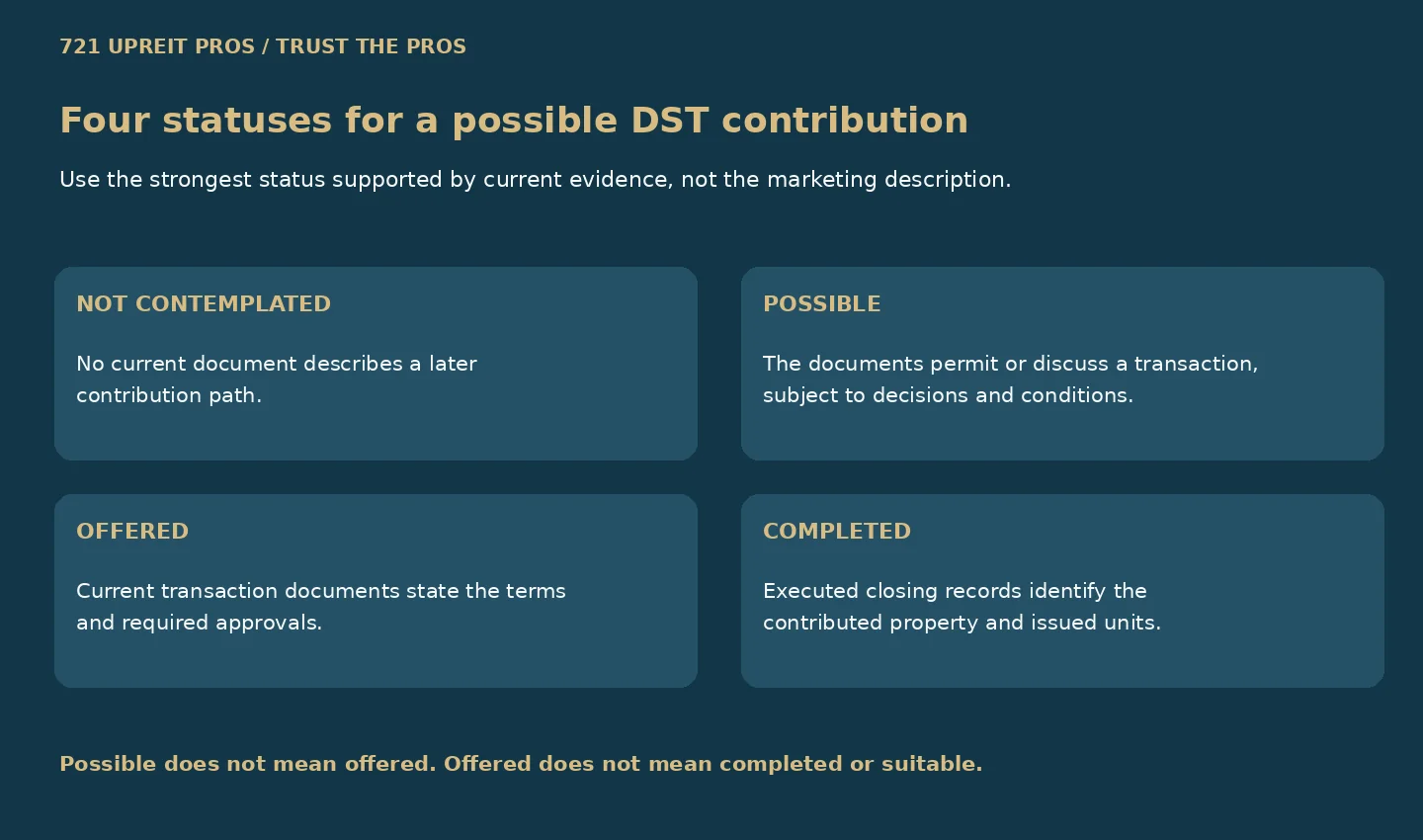
Use a four-status ledger so that planning language is not mistaken for a completed transaction. “Not contemplated” means the current documents do not describe a path. “Possible” means a transaction is discussed or permitted but remains subject to discretion or conditions. “Offered” means current transaction documents identify terms and approvals. “Completed” requires executed closing evidence and issued units.
| Status | What you can say | What remains open |
|---|---|---|
| Not contemplated | No current document was found describing a later contribution | Whether any path will ever be proposed |
| Possible | Documents discuss or permit a transaction under stated limits | Timing, acceptance, valuation, approvals and terms |
| Offered | A current proposal or contribution package identifies the transaction | Satisfaction of conditions and closing |
| Completed | Executed records identify the contribution and OP units issued | Ongoing unit, tax, distribution and liquidity questions |
An SEC-filed 2023 registration statement offers a useful dated example. It described non-binding acquisition agreements for identified DST properties, lender-consent conditions and the possibility that a property might not be available when the buyer sought to acquire it. The example shows why “identified,” “expected” and “available for acquisition” are different statuses. It is not a current offering or a universal transaction form.
How could two similar DSTs reach different eligibility results?
Consider two fictional DSTs, each originally acquired in a completed 1031 exchange and each marketed with a possible future 721 UPREIT path. This is a document exercise, not a return or tax projection.
DST A's current trust documents permit the trustee to pursue a disposition. The receiving operating partnership delivers a property-specific proposal, completes underwriting, obtains lender consent, agrees on the liability schedule and valuation, and circulates a contribution agreement naming the OP-unit class. The status can move from possible to offered, but it is not completed until the conditions are met and the closing records show the units issued.
DST B's old marketing deck mentions a possible 721 path, but the current file contains no contribution proposal. A property loan restricts transfers, the lender has not consented, and no receiving operating partnership has agreed to value or accept the asset. That interest remains only a possible planning idea. The investor should prepare a fallback plan rather than budget around a conversion date.
The difference is not that one has the letters DST and the other does not. It is the documented authority, counterparty willingness, property and debt review, agreed economics and completion evidence.
What should you verify before relying on DST-to-721 eligibility?
- Identify the exact DST, beneficial interest, ownership records and current governing documents.
- Confirm how the interest was treated at acquisition and keep the earlier 1031 file separate.
- Map trustee, sponsor, lender and investor authority, notices, consents and conditions.
- Define the property or interest proposed for contribution and obtain current operating due diligence.
- Reconcile outstanding debt, liabilities, payoff or assumption terms and any other consideration.
- Request the receiving operating partnership's current acceptance terms, approvals and due-diligence list.
- Compare supported property value, adjustments, OP-unit class, exchange ratio, fees and closing statement.
- Ask your CPA and attorney to apply Section 721, including exceptions and liability rules, to the exact transaction.
- Do not mark the transaction completed until the executed records identify the contribution and units issued.
Use the 721 UPREIT transaction sequence to place these gates in context, and compare the separate securities eligibility questions. Accredited-investor status, where required for an offering, does not prove that a particular DST asset is acceptable for contribution.
Bring the evidence ledger to your CPA, attorney, qualified intermediary and investment professional before relying on a later transaction. For a coordinated investment conversation, talk to a 721 UPREIT advisor. No advisor or document can guarantee acceptance, conversion, liquidity, distributions, returns or tax treatment.
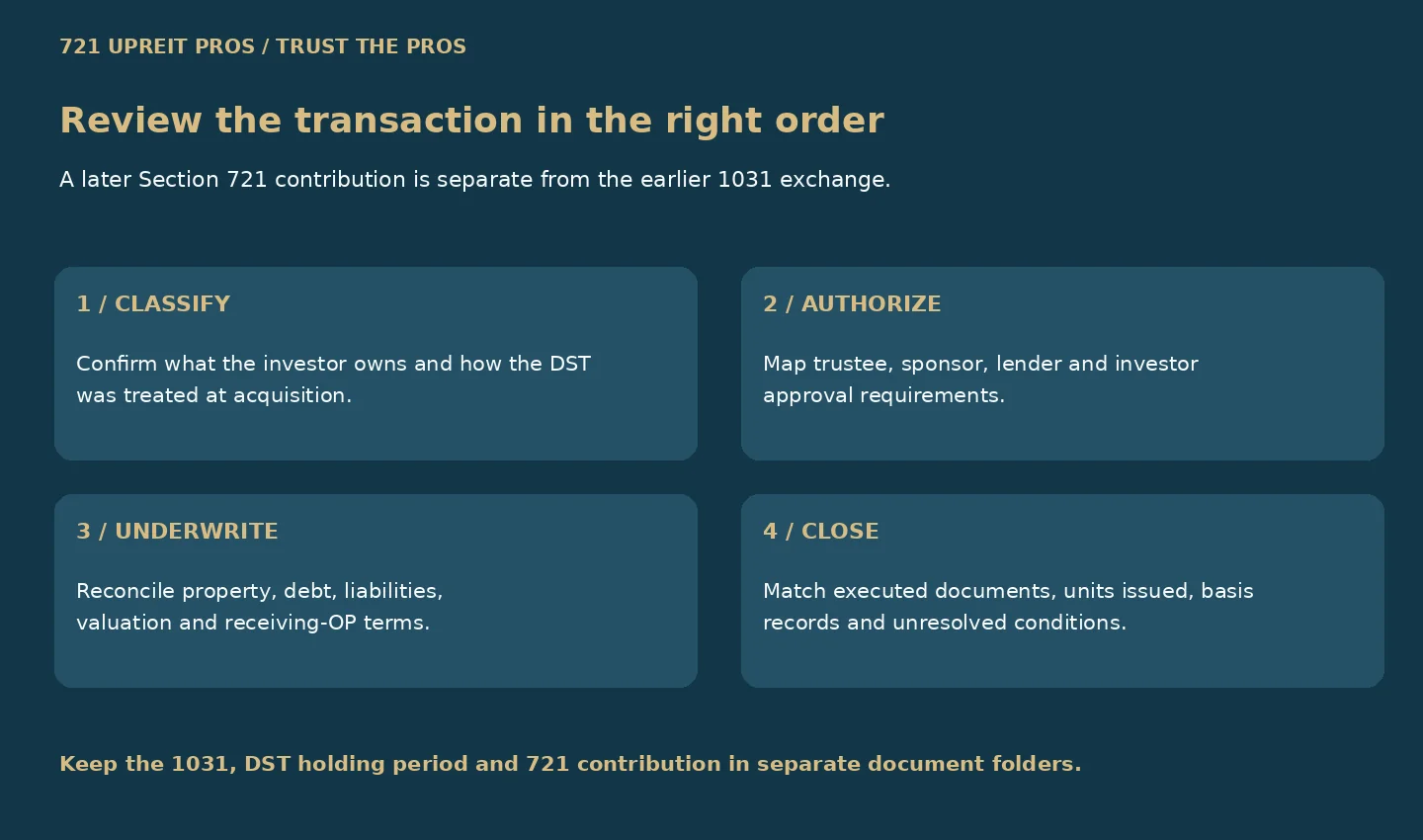
Watch the one-minute DST eligibility review
This original silent video has English captions and a complete transcript. It explains the evidence sequence and makes no claim that a particular DST will be accepted.
Read video transcript
0:00 · Can every DST enter a 721 UPREIT?
No. A DST label or projected exit does not establish acceptance.
0:12 · Identify the interest
Match the trust, investor interest, documents and tax file.
0:24 · Map authority
Confirm trustee, sponsor, lender and investor approval requirements.
0:36 · Test the economics
Reconcile property, debt, liabilities, valuation and proposed unit class.
0:48 · Require closing evidence
Possible is not offered. Offered is not completed or guaranteed.
Download the DST contribution eligibility checklist
Sources checked October 22, 2026: Internal Revenue Service Revenue Ruling 2004-86; 26 U.S.C. § 721; and a dated SEC-filed transaction example. Educational only, not tax, legal or investment advice.
Frequently asked questions
Does every DST qualify for a later 721 UPREIT contribution?
No. The exact interest, governing documents, authority, property, debt, receiving operating partnership and transaction terms must be reviewed. A DST label does not create acceptance rights.
Does Revenue Ruling 2004-86 guarantee a future 721 transaction?
No. It addresses a particular trust arrangement and federal tax classification for the facts described. It does not require an operating partnership to accept an interest or property later.
Can a DST investor demand the conversion?
Do not assume so. Review trustee powers, sponsor discretion, investor rights, lender requirements and current transaction documents. A possible path may not be an individual investor election.
Why does the DST's debt matter?
Loan restrictions, lender consent, payoff or assumption terms and liability shifts can affect feasibility, economics and taxes. Ask the CPA and attorney to review all liabilities and consideration.
When can I call a DST-to-721 transaction completed?
Use executed closing evidence that identifies what was contributed, the liabilities and adjustments, and the OP units issued. A proposal, approval or target date is not completion.
Is accredited-investor status the same as DST contribution eligibility?
No. Securities eligibility, when applicable, concerns the investor or offering. Contribution eligibility also depends on the asset, documents, authority, counterparty acceptance and transaction terms.
TALK TO A 721 UPREIT ADVISOR
Ready to discuss your 721 options?
Request a callback to discuss the questions raised by this article, your timing and what to ask before you commit. Share your name, email and phone below to start the conversation.
No investment commitment or financial documents required. A callback request does not book an appointment or establish an advisory relationship.