
721 UPREIT PROS / INVESTOR ELIGIBILITY
Does a 721 UPREIT require accredited investor status?
Section 721 does not itself require a property owner to be an accredited investor. The practical answer depends on how the OP units are offered, the securities exemption or registration path, the operating partnership's eligibility rules and whether the property and transaction are accepted.
By 721 UPREIT Pros · September 24, 2026 · Accredited-investor eligibility worksheet
Key takeaways
- Section 721 tax treatment and securities-offering eligibility are separate questions.
- Identify the actual investor, legal issuer and offering exemption before relying on an accreditation label.
- Sponsor property acceptance and investment suitability require additional review.
- Resolve eligibility and verification requirements before committing to a time-sensitive property sale or exchange.

This article answers a narrower question than the complete 721 UPREIT guide. It does not decide whether a reader qualifies for an offering. It shows where the answer should come from and why a tax rule, a securities rule and a sponsor's commercial screen should not be treated as one test.
Do you have to be accredited for a 721 UPREIT?
Not because Section 721 says so. Section 721 generally addresses whether gain or loss is recognized when property is contributed to a partnership in exchange for a partnership interest. It does not contain an accredited-investor test. However, OP units are typically issued as securities, and many private UPREIT transactions or related DST offerings may use an exemption or sponsor policy that limits participation to accredited investors. The current offering and contribution documents control the practical eligibility answer.
TALK TO A 721 UPREIT ADVISOR
Talk to a 721 UPREIT advisor
Request a callback to discuss the questions raised by this article, your timing and what to ask before you commit. Share your name, email and phone below to start the conversation.
No investment commitment or financial documents required. A callback request does not book an appointment or establish an advisory relationship.
That distinction matters. A property owner can satisfy a tax-law concept yet fail an offering-eligibility screen. An accredited investor can still have a property rejected, fail a sponsor's suitability or transaction-size criteria, or decide the unit terms and liquidity restrictions do not fit. Eligibility opens a review. It does not establish suitability, acceptance, value or a favorable tax result.
Key takeaway
Ask four separate questions: Does the transfer fit Section 721? What securities-law path applies to the OP-unit issuance? Does the contributor meet that offering's eligibility and verification rules? Will the operating partnership accept the property and negotiated terms?
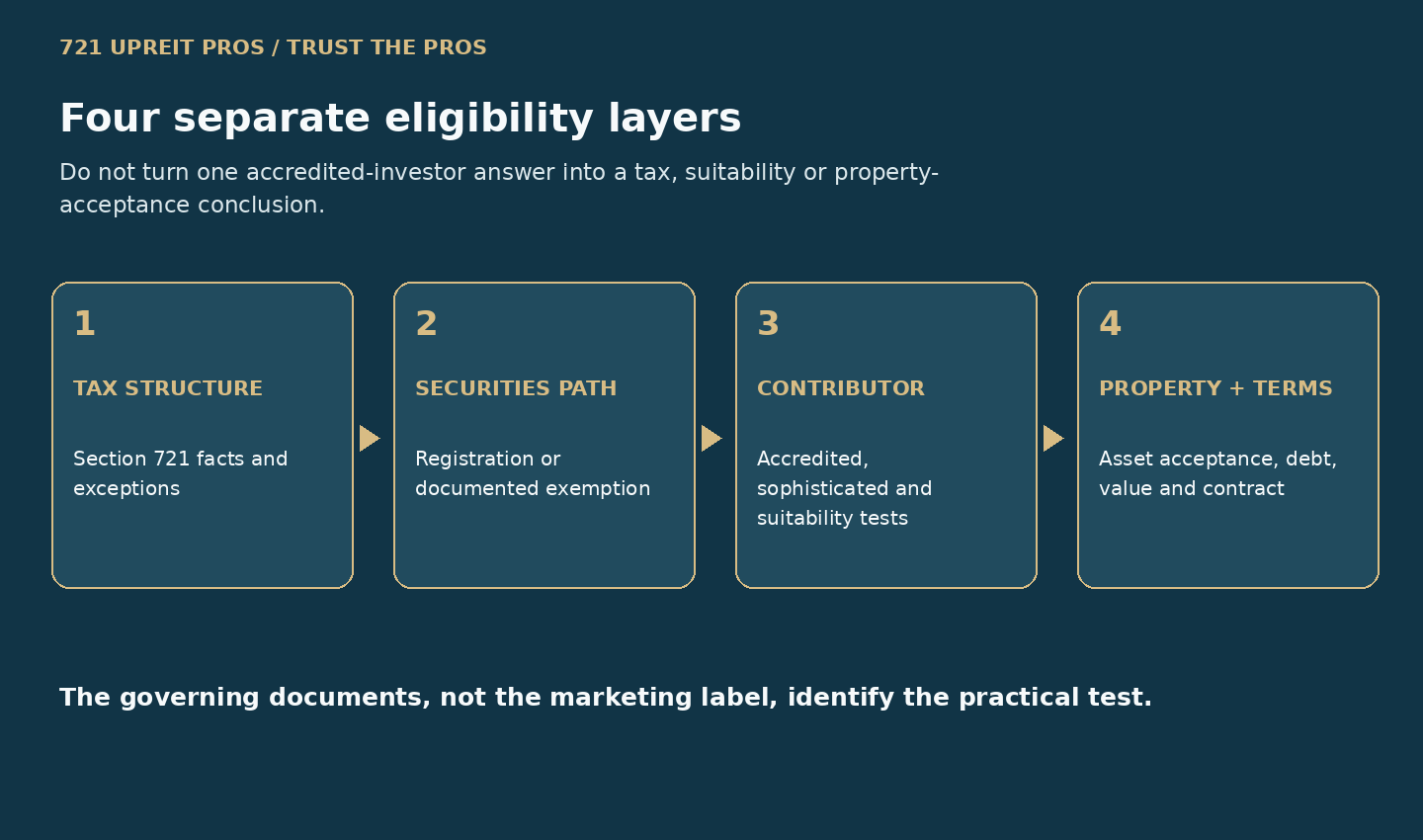
What are the four layers of 721 UPREIT eligibility?
A reliable file identifies the source document, decision maker and evidence for each layer. Do not accept a single marketing checkbox as proof that every layer is complete.
| Layer | Question | Primary evidence | Who confirms it? |
|---|---|---|---|
| 1. Tax structure | Is property being contributed to a partnership for a partnership interest, and what other facts affect recognition? | Transaction steps, contribution agreement, entity chart, property schedule, debt and consideration records | Tax counsel and CPA using the actual closing facts |
| 2. Securities pathway | Is the OP-unit issuance registered, exempt or part of another documented offering path? | Offering memorandum, subscription or contribution documents, exemption representations and securities-law analysis | Issuer and securities counsel |
| 3. Contributor eligibility | Must the contributor be accredited, sophisticated, suitable or meet other program criteria? | Investor questionnaire, eligibility representations, verification requests and sponsor policy | Issuer, broker-dealer or authorized reviewer under the applicable process |
| 4. Property and transaction | Will this operating partnership accept this asset, ownership structure, debt, value and negotiated terms? | Property diligence, title, authority, loan documents, valuation, unit schedule and signed conditions | Operating partnership and its acquisition, legal, tax and credit teams |
These layers can produce different answers. A direct contribution may be privately negotiated with an existing property owner. A DST interest might first be acquired in a private placement and only later become part of a separate UPREIT contribution. A registered REIT share purchase is another transaction entirely. The label “721” does not identify which securities-law route applies.
Who is an accredited investor?
Rule 501(a) of Regulation D defines multiple categories of accredited investors, including individuals who meet specified net-worth, income or professional-credential tests and entities that meet specified status, asset, investment or ownership tests. Do not reduce the definition to one income number when the contributor may be an LLC, partnership, trust or other entity.
For individuals, the SEC's current educational summary states that a person may qualify with net worth over $1 million, alone or with a spouse or partner, excluding the primary residence. It also lists income over $200,000 individually or $300,000 with a spouse or partner in each of the prior two years, with a reasonable expectation of reaching the same level in the current year. Certain qualifying professional credentials, issuer-insider roles, knowledgeable-employee status and family-office relationships can also apply in specified circumstances.
The detailed rule matters. For example, Rule 501 includes special treatment for debt secured by a primary residence in the net-worth calculation. It also includes several entity categories, a category for certain entities owning more than $5 million in investments, and a category for an entity whose equity owners are all accredited investors. A trust's path may differ from an LLC's path, and an entity should not assume that the owner's personal status automatically answers the entity's question.
Use the current SEC accredited-investor overview for a plain-language starting point and Rule 501 for the actual categories and calculation details. The SEC page was last reviewed April 24, 2026. This article does not replace the current rule, offering documents or legal advice.
Why does the offering path change the answer?
Different securities exemptions impose different purchaser conditions. Under current Rule 506(c), all purchasers must be accredited investors and the issuer must take reasonable steps to verify that status. Rule 506(b) can permit a limited number of non-accredited purchasers who satisfy the rule's sophistication standard, subject to the rule's other conditions. An issuer may still adopt a stricter accredited-only policy even when a legal exemption could permit something broader.
Rule 506 also shows why “I signed a questionnaire” may not be a complete answer. The verification standard depends on the offering path. Rule 506(c) identifies non-exclusive methods involving income records, asset and liability records, or written confirmation from specified professionals. Those examples are not a universal checklist for every transaction.
Ask the issuer or authorized intermediary to identify the exemption or registration path in writing. Then locate the specific representation that defines who may participate and the evidence required. Keep the completed questionnaire, supporting confirmation and final signed representation with the closing file. Do not email sensitive tax returns, account statements or credit reports to an unverified address simply because a marketing page requests them.
Five offering questions to ask
- What security is being issued, by which legal entity, and to which contributor?
- What registration statement, exemption or other securities-law basis applies?
- Does the transaction require accredited status, another sophistication test or additional suitability criteria?
- Who must verify the status, what evidence is accepted and how will sensitive information be protected?
- What happens if the contributor cannot make a required representation before closing?
Whose eligibility is tested when a property is held in an entity?
Start with the person or entity that will actually receive the OP units. The deed owner, tax owner, borrower, individual manager and proposed OP-unit holder may not be the same. The securities questionnaire should match the legal recipient identified in the contribution documents.
Assume two siblings own an LLC that holds an apartment property. If the LLC will contribute the property and receive OP units, the eligibility review may focus on the LLC and the applicable entity category. The siblings' personal income or net worth might still matter under a look-through category or sponsor process, but it should not be substituted casually for the LLC analysis. If the transaction instead distributes interests or changes the contributor before closing, tax, lender, title and securities questions may all change.
Prepare a one-page entity chart before answering eligibility questions. Show the record property owner, tax classification, direct and indirect owners, percentages, managers or trustees, authorized signers, borrower and intended OP-unit recipient. Attach the deed, organizational documents and resolutions that support the chart. Then ask the issuer which accredited-investor category it expects the recipient to rely on.
The related direct-property-to-UPREIT acceptance checklist covers asset, authority, debt and valuation evidence. Accredited status does not cure a title problem, missing consent, lender restriction or valuation gap.
Does a DST-to-721 pathway use the same eligibility test twice?
Do not assume the DST purchase and a later UPREIT contribution are one eligibility event. A DST interest may be sold in a private securities offering with its own accredited-investor, suitability and verification requirements. A later contribution to an operating partnership is a separate transaction with a different issuer, agreement, timing and set of representations.
A DST offering may describe a possible future 721 pathway, but that description is not a guarantee that a conversion will occur or that the operating partnership will accept the interest. The investor should keep the DST subscription file separate from any later UPREIT eligibility file and compare the named issuer, security, exemption, decision rights and verification date.
How can two owners get different answers?
Consider two simplified hypothetical owners. These examples are controls for the question sequence, not legal conclusions, offers or eligibility determinations.
| Fact pattern | What Section 721 answers | What it does not answer | Next evidence |
|---|---|---|---|
| Owner A contributes a directly owned industrial property to an operating partnership in a privately negotiated exchange for OP units | Whether the described property-for-partnership-interest transfer can fit the general nonrecognition framework, subject to the full facts | Which securities path applies, whether accredited status is required, whether the asset is accepted or what unit terms are fair | Contribution agreement, issuer counsel's offering-path explanation, eligibility questionnaire and property acceptance file |
| Owner B uses a 1031 exchange to acquire a DST interest marketed with a possible later 721 contribution | Nothing about the initial 1031 purchase by itself; Section 721 becomes relevant only if a later qualifying partnership contribution actually occurs | DST offering eligibility, future conversion certainty, timing, sponsor acceptance, OP-unit value or liquidity | DST private placement memorandum and subscription file now; separate conversion and UPREIT documents later if proposed |
Owner A might qualify under the transaction's actual securities path yet have the property declined. Owner B might be accredited for the DST offering but never receive an opportunity to contribute the DST interest. The reverse can also happen: an owner may have a property a sponsor wants but fail an accredited-only offering policy. The sequence prevents a tax label from becoming an unsupported promise.
What documents prove the answer?
Build an evidence map that names the exact document and date behind each conclusion. If a requirement appears only in a sales email or call note, mark it unverified until it is reconciled with the governing documents.
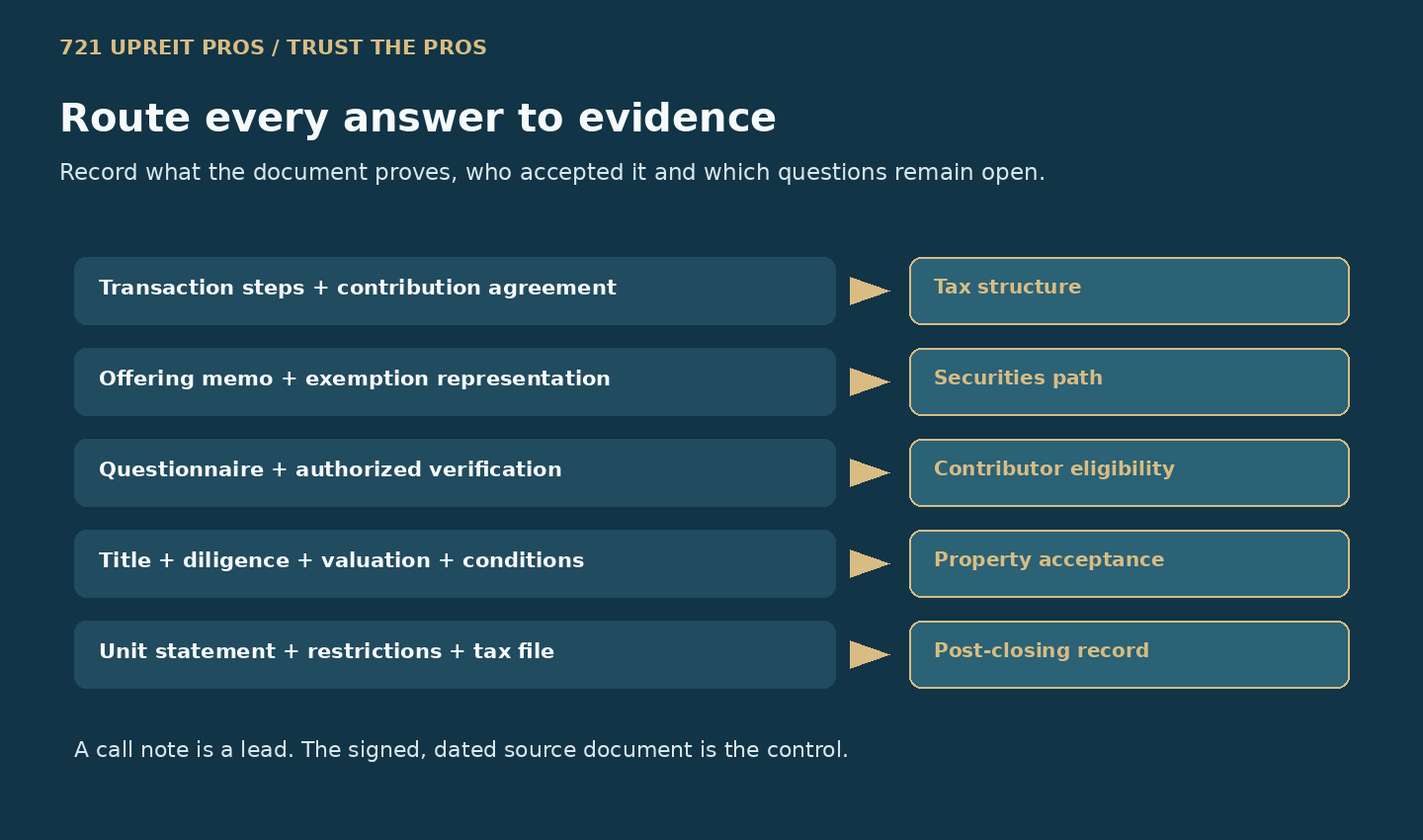
- Tax structure: step plan, contributor and property schedule, entity chart, debt schedule, consideration schedule, contribution agreement and CPA or counsel workpaper.
- Securities path: offering memorandum or exemption explanation, subscription or contribution representations, issuer identity and unit-class documents.
- Eligibility: current questionnaire, applicable Rule 501 category, required verification record, suitability information and written acceptance of the eligibility file.
- Property acceptance: diligence request list, title and authority documents, valuation schedule, debt approval, closing conditions and final acceptance.
- Post-closing: unit statement, operating partnership agreement, transfer or redemption restrictions, tax-basis records and future reporting contacts.
Do not send a self-created net-worth calculation as if it were the issuer's final verification. Use the authorized process. If a CPA, attorney, registered broker-dealer or registered investment adviser is asked to provide a confirmation under Rule 506(c), confirm that the request, timing and scope match the current rule and the offering's instructions.
Being accredited does not mean the investment is approved by the SEC, low-risk or suitable. Review fees, concentration, leverage, governance, valuation, transfer restrictions, redemption terms, distribution policy and tax consequences. The 721 UPREIT risk and due-diligence guide provides the broader decision framework.
Watch the eligibility briefing and download the worksheet
The one-minute briefing keeps the four questions separate: tax structure, securities pathway, contributor eligibility and property acceptance.
Download the eligibility evidence worksheet
Read video transcript
0:00 · Does Section 721 require accreditation?
No. Section 721 states a partnership contribution rule, not an accredited-investor test. The offering path may still require it.
0:12 · Layer one: tax structure
Confirm the contributor, property, partnership interest, debt and other consideration. Tax treatment is fact-specific.
0:24 · Layer two: securities path
Identify the registration or exemption used for the OP-unit issuance. Rule 506(b) and Rule 506(c) have different purchaser conditions.
0:36 · Layer three: contributor
Match the actual OP-unit recipient to a current Rule 501 category and the offering's verification process. Protect sensitive records.
0:48 · Layer four: property and terms
Accreditation does not guarantee asset acceptance, suitability, value or liquidity. Keep the signed evidence file.
What should you do next?
Identify the proposed OP-unit recipient and ask for the actual offering path and eligibility representation before collecting sensitive documents. Then reconcile that answer with the property acceptance file, contribution agreement and tax analysis. If the structure or issuer changes, repeat the check rather than carrying an old accreditation answer forward.
For a current eligibility and transaction discussion, review your 721 UPREIT qualification questions with an advisor. Bring the worksheet, entity chart and documents listed above. No advisor, article or checklist can guarantee sponsor acceptance, tax deferral, liquidity, value or investment results.
Sources
- Internal Revenue Code Section 721, general contribution rule and statutory exceptions.
- SEC accredited-investor overview, last reviewed April 24, 2026.
- 17 CFR 230.501, current Regulation D definitions and accredited-investor categories.
- 17 CFR 230.506, current Rule 506(b) and 506(c) conditions and verification provisions.
Educational use only. This material is not tax, legal or investment advice and is not an offer or solicitation. Rules, offering terms and personal facts can change. Review current governing documents with qualified tax, legal and investment professionals.
Frequently asked questions
Does Section 721 itself require accredited investor status?
Section 721 does not itself impose an accredited-investor test. The securities-offering path and actual issuer documents can impose separate requirements.
Does owning an expensive property prove accreditation?
No. Gross property value is not the complete individual or entity accreditation test. Relevant liabilities, ownership and the specific permitted test must be considered.
Is my primary residence included in the individual net-worth test?
The SEC’s individual net-worth route generally excludes the value of the primary residence and has specific rules for related debt. Use current SEC guidance and verify the actual calculation rather than relying on a property valuation.
If I qualify for a DST, am I automatically approved for later OP units?
Do not assume that. Identify the legal investor, securities path, documents and verification requirements for each separate step, including a potential later contribution.
Who is evaluated when my LLC owns the property?
Start with the actual entity receiving the security. Entity tests and, in some cases, owner information may be relevant. Ask the issuer and legal professional which test and evidence apply.
Does accreditation mean the investment fits my retirement plan?
No. Eligibility does not establish suitability, dependable distributions or access to cash. Review fees, control, concentration, liquidity and household needs separately.
BEFORE YOUR ADVISOR CONVERSATION
Three questions before you commit
This companion briefing covers the professional's identity, compensation and how restrictions fit your cash needs. Use it alongside this article's specific document checks.
Loading the video connects to YouTube. Watch on YouTube · 721 UPREIT Pros channel · Read the full advisor checklist.
Read video transcript
Before you hire a seven twenty-one UPREIT advisor, ask these three questions.
First: who exactly am I hiring? Get the professional's legal name, firm and registration information. Check the record through Investor dot gov and read the firm's relationship summary where applicable. Ask whether this conversation involves brokerage services, investment advice, or both. A marketing title alone does not answer that question.
Second: who gets paid, and how much? Request a written cost breakdown in dollars. Identify the payer, calculation base, payment timing and ongoing charges. Include product expenses and embedded compensation. No separate advisor invoice does not mean there are no costs.
Third: how does this fit my cash needs? Review the actual agreements. Ask who controls a possible conversion and what happens if it does not occur. Separate permission to request redemption from approval, pricing and payment. Do not assume a fixed cash-out date.
Then agree on responsibilities. Your investment professional, CPA, attorney and qualified intermediary can have different roles. Put continuing service and unresolved questions in writing.
Read the complete advisor checklist using the article link in the description. Seven twenty-one UPREIT Pros. Trust the Pros. Educational only. Investments involve risk and may be illiquid. Tax treatment depends on your circumstances.
Educational only. Investments involve risk and may be illiquid. Footage is illustrative; narration is synthetic.
TALK TO A 721 UPREIT ADVISOR
Ready to discuss your 721 options?
Request a callback to discuss the questions raised by this article, your timing and what to ask before you commit. Share your name, email and phone below to start the conversation.
No investment commitment or financial documents required. A callback request does not book an appointment or establish an advisory relationship.