
721 UPREIT PROS / PROPERTY CONTRIBUTION COSTS
721 UPREIT Closing Costs: Who Pays When You Contribute Property?
There is no universal 721 UPREIT closing-cost split. A direct property contribution agreement should assign title insurance, survey, transfer taxes, recording, escrow, legal work and adjustments. Ask who pays each invoice and whether the amount also reduces the value credited to the contributor. Read the draft closing statement against the signed agreement before comparing this path with a 1031-to-DST purchase.
By 721 UPREIT Pros · November 17, 2026 · Filed-agreement cost allocation and original comparison
Key takeaways
- A direct 721 property contribution has no universal closing-cost split.
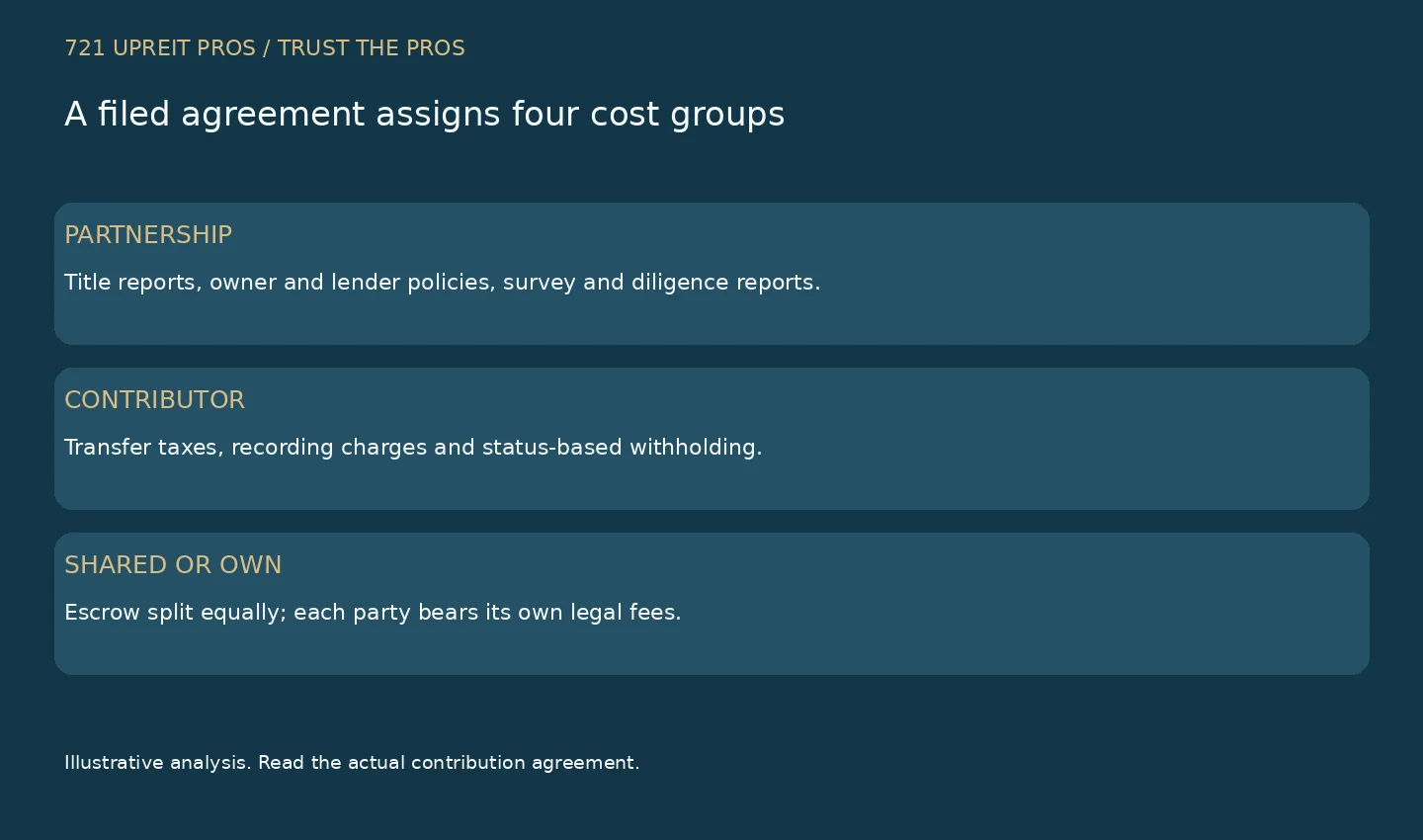
- A December 2024 filed agreement assigns title and survey to the partnership, transfer and recording charges to the contributor, and escrow equally.
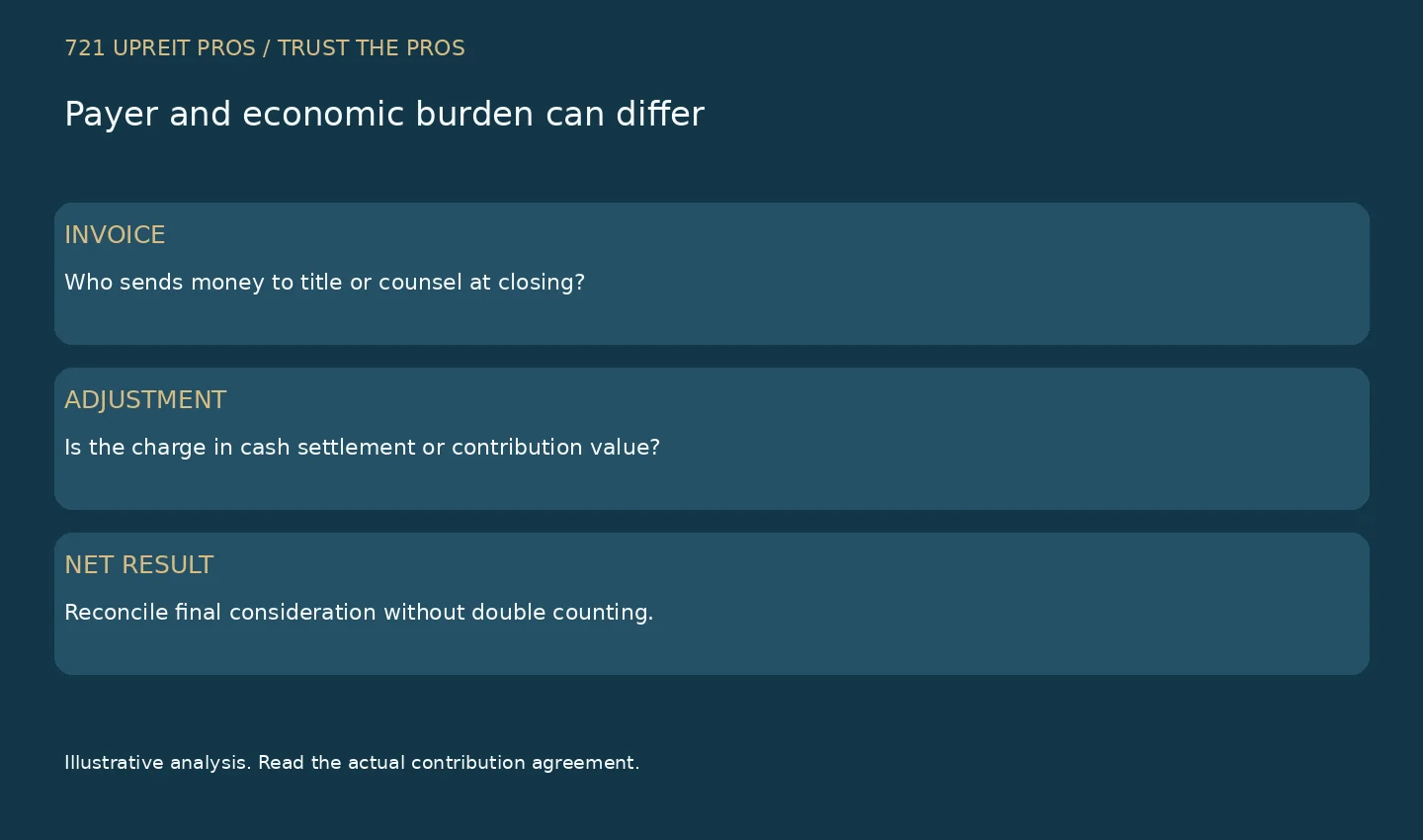
- The party paying a vendor may differ from the party bearing the economic cost after contribution-value adjustments.
- Compare signed documents and a final settlement bridge; keep a 1031-to-DST route in a separate cost file.
“No upfront fee” can be an incomplete answer when a property owner is considering a direct contribution to a REIT operating partnership. The seller may still have transfer taxes, title exceptions to cure, legal bills, escrow charges and prorations. Some costs are paid by the partnership, some by the contributor, and some are shared. The economic burden can also appear as a reduction to the value assigned at closing rather than a separate bill.
This article addresses the property contribution closing, not the full-life management and investor-servicing fee schedule. The DST and UPREIT fee ledger owns that wider cost intent. Start with the direct-property acceptance checklist to establish whether a partnership will review the asset at all. No agreement obligates an operating partnership to take a property.
TALK TO A 721 UPREIT ADVISOR
Talk to a 721 UPREIT advisor
Request a callback to discuss the questions raised by this article, your timing and what to ask before you commit. Share your name, email and phone below to start the conversation.
No investment commitment or financial documents required. A callback request does not book an appointment or establish an advisory relationship.

What does an actual contribution agreement say?
A contribution agreement filed with the SEC and dated December 14, 2024 provides a useful documented example. Section 2.4 assigns preliminary title and title-document costs, owner and lender title-policy premiums, an updated survey and the operating partnership's third-party diligence reports to the operating partnership. It assigns documentary or other transfer taxes, recording charges and applicable status-based withholding to the contributor. Escrow charges and otherwise unassigned closing costs are split equally. Each side pays its own attorneys.
That is one negotiated agreement, not a standard schedule, a current offer to this site's readers, or evidence that the same allocation applies in every state. It concerns specific parties and a specific property. A different contribution agreement might use local commercial custom, place title premiums on the contributor, split transfer taxes differently or adjust consideration for a charge the partnership pays on someone else's behalf. A filed 2006 Pacific Office Properties agreement shows why the invoice alone is insufficient: its Section 14 addresses cases where third-party title or survey costs are paid by one party but reduce the contribution value under specified conditions.
Read the actual executed agreement, any master agreement, exhibits and amendments. Verify the legal party that receives the property, the property state and county, and the latest signed closing statement. A marketing slide or headline percentage cannot override the transaction documents.
Why distinguish the invoice payer from the economic burden?
Suppose a title company sends a $12,000 invoice to the partnership. That tells you who remits the money. It does not tell you whether the contributor's credited value is unchanged, whether the invoice is reimbursed, whether it is included in a negotiated adjustment, or whether the partnership bears it permanently. Section 14 of the older filed example explicitly contemplated a value and consideration reduction for certain costs. Do not infer the tax or accounting result from the vendor bill alone.
For a fictional illustration, assume proposed gross contribution value of $2,000,000, debt of $600,000 and a separately negotiated $15,000 seller-side closing adjustment. Before other terms, the economic difference between $1,400,000 and $1,385,000 of net value is $15,000. This is arithmetic only. It does not predict the actual consideration, partnership interest, tax basis, debt treatment or whether a sponsor would agree. If the $15,000 already appears in the net value, subtracting it again in an advisor comparison would understate the proposal.
Ask for a bridge from agreed property value to final consideration. Mark each item as a seller cash payment, buyer cash payment, escrow debit, reimbursement, value adjustment, reserve, loan payoff or proration. Loan principal is not a closing fee. Property-tax and rent prorations are not automatically sponsor compensation. The property-value versus equity guide explains why gross value is not cash or investable equity.
| Cost line | December 2024 filed example | What to verify in your proposal |
|---|---|---|
| Title, survey and due diligence | Operating partnership | Who orders, pays and retains the report; any later adjustment |
| Transfer and recording taxes | Contributor | Actual jurisdiction, tax base and exemptions, if any |
| Escrow and other unassigned closing costs | Split equally | Exact split, caps, exclusions and settlement entries |
| Legal work | Each party pays its own | Outside counsel, lender counsel and extraordinary work |
| Withholding | Contributor when applicable to status | Applicability and separate tax treatment |
Use this matrix to ask precise questions, not to import another property's terms. Request an itemized estimate before signing and a final reconciliation before closing. If the draft statement and agreement disagree, have closing counsel resolve the discrepancy in writing.
How does a direct contribution compare with a 1031-to-DST path?
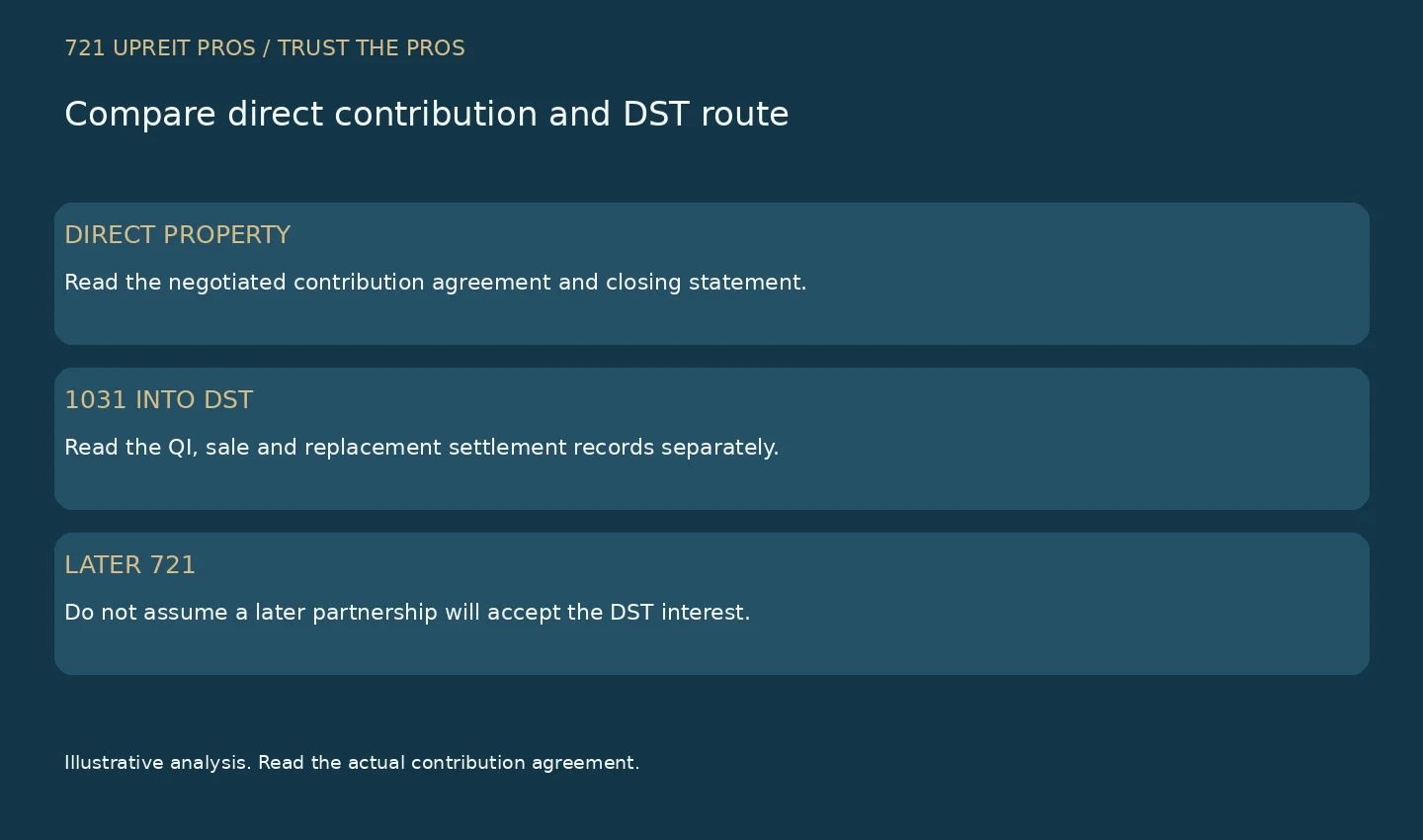
These are different transactions. In a direct Section 721 proposal, the property owner negotiates with a partnership to contribute property in exchange for a partnership interest. Section 721 describes general nonrecognition for qualifying contributions but does not set who pays title, transfer or legal costs. The agreement, local rules and settlement documents do that. Other tax provisions and transaction facts can affect the result.
In a 1031-to-DST route, the seller first exchanges qualifying investment or business real property for qualifying replacement real property. That step has its own sale-side and replacement-side costs, qualified intermediary arrangements and deadlines. The IRS Publication 551 distinguishes exchange expenses from other amounts on a closing statement, including property-tax and rent prorations. Do not assume every line can be paid from exchange proceeds without tax consequences; have the QI and CPA classify the actual entries. A potential later DST contribution to a partnership is separate and not guaranteed.
Compare the same starting property and date across the viable paths. A direct proposal might have fewer transaction stages but require a partnership willing to accept the actual building, lender terms and negotiated cost split. A DST route may provide a different replacement choice, but includes its own purchase documents and costs. A taxable sale can provide cash while creating a different tax analysis. The written advisor comparison is useful for these alternatives; do not compare just one headline fee across unlike structures.
What should the seller request before signing?
- Ask the prospective partnership for a dated property-specific indication of interest and the latest draft contribution agreement.
- Obtain a closing-cost schedule naming the payer, calculation method, jurisdiction and any cap for each item.
- Request the value-to-consideration bridge, including debt, reserves, credits, prorations and any charge that reduces contributed value.
- Have title and counsel identify transfer, recording and withholding questions in the property jurisdiction.
- Ask whether outside counsel, lender consent, environmental review, title cures or extra diligence can create additional costs if the deal stops.
- For a 1031 alternative, ask the QI and CPA to review the separate sale and DST purchase statements before the relinquished sale closes.
For more background, see the 721 UPREIT guide, the transaction sequence and the due-diligence questions. The DST Experts overview explains the possible DST stage, while this property-sale route comparison helps place costs in context. To discuss a specific proposal, Talk to a 721 UPREIT advisor.
Watch the closing-cost decision map
This original one-minute video distinguishes who pays the invoice from who bears the economic cost.
Read video transcript
0:00 · Who pays at closing?
The contribution agreement, not a generic percentage, assigns costs.
0:12 · Read the filed example
Title and survey to the partnership; transfer and recording to contributor.
0:24 · Track the economic burden
A billed cost can also change net contribution value.
0:36 · Do not double subtract
Reconcile the draft closing statement to final consideration.
0:48 · Separate the DST path
A 1031 purchase and later 721 proposal have different documents.
Primary sources checked November 17, 2026: the December 2024 filed contribution agreement, a 2006 historical comparison, IRS Publication 551 and Section 721. The filed agreements are examples, not current offers. No named expert review or universal tax result is represented.
Frequently asked questions
Does Section 721 specify who pays closing costs?
No. The tax statute describes the general contribution treatment. The parties, local rules and actual transaction documents determine cost allocation.
Who pays title insurance in a direct contribution?
It depends on the agreement. One December 2024 SEC-filed example assigns owner and lender title-policy premiums to the operating partnership; this is not a universal term.
Does the contributor always pay transfer tax?
No universal rule can be inferred. Check the property jurisdiction and negotiated agreement. The cited 2024 example assigns documentary and recording charges to its contributor.
Can a cost paid by the partnership still reduce my consideration?
Yes, if the governing agreement provides an adjustment or reimbursement. A historical filed agreement shows such a structure. Reconcile the final statement to credited value.
Are escrow and legal fees included in an advertised sponsor fee?
Do not assume they are. The cited 2024 agreement splits escrow charges and has each side pay its own attorneys. Ask for an itemized property-specific schedule.
Can 1031 exchange proceeds pay every closing-statement charge?
Do not assume so. IRS Publication 551 distinguishes exchange expenses from other items such as tax and rent prorations. Have the QI and CPA review actual entries before closing.
TALK TO A 721 UPREIT ADVISOR
Ready to discuss your 721 options?
Request a callback to discuss the questions raised by this article, your timing and what to ask before you commit. Share your name, email and phone below to start the conversation.
No investment commitment or financial documents required. A callback request does not book an appointment or establish an advisory relationship.