
721 UPREIT PROS / ADVISOR SELECTION
721 UPREIT Advisor: What Should a Written Comparison Show?
Before choosing a 721 UPREIT advisor's proposal, request a dated written comparison of keeping the property, a qualifying 1031 exchange into replacement real estate or a DST, a direct partnership contribution if available, and a taxable sale. The document should identify eligibility, cash needs, costs, control, tax assumptions and unresolved questions for each feasible path.
By 721 UPREIT Pros · November 14, 2026 · Original four-path comparison worksheet
Key takeaways
- Ask for a dated comparison of each feasible path before selecting a transaction.
- Separate Section 1031 deadlines and QI steps from a direct Section 721 contribution.
- Test cash needs, debt, costs and control with the same property facts.
- Label documented terms, estimates and unresolved questions.
A polished recommendation can still leave the most important alternative invisible. Ask the professional to show what was considered, what was ruled out and why. The comparison should be tailored to your property's debt, basis, sale timing, expected spending needs and tolerance for concentrated or illiquid real estate. A generic sponsor brochure cannot answer those questions for you.
Use this as an advisor-selection test before committing to a property sale or investment. The existing hiring guide covers registration, service capacity and compensation. This worksheet focuses on the quality of the recommendation itself: whether a seller can trace its assumptions to source documents and see the tradeoffs side by side.
TALK TO A 721 UPREIT ADVISOR
Talk to a 721 UPREIT advisor
Request a callback to discuss the questions raised by this article, your timing and what to ask before you commit. Share your name, email and phone below to start the conversation.
No investment commitment or financial documents required. A callback request does not book an appointment or establish an advisory relationship.

Which paths should the advisor compare?
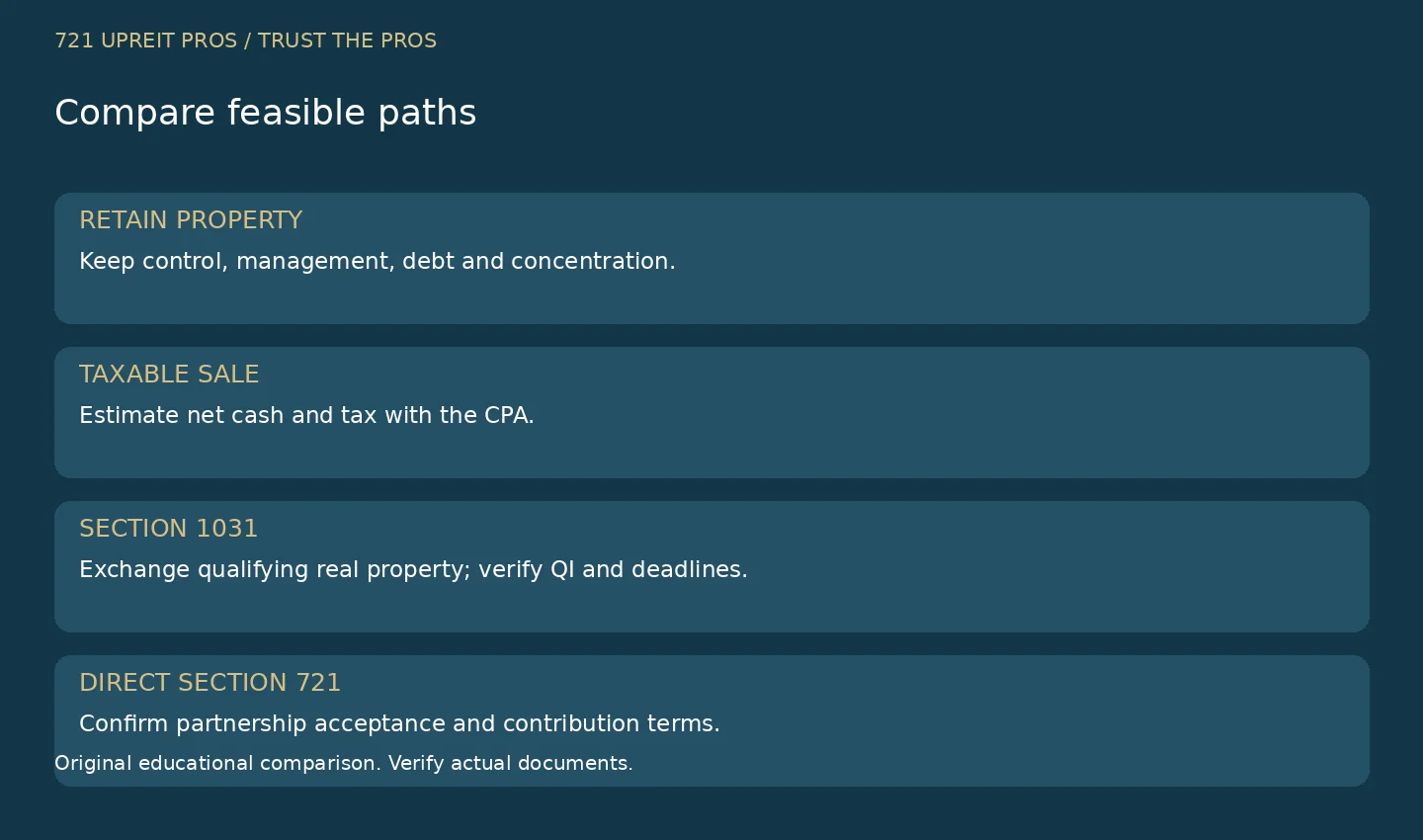
Start with what is actually feasible for this owner and property. Holding the property preserves direct control but retains management, debt and concentration. A taxable sale may provide cash and flexibility while creating a tax bill that needs a CPA's estimate. A qualifying Section 1031 exchange is generally an exchange of investment or business real property for like-kind real property. A DST interest may qualify as replacement real property only if the particular arrangement meets the applicable requirements. A separate Section 721 contribution involves property contributed to a partnership for a partnership interest, with important exceptions and transaction-specific consequences. A seller cannot assume that selling first and buying REIT shares afterward qualifies under either provision.
There are two common routes to evaluate, not a universal sequence. A direct 721 contribution requires a willing partnership, accepted property and negotiated documents before closing. A 1031 exchange into a qualifying DST can be followed by a later potential 721 transaction only if the relevant parties, documents and timing permit it. That later step is not guaranteed. The advisor should label each route as available, conditional or unavailable based on the current evidence rather than present a hypothetical conversion as a promise.
What belongs in the written evidence column?
For every path, request the source of each factual assertion. For a contemplated sale, ask for the property's estimated net proceeds, debt payoff and transaction costs, with the assumptions labeled. For a 1031 route, identify the qualified intermediary, replacement-property identification plan and the applicable deadlines. The IRS says a deferred exchange generally has a 45-day identification period and a 180-day receipt period, subject to the tax-return due-date limit. Those clocks belong to Section 1031, not every Section 721 contribution.
For a DST, request the actual offering and trust documents, property and financing terms, expense schedule, distribution policy and any described conversion rights. For a direct contribution, request the proposed contribution and partnership agreements, valuation method, debt treatment, ownership interest and any tax-protection terms. A term sheet is a starting point, not proof that a transaction has closed or that every condition will be satisfied.
The advisor's own service terms also belong in the evidence column: brokerage or advisory capacity, the programs available through the firm, compensation from you and third parties, and what monitoring is included. The SEC's Form CRS guidance explains that brokerage and advisory services, fees, conflicts and monitoring can differ. Registration is a basic check, while a written, property-specific comparison tests the work you are paying the professional to do.
| Question | Retain or taxable sale | 1031 replacement or DST | Direct 721 contribution |
|---|---|---|---|
| Feasibility | Ownership and sale facts | QI plan, eligible property and deadlines | Partnership acceptance and signed terms |
| Cash and control | Net proceeds or property cash flow | Replacement asset and DST restrictions | Interest rights, distributions and restrictions |
| Costs | Sale expenses, debt and estimated tax | Exchange, sponsor and property expenses | Contribution, partnership and ongoing expenses |
| Open decision | Keep or sell, with CPA estimate | Identify and close on qualifying replacement | Whether the contribution is accepted and closes |
How would a seller use the comparison?
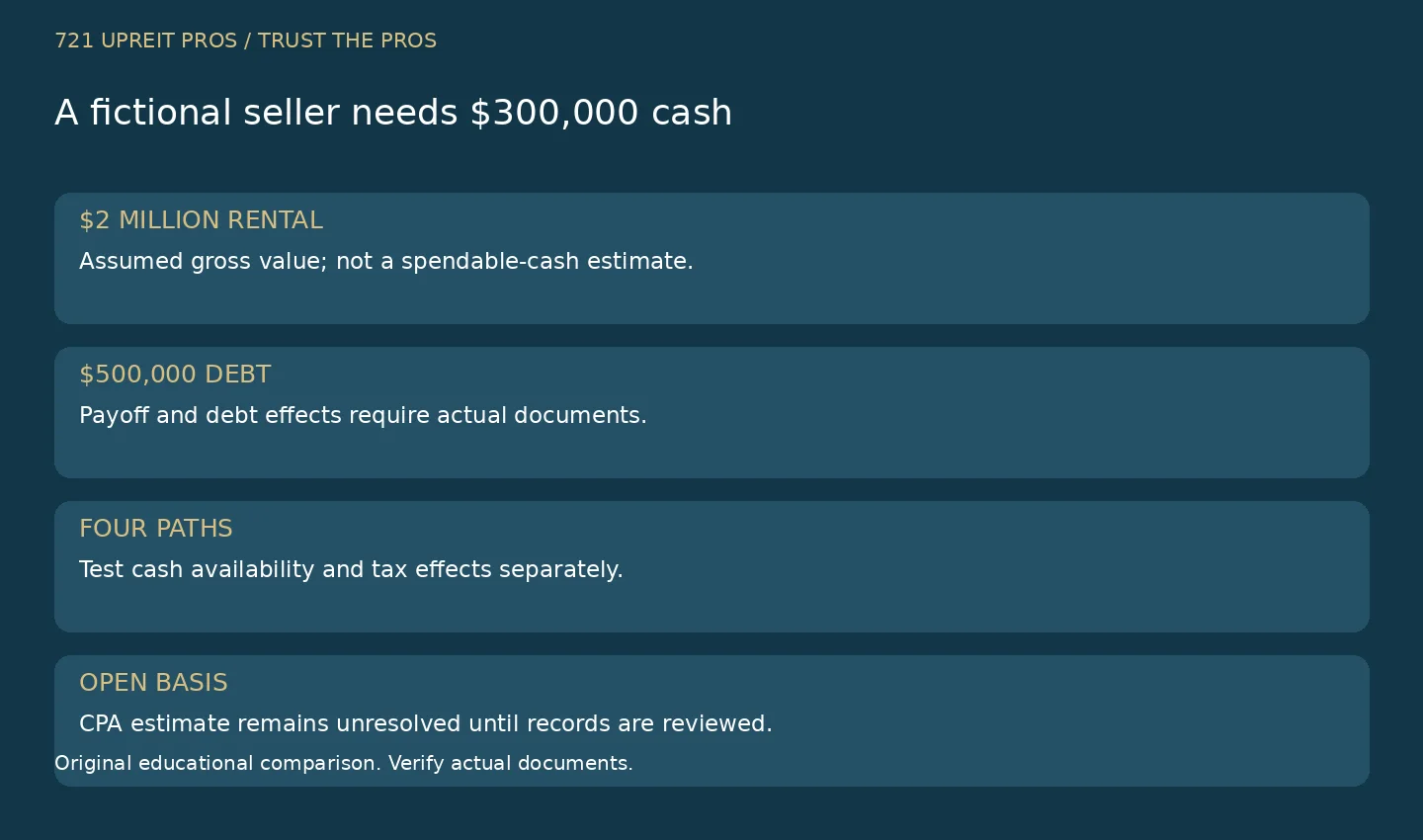
Imagine a fictional owner of a $2 million rental building with $500,000 debt, an unknown tax basis and a sale under consideration. The owner's immediate goal is $300,000 of accessible cash for a separate obligation. Those figures are illustrative, not a client case or projected offer. A recommendation that simply lists a 721 strategy as “tax deferred” fails to answer whether the owner can meet the cash obligation without changing the transaction's tax treatment.
The owner asks Advisor A for four dated columns: hold, taxable sale, 1031 replacement including a DST candidate, and direct 721 if an operating partnership will consider the building. Advisor A identifies which offers are available, shows documents for the actual candidates, leaves basis and tax amounts open for the CPA, and explicitly states that a DST's later contribution is conditional. Advisor B presents one attractive distribution figure and assumes a future DST-to-721 step without showing the relevant right. Advisor A's comparison is more decision-ready even if its recommendation ultimately differs. This is a method of judging the evidence, not a ranking of real advisors or investments.
The $300,000 need changes every column. Holding may require a separate financing or asset plan; a taxable sale could supply proceeds after estimated liabilities; a 1031 exchange must be reviewed for cash received and possible taxable boot; and a direct partnership contribution may provide an interest rather than the needed cash. The CPA, attorney and qualified intermediary must test the actual documents and timing. Do not use a hypothetical gross sale price as spendable cash.
How do you test a recommendation for conflicts?
Ask what the advisor and firm would earn in each feasible path and whether the recommendation changes if the owner keeps the property or chooses a program the firm cannot sell. Compare direct fees with compensation embedded in an offering and with ongoing expenses. Ask which assumptions came from an issuer, an independent source, or the advisor's own estimate. The answer should show differences in scope and uncertainty, not claim that every alternative has an identical risk.
Request the current Form CRS and any relevant advisory brochure or brokerage disclosures. Confirm the professional and firm through Investor.gov's search and read the record in context; a registration record does not prove expertise in a particular transaction. The SEC's investor bulletin specifically suggests asking about relevant experience, product range, compensation, conflicts and monitoring. An advisor should be able to explain why an unavailable or unsuitable alternative was excluded without inventing a cost or promising a tax outcome.
What should you request before acting?
- Give the advisor the property's basic facts and a dated list of cash, income, control and estate-planning priorities without sending sensitive records through an unverified channel.
- Ask for a dated comparison of each feasible path, with a clear reason for excluding any path.
- Require exact legal names and current documents for any proposed DST, REIT or partnership transaction; do not treat a sponsor brand as an offering identity.
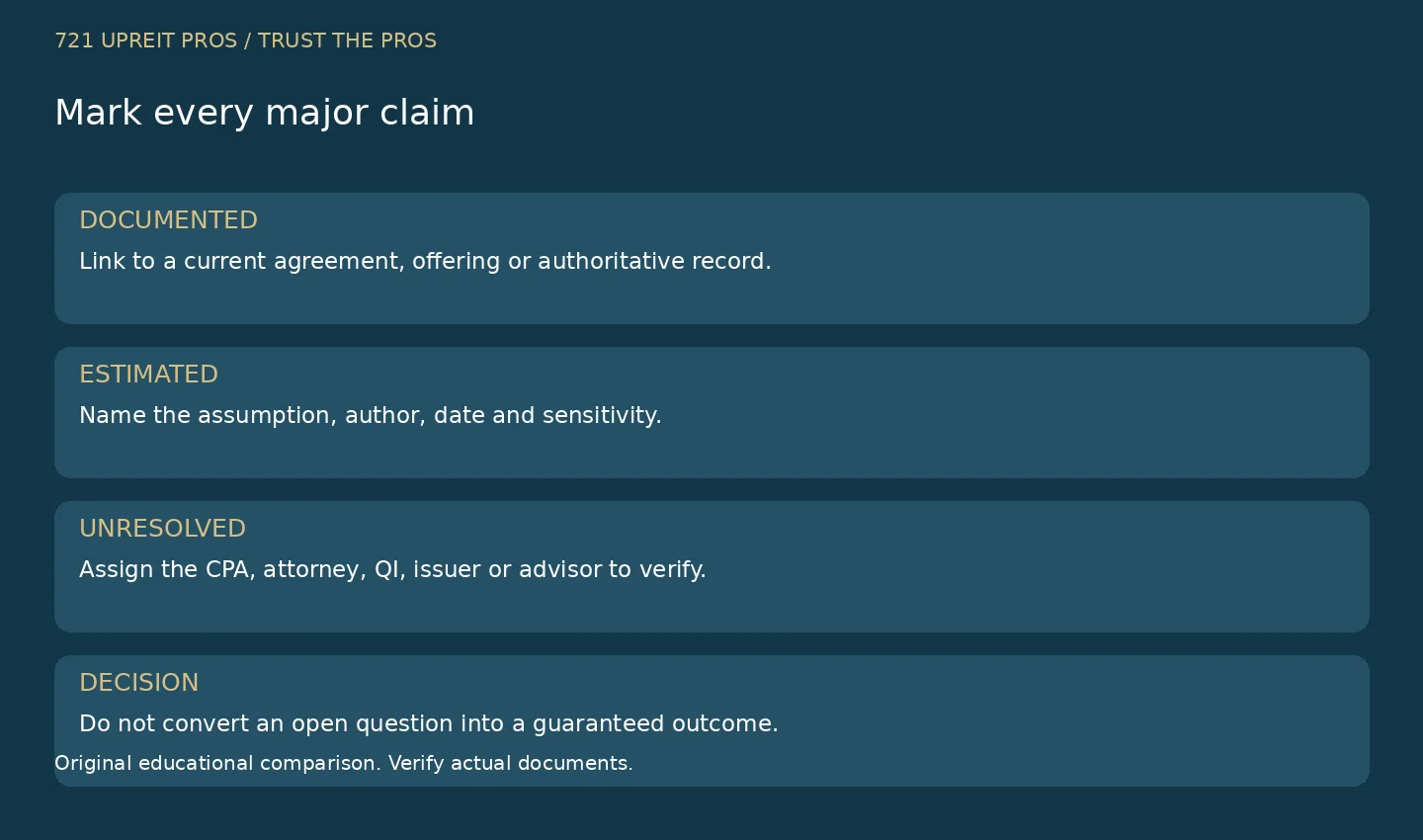
- Separate documented terms from estimates. Record who will verify debt, basis, tax effects, eligibility, deadlines, costs and liquidity.
- Take the resulting questions to your CPA, attorney and qualified intermediary as their roles require before closing or signing investment paperwork.
Use the 721 investor guide for the broad comparison and transaction sequence for timing. The DST document checklist helps identify missing terms. For the separate exchange-stage questions, see DST Experts' pre-exchange questions and this DST-versus-721 property-sale comparison. To discuss your own alternatives, Talk to a 721 UPREIT advisor.
Watch the four-path evidence test
This one-minute original briefing shows how to distinguish a sourced recommendation from an untested assumption.
Read video transcript
0:00 · Compare four paths
Hold, taxable sale, 1031 and direct 721 if available.
0:12 · Ask what is feasible
A DST-to-721 later step is conditional, not automatic.
0:24 · Put cash first
Test the amount needed before relying on tax deferral.
0:36 · Mark the evidence
Documented, estimated or unresolved.
0:48 · Assign the next check
CPA, attorney, QI, issuer and advisor have distinct roles.
Download the four-path comparison worksheet
Sources checked November 14, 2026: SEC advisor questions, Form CRS guidance, IRS Form 8824 instructions, IRS Publication 544 and 26 U.S.C. §721. Educational framework; no named expert review or transaction outcome represented.
Frequently asked questions
Must every advisor recommend all four paths?
No. A path may be unavailable or unsuitable. Ask for the reason and supporting fact rather than an invented offer.
Is a DST-to-721 conversion guaranteed?
No. A later transaction depends on actual agreements, parties, eligibility and timing.
Does the 45-day rule apply to a direct 721 contribution?
The 45-day replacement-property identification rule is associated with a deferred Section 1031 exchange, not every partnership contribution under Section 721.
Who estimates the seller’s tax bill?
A CPA should review actual basis, debt, depreciation and transaction facts. The advisor can identify assumptions without promising a result.
What if the seller needs cash soon?
Model the amount and date against each path, after costs and possible tax. Do not treat an illiquid interest or gross sale price as cash available to spend.
How can I compare advisor compensation?
Request direct and embedded compensation, ongoing charges, service scope and relevant Form CRS or firm disclosures for each path.
TALK TO A 721 UPREIT ADVISOR
Ready to discuss your 721 options?
Request a callback to discuss the questions raised by this article, your timing and what to ask before you commit. Share your name, email and phone below to start the conversation.
No investment commitment or financial documents required. A callback request does not book an appointment or establish an advisory relationship.