
721 UPREIT PROS / MINIMUM INVESTMENT
721 UPREIT minimum investment: property value or equity?
There is no universal 721 UPREIT minimum investment in Section 721. A sponsor may screen gross property value, net contributed equity, eligible ownership percentage, debt, transaction costs or an offering-level minimum. Ask which dollar amount the threshold measures before deciding whether a property qualifies.
By 721 UPREIT Pros · September 24, 2026 · Minimum-size reconciliation worksheet
Key takeaways
- There is no universal Section 721 dollar minimum for every UPREIT transaction.
- Separate gross property value, debt, net contributed equity and the value of units issued.
- Direct-property acceptance and a DST subscription can use different screens.
- Confirm the exact requirement in current documents before relying on proceeds for a retirement plan.

This page answers a narrower question than the complete 721 UPREIT guide. It explains why a $5 million property can produce much less contributed equity, why a DST subscription minimum is different from a later contribution threshold, and why a REIT share-purchase minimum may be irrelevant to a negotiated OP-unit contribution.
What is the minimum investment for a 721 UPREIT?
The actual minimum is set by the transaction and sponsor documents, not by Section 721. Section 721 generally addresses whether gain or loss is recognized when property is contributed to a partnership for a partnership interest. It does not set a dollar minimum, require an operating partnership to accept a property or establish how many OP units must be issued.
TALK TO A 721 UPREIT ADVISOR
Talk to a 721 UPREIT advisor
Request a callback to discuss the questions raised by this article, your timing and what to ask before you commit. Share your name, email and phone below to start the conversation.
No investment commitment or financial documents required. A callback request does not book an appointment or establish an advisory relationship.
A direct property contribution may require an asset or equity amount large enough to justify diligence, negotiation and integration. A DST-to-721 pathway may begin with a separate DST subscription minimum. A public or non-traded REIT share purchase may publish another minimum. These figures measure different transactions and cannot be substituted for one another.
Direct answer
Ask the sponsor to complete this sentence in writing: “The applicable minimum is $____ measured by ____ as of ____.” Then reconcile that number to debt, cash adjustments, ownership percentages and the contribution agreement.
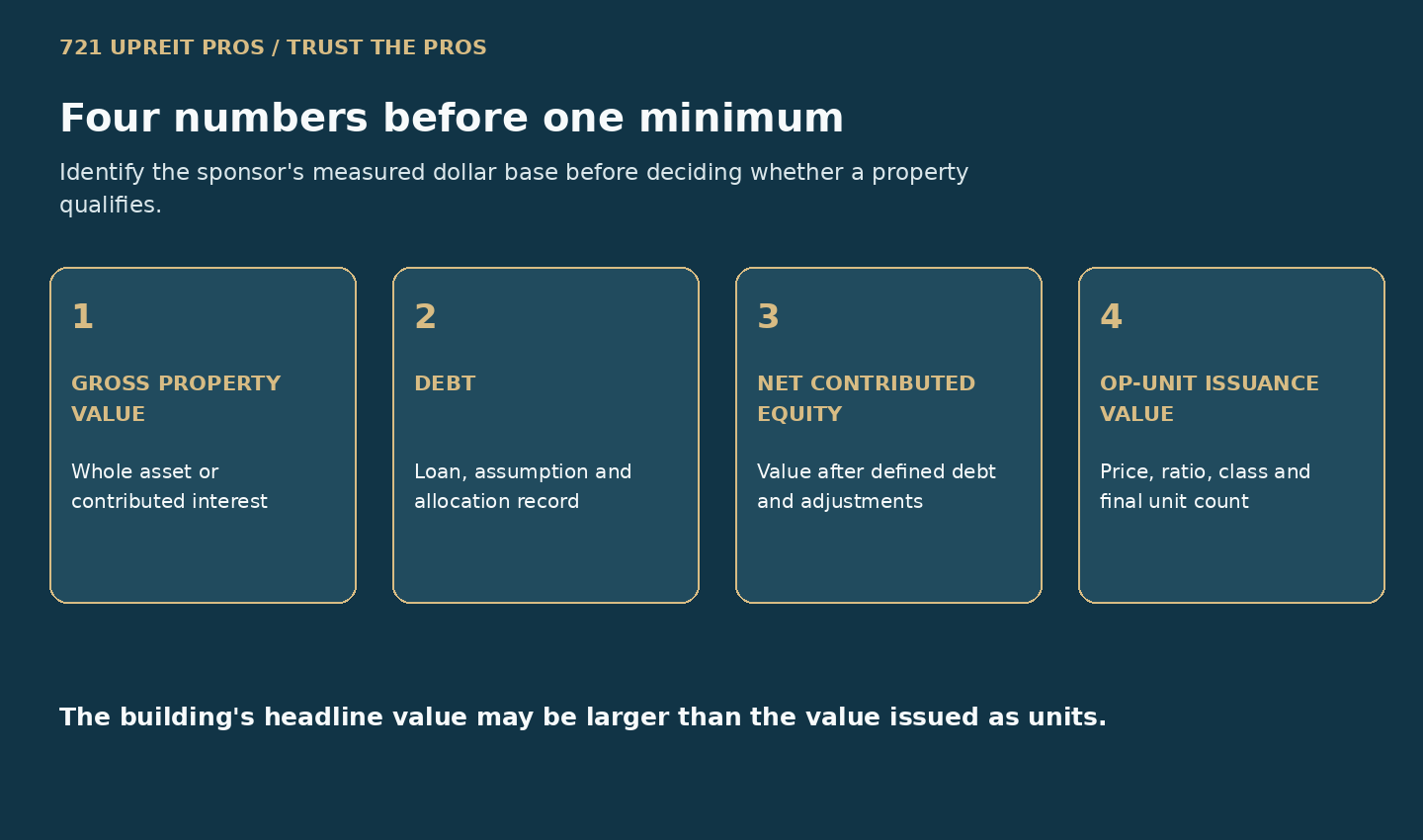
Which four numbers should a property owner separate?
Start with gross property value, subtract or separately account for debt, reconcile closing adjustments, and identify the value actually exchanged for OP units. The sponsor may use another measure for its acceptance screen, so record both the calculation and the controlling term.
| Dollar amount | What it may describe | Why it can differ | Evidence |
|---|---|---|---|
| Gross property value | Agreed value of the whole real estate asset or interest | It may include value supported by debt and ownership not being contributed | Valuation, purchase-price schedule and contribution agreement |
| Debt associated with the asset | Loan balance, assumed liability or allocated partnership liability | Debt treatment can change net economics and tax analysis without changing the building's gross value | Payoff, lender consent, debt schedule and Section 752 analysis |
| Net contributed equity | Value attributable to the interest after specified debt and adjustments | Cash paid out, reserves, costs, prorations and retained ownership can alter the amount | Closing statement and value bridge |
| OP-unit issuance value | Agreed contribution value divided by the applicable issue price or exchange ratio | Unit class, pricing date and contractual adjustments control the final count | Unit schedule, pricing certificate and post-closing statement |
Keep sponsor acceptance and tax consequences separate. A sponsor can decline a property that exceeds its stated size target because of location, asset type, title, tenant concentration, debt or operating issues. Conversely, a sponsor can negotiate a transaction that does not match a public marketing example. The direct-property acceptance checklist covers those non-size gates.
Why do published minimums vary so widely?
Published figures often belong to different legal pathways, products and share classes. Compare only figures that answer the same question.
| Pathway | Possible minimum | What it does not prove |
|---|---|---|
| Direct property to operating partnership | Sponsor-specific property or equity threshold, often negotiated | That every asset above the number will be accepted |
| 1031 exchange into a DST | Minimum subscription stated in the current DST offering | That a future 721 contribution will occur or use the same threshold |
| Later DST-to-721 contribution | Terms of the option, contribution agreement and sponsor decision | That the original subscription minimum determines OP-unit value |
| Direct purchase of REIT shares | Share-class minimum in a prospectus or subscription document | That the same number applies to a property-for-OP-unit contribution |
A current sponsor example illustrates the variation. Origin Exchange's public FAQ states a $250,000 minimum for its program and accredited-investor requirement. That figure belongs to that named program and should not be described as the minimum for all 721 UPREITs. Review the current Origin Exchange FAQ and its offering materials before relying on it.
A different example appears in Blackstone Real Estate Income Trust's March 2026 SEC filing. Its public Q&A discusses share-purchase minimums by class. Those are subscription terms for REIT common stock, not proof of the property value or equity required for a negotiated OP-unit contribution. See the March 2026 SEC filing for the dated example.
Worked example: a $6 million property is not a $6 million contribution
Reconcile the value received by the operating partnership rather than copying the property's headline value. The following example is hypothetical and is not an offering or tax conclusion.
| Item | Amount | Effect on illustration |
|---|---|---|
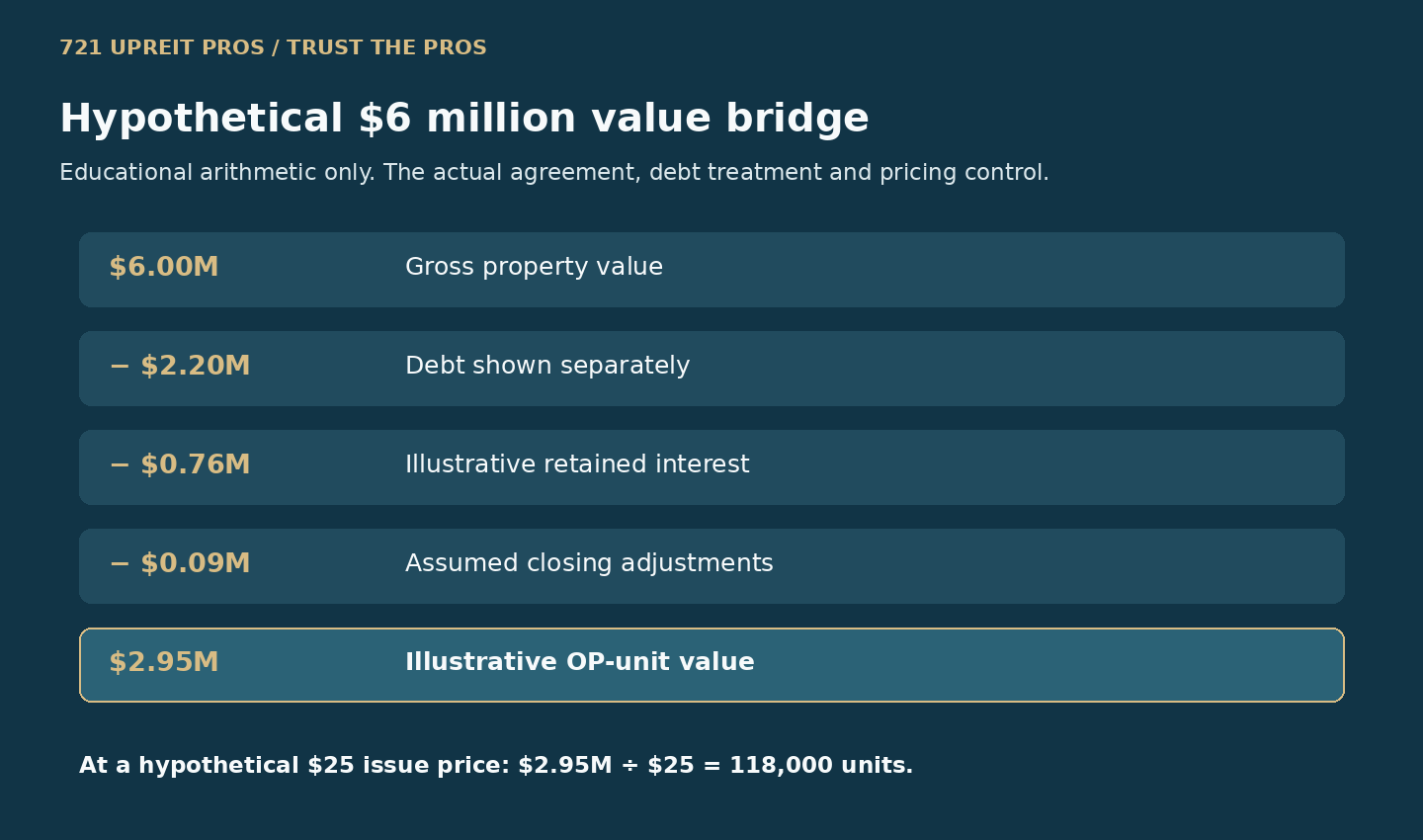
| Agreed gross property value | $6,000,000 | Starting value for the whole asset |
| Debt addressed at closing | ($2,200,000) | Shown separately; actual liability treatment requires tax and legal review |
| Owner retains 20% of the equity interest | ($760,000) | Illustrative retained value after debt |
| Illustrative cash and closing adjustments | ($90,000) | Must be tied to the closing statement |
| Illustrative value issued as OP units | $2,950,000 | Amount used for the hypothetical unit calculation |
The arithmetic is: $6,000,000 less $2,200,000 equals $3,800,000 of simplified equity. Twenty percent of that amount is $760,000. After subtracting the retained $760,000 and $90,000 of assumed adjustments, the illustrative value issued as units is $2,950,000.
If the applicable issue price were hypothetically $25 per unit, $2,950,000 divided by $25 would equal 118,000 units. Confirm the unit class, pricing date, rounding, adjustments and final statement. Changing the assumed issue price to $27 would produce about 109,259 units before any contractual rounding. More units at a lower issue price do not automatically mean more wealth.
Now compare the result with a fictional sponsor threshold of $3 million of contributed equity. The $6 million building would miss that illustrative threshold by $50,000. This does not mean the transaction fails, qualifies for a waiver or should be restructured. It shows why the measured dollar base must be known before using a minimum in planning.
How do debt and Section 752 affect the review?
Debt can affect both economics and tax analysis, so it should not be treated as a simple eligibility subtraction. Section 752 contains rules for changes in a partner's share of partnership liabilities. Section 721's general nonrecognition rule does not erase those liability rules or other possible consequences.
Ask the CPA and tax counsel to analyze liabilities using the actual ownership, guarantees, partnership agreement and closing sequence. Keep their calculation separate from the sponsor's commercial minimum. Use the OP-unit debt change worksheet to organize the liability record.
What should you ask before relying on a minimum?
- Which pathway? Direct property contribution, DST subscription, later DST contribution or REIT share purchase?
- Which dollar base? Gross property value, net equity, contributed interest value, cash subscription or OP-unit issuance value?
- Which owner? Whole property, one tenant-in-common interest, LLC interest or DST beneficial interest?
- Which date? Initial review, valuation date, contribution closing or unit pricing date?
- Which document controls? Marketing page, PPM, contribution agreement, side letter, pricing certificate or partnership agreement?
- Can the sponsor waive it? Who has authority, and must the waiver be written?
- What other gates remain? Accreditation, suitability, property diligence, debt approval, title, tax review and liquidity fit?
Download the worksheet and assign every number to a source. Leave a value unresolved when the sponsor has not confirmed the measured base. Do not convert an informal estimate into a qualification statement.
Watch the one-minute minimum-size briefing
The video walks through the four numbers and the $6 million hypothetical value bridge.
Download the minimum-size reconciliation worksheet
Read video transcript
0:00 · What is the 721 UPREIT minimum?
Section 721 sets no universal dollar minimum. The sponsor and transaction documents identify the applicable threshold.
0:12 · Separate four numbers
Record gross property value, debt, net contributed equity and OP-unit issuance value. Do not use them interchangeably.
0:24 · Match the pathway
A DST subscription minimum, a later 721 contribution and a REIT share purchase are different transactions. Their minimums can differ.
0:36 · Reconcile the value bridge
A $6 million property with debt, retained ownership and adjustments may produce $2.95 million of illustrated unit value. Verify every input.
0:48 · Get the answer in writing
Record the measured dollar base, date, document and waiver authority. Acceptance and tax results remain separate reviews.
Prepare for an advisor discussion
Bring the property value, current debt statement, ownership chart and proposed transaction terms. Talk to a 721 UPREIT advisor about which threshold applies and what remains subject to sponsor, tax and legal review.
Sources
- Internal Revenue Code Section 721, partnership contribution rule and exceptions.
- Internal Revenue Code Section 752, treatment of certain liability changes.
- IRS Publication 541, revised December 2025, partnership tax framework.
- Origin Exchange FAQ, sponsor-specific minimum example checked September 24, 2026.
- BREIT March 2026 SEC filing, dated share-class minimum example.
Educational use only. This is not tax, legal or investment advice or an offer. Examples are hypothetical. Sponsor terms and available offerings change. No acceptance, contribution, tax result, liquidity, value or return is guaranteed.
Frequently asked questions
Is a stated minimum based on property value or equity?
It depends on the actual transaction. Ask whether the threshold measures gross asset value, net equity, subscription amount or another documented amount.
Does a $6 million property mean I am contributing $6 million?
Not necessarily. Debt, closing adjustments and the agreed economics affect the contribution analysis. The article’s hypothetical example keeps those amounts separate.
Can several property owners combine their equity to meet a minimum?
Do not assume aggregation is permitted. Ownership, authority, the legal contributor and sponsor acceptance must be reviewed under the proposed structure.
Is a DST minimum the same as a direct 721 UPREIT contribution minimum?
No universal equivalence exists. A DST subscription and a negotiated direct-property contribution are different transactions with different documents and acceptance criteria.
Does meeting a minimum guarantee property acceptance?
No. Asset type, location, economics, title, debt and diligence can affect the sponsor’s decision independently of size.
Should I commit all my equity to reach a minimum?
That decision requires a review of liquidity, tax estimates, other cash sources and investment suitability. Meeting a threshold does not establish that committing the amount fits your needs.
BEFORE YOUR ADVISOR CONVERSATION
Three questions before you commit
This companion briefing covers the professional's identity, compensation and how restrictions fit your cash needs. Use it alongside this article's specific document checks.
Loading the video connects to YouTube. Watch on YouTube · 721 UPREIT Pros channel · Read the full advisor checklist.
Read video transcript
Before you hire a seven twenty-one UPREIT advisor, ask these three questions.
First: who exactly am I hiring? Get the professional's legal name, firm and registration information. Check the record through Investor dot gov and read the firm's relationship summary where applicable. Ask whether this conversation involves brokerage services, investment advice, or both. A marketing title alone does not answer that question.
Second: who gets paid, and how much? Request a written cost breakdown in dollars. Identify the payer, calculation base, payment timing and ongoing charges. Include product expenses and embedded compensation. No separate advisor invoice does not mean there are no costs.
Third: how does this fit my cash needs? Review the actual agreements. Ask who controls a possible conversion and what happens if it does not occur. Separate permission to request redemption from approval, pricing and payment. Do not assume a fixed cash-out date.
Then agree on responsibilities. Your investment professional, CPA, attorney and qualified intermediary can have different roles. Put continuing service and unresolved questions in writing.
Read the complete advisor checklist using the article link in the description. Seven twenty-one UPREIT Pros. Trust the Pros. Educational only. Investments involve risk and may be illiquid. Tax treatment depends on your circumstances.
Educational only. Investments involve risk and may be illiquid. Footage is illustrative; narration is synthetic.
TALK TO A 721 UPREIT ADVISOR
Ready to discuss your 721 options?
Request a callback to discuss the questions raised by this article, your timing and what to ask before you commit. Share your name, email and phone below to start the conversation.
No investment commitment or financial documents required. A callback request does not book an appointment or establish an advisory relationship.