
721 UPREIT PROS / PRE-CLOSING CHANGE CONTROL
The 721 contribution changed before closing: what should you re-underwrite?
When a proposed 721 contribution changes before closing, compare the current proposal with the signed baseline, identify the document that would make each change effective, recalculate value and OP-unit consideration, and recheck debt, tax-protection terms, dates, consents and closing conditions. A revised spreadsheet or email is not automatically an amendment, consent or waiver.
Prepared by 721 UPREIT Pros · Published October 10, 2026 · General education

This page addresses a transaction that may still close under revised terms. If the deal already stopped, use the failed-closing unwind checklist. If it closed, use the closing-evidence checklist. The transaction sequence explains where these records fit.
What is the first step when 721 contribution terms change?
Freeze the signed baseline and start a dated change register. For each proposed change, record the old term, new term, source document, effective status, authorized signer, affected calculations, dependencies, professional questions and investor decision.
TALK TO A 721 UPREIT ADVISOR
Talk to a 721 UPREIT advisor
Request a callback to discuss the questions raised by this article, your timing and what to ask before you commit. Share your name, email and phone below to start the conversation.
No investment commitment or financial documents required. A callback request does not book an appointment or establish an advisory relationship.
Do not overwrite the earlier version. Preserve drafts, redlines and signed documents separately. Label an unsigned term as proposed. Label a condition as waived only when the agreement permits the waiver and the authorized party has actually made it. Ask counsel to determine legal effect and a tax professional to revisit tax assumptions before the contributor makes a new commitment.
Re-underwrite six categories, not just the headline price
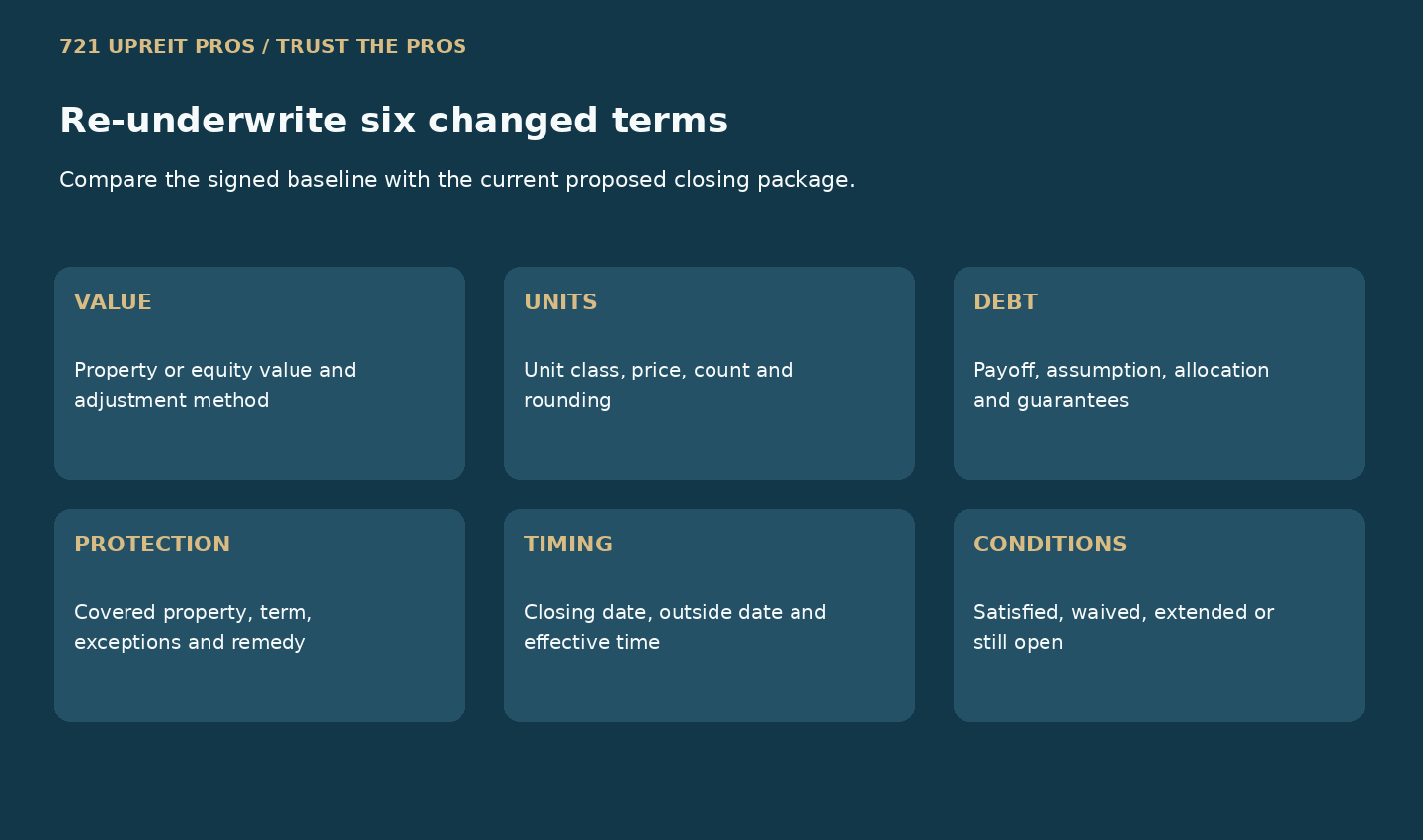
| Category | Compare | Evidence to request |
|---|---|---|
| Property and equity value | Valuation date, method, agreed value, adjustments and closing cash | Current valuation support, approved adjustment schedule and revised closing statement |
| OP-unit consideration | Unit class, reference value, count, rounding and recipient | Formula in the operative agreement, calculation workpaper and final ledger instructions |
| Debt | Payoff, assumption, allocation, reserves, guarantees and lender conditions | Lender consent, payoff or assumption documents and guaranty-release evidence |
| Tax protection | Covered property, protected amount, term, exceptions and remedy | Current tax-protection agreement, schedules and tax-professional analysis |
| Timing | Due-diligence end, target closing, outside date and effective time | Signed amendment or authorized notice plus a revised responsibility calendar |
| Conditions | Satisfied, open, extended or waived conditions | Condition checklist, supporting delivery, consent or written waiver |
A single change can cascade. A revised property value may alter equity, unit count, transfer-tax calculations and closing statements. A closing extension may make a lender quote, consent, valuation or certificate stale. A narrowed tax-protection schedule may change the risk analysis even when the unit count stays the same.
Name the instrument that changes the deal
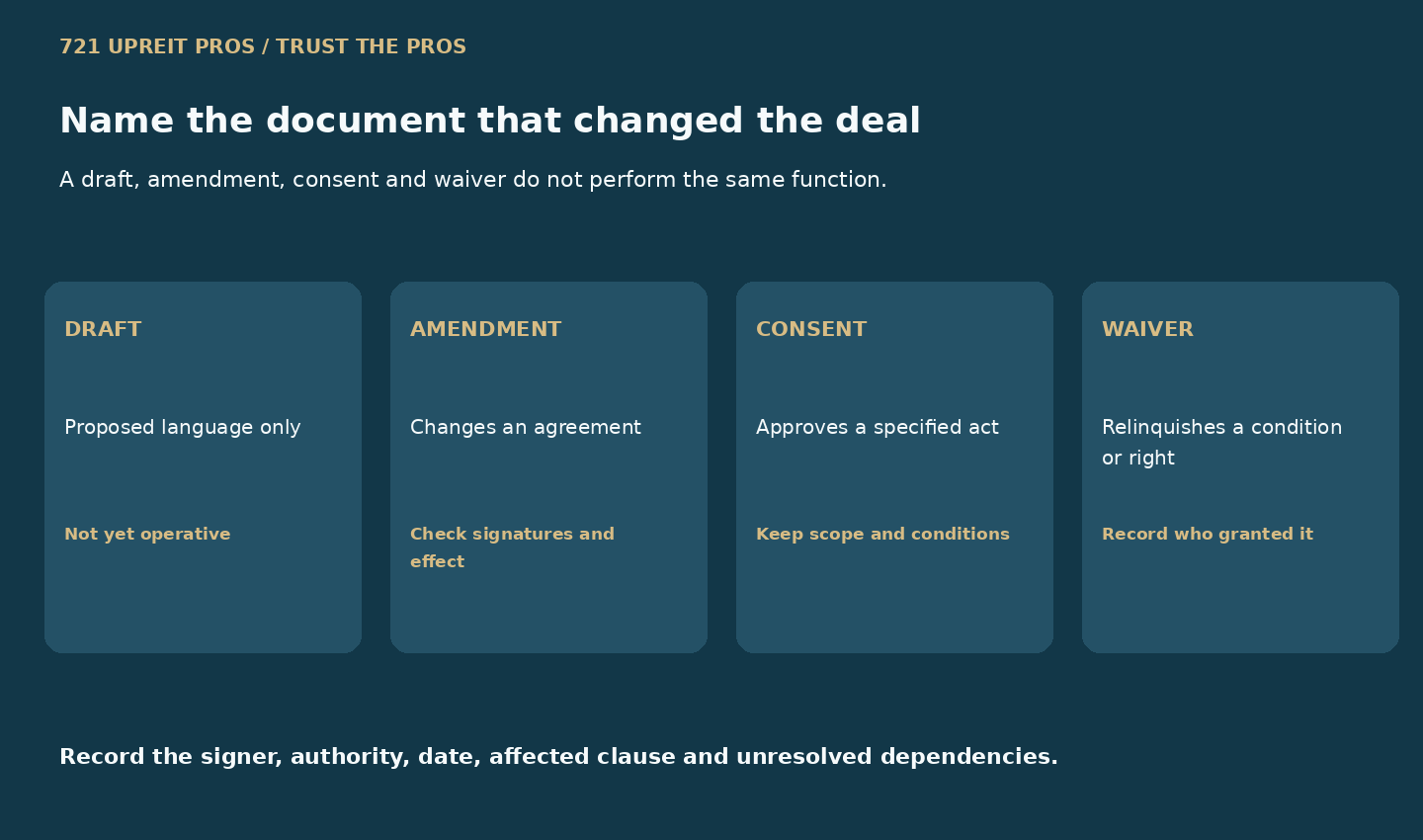
A draft proposes language. An amendment changes the agreement. A consent approves a specified act. A waiver relinquishes a condition or right to the extent stated. A notice may exercise an existing extension or termination right without amending the agreement. Actual authority and form depend on the controlling documents.
For every item, log the title, date, version, affected section, parties, signers, stated effective time and related schedules. Confirm whether the document says it controls in a conflict and whether the rest of the agreement remains in force. An SEC-filed Lodging Fund REIT III amendment, for example, extended a due-diligence period, said the amendment controlled in a conflict and ratified the rest of the agreement. Another amendment chain later changed the closing date and replaced a schedule. Those are examples of negotiated drafting, not universal rules.
| Question | Why it matters |
|---|---|
| Is it signed? | An unsigned draft may show negotiation without changing the operative deal. |
| Who had authority? | Board, partnership, lender or contributor approval may be required by different documents. |
| What exactly changed? | A limited consent or waiver should not be expanded beyond its stated scope. |
| What remains open? | An amendment can leave other conditions, deliveries and remedies unchanged. |
Recalculate value, adjustments and OP units from the current source
Start with the consideration formula in the current operative agreement. Reconcile the agreed property or equity value, debt and liability treatment, prorations, reserves, credits, closing costs, cash components, unit class, reference value and rounding. Keep the formula and every input visible. Do not back into a unit count by copying a marketing presentation.
An SEC-filed Bluerock amendment changed a contribution-consideration formula and the mix of unit consideration while reaffirming specified closing conditions. The useful lesson is that the economic change belongs in the signed amendment and all dependent schedules, not that its particular formula applies elsewhere. A Rexford agreement illustrates another control: calculations were prepared before closing under an agreed procedure and treated as final absent manifest error under that agreement.
Ask who is responsible for updating the closing statement, unit schedule, partnership-admission record and tax workpapers. If those files show different numbers, keep the transaction pending until the discrepancy is explained and resolved.
Re-underwrite debt and tax-protection terms together
Debt affects more than net equity. A changed payoff, assumption, refinance, allocation or guarantee can alter closing cash, lender consent, liability allocations and the tax analysis. Request current lender documents and confirm their expiration dates and conditions. A draft consent is not approval. A payoff quote is not proof of payoff. A planned guaranty release is not a completed release.
Then compare the current tax-protection package with the baseline. Identify the covered property, protected parties, protected amount, term, permitted transactions, exceptions, notice rights and stated remedy. Determine whether debt changes affect any minimum-liability or guarantee provision. Legal and tax professionals should interpret the actual provisions and model the contributor's facts. Neither the label “tax protection” nor a proposed Section 721 structure guarantees deferral.
Rebuild the condition and deadline calendar
Separate a target closing date from a due-diligence deadline, cure period, outside date, effective time and post-closing delivery. Record the source for each date, responsible party, notice method and consequence of a missed step. When a date moves, check whether appraisals, lender approvals, certificates, estoppels, title commitments, financial statements or other deliveries must be refreshed.
A 2020 SEC-filed contribution agreement illustrates the possible branches when conditions remained unsatisfied: the parties could waive specified conditions, terminate, or extend the closing under that agreement, while lender approvals and delayed interests required their own treatment. The agreement is evidence of one negotiated structure, not a rule for other transactions.
| Field | Record |
|---|---|
| Condition | Exact section and plain-language description |
| Benefited party | Who may insist on, satisfy or waive it under the agreement |
| Evidence | Consent, certificate, approval, delivery or other required proof |
| Status | Open, satisfied, waived, extended, disputed or not applicable |
| Dependency | Numbers, documents or dates that must change if the condition changes |
Fictional example: three changes produce a different decision
This example is arithmetic for record organization, not a valuation, offer or tax conclusion. Example Property LLC signs a proposed contribution agreement with a $7.20 million property value, $2.40 million of debt and provisional net equity of $4.80 million. At a stated $24 reference value, the draft schedule shows 200,000 OP units.
Before closing, the parties propose a $7.05 million value after updated property information. The revised debt and closing-adjustment schedule produces $4.65 million of provisional net equity. The proposed unit reference value is now $25, producing 186,000 provisional units. The target closing moves from May 31 to June 30, one lender consent remains open and the tax-protection schedule narrows the covered property list.
| Item | Signed baseline | Current proposal | Required follow-up |
|---|---|---|---|
| Property value | $7.20 million | $7.05 million | Valuation support and signed economic amendment |
| Net equity | $4.80 million | $4.65 million | Reconcile debt, costs, credits and closing cash |
| Reference value | $24 | $25 | Identify contractual source and effective date |
| Provisional units | 200,000 | 186,000 | Check class, rounding, recipient and ledger instruction |
| Target closing | May 31 | June 30 | Signed extension and refreshed delivery calendar |
| Lender consent | Expected before closing | Still open | Do not mark condition satisfied |
| Tax protection | Broader covered-property schedule | Narrower proposed schedule | Legal and tax review of changed protection |
The arithmetic explains the proposed difference of 14,000 units, but it does not make the revision effective or acceptable. The contributor needs the current document package, explanation of every input, updated risk and tax analysis, and a deliberate accept, reject, negotiate or pending decision.
Reconcile five files before a new commitment
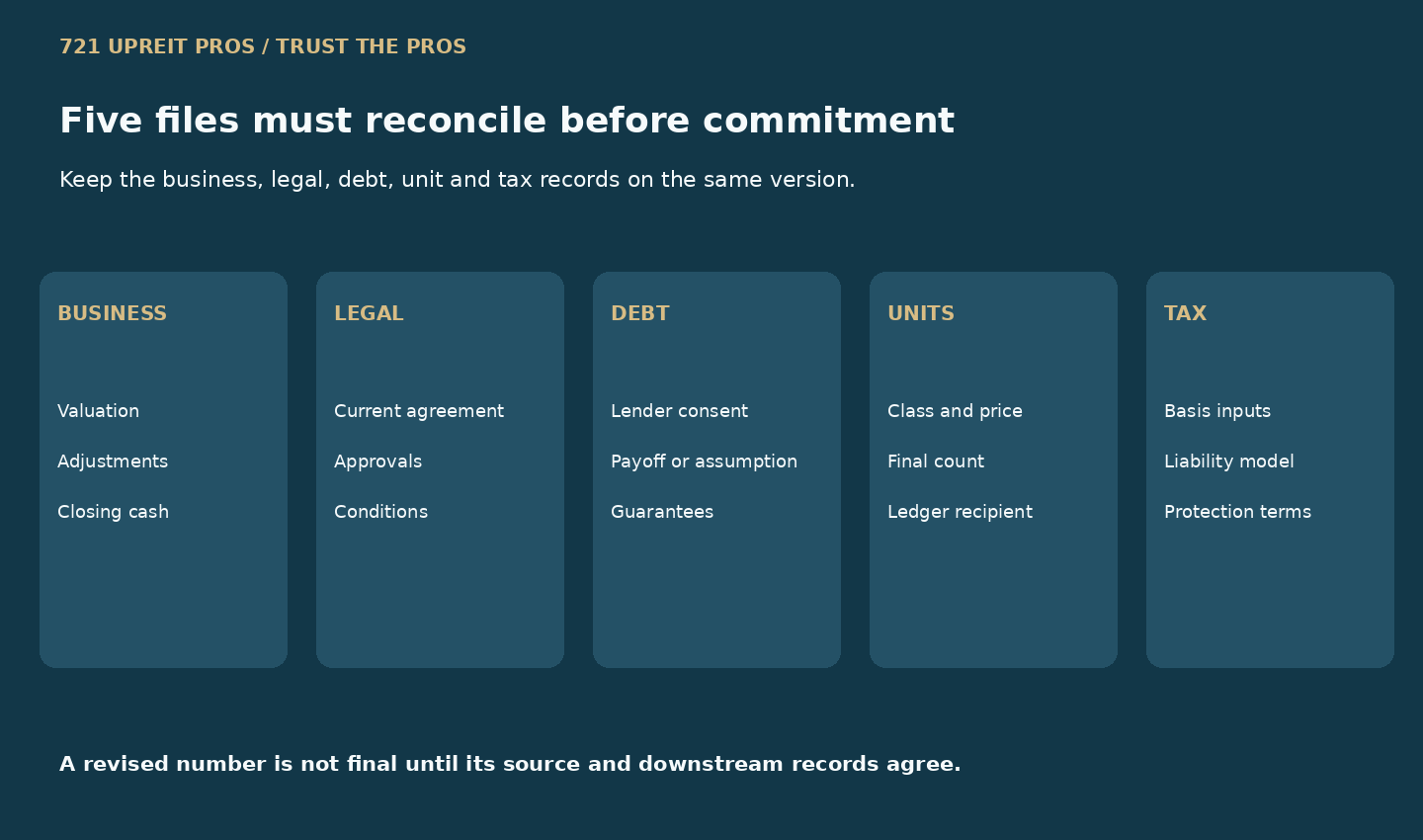
- Business file: Current value, adjustment schedule, closing cash and decision memo.
- Legal file: Operative agreement, redline, signed amendment, approvals, consents, waivers and condition register.
- Debt file: Payoff or assumption, allocation, reserves, guarantees, releases and lender evidence.
- Unit file: Class, reference value, calculation, rounding, recipient, admission and final ledger instruction.
- Tax file: Basis inputs, liability analysis, cash items, protection terms and current professional conclusions.
Ask: Which version controls? Who approved it? What changed economically? Which conditions remain open? Which dates moved? Which third-party records are stale? Which tax assumptions changed? What must be true before the contributor signs or closes?
For broader transaction context, review the DST 1031 Experts 721 exchange guide. To organize an investment-side discussion, talk to a 721 UPREIT advisor. Agreement interpretation and tax conclusions belong with the appropriate attorney and tax professional.
Watch the change-control briefing and download the register
The original one-minute captioned video shows how to separate document status from economics and reconcile the current package. It is a silent visual explainer, not a legal or tax determination.
Read video transcript
0:00 · When terms change before closing
Stop and identify the signed baseline. Create a dated change register.
0:12 · Re-underwrite the economics
Compare value, units, debt and closing cash. Recalculate from current source records.
0:24 · Classify the document
Drafts, amendments, consents and waivers differ. Verify signatures, authority and scope.
0:36 · Recheck conditions and dates
Identify what is satisfied, open or waived. Do not treat a target date as a legal deadline.
0:48 · Reconcile five files
Business, legal, debt, unit and tax records must agree. Actual agreements control.
Download the pre-closing change register. Use it to preserve versions, classify each change and reconcile dependent records.
Primary sources and review limits
Sources checked October 10, 2026. SEC-filed exhibits show negotiated transaction terms and amendment practices, not standard language or current offering availability. This educational checklist has not received a named advisor, CPA or attorney review.
- Lodging Fund REIT III first amendment dated May 18, 2021: due-diligence extension, conflict control and ratification.
- Lodging Fund REIT III fifth amendment dated June 29, 2022: amendment chain, closing-date extension and schedule replacement.
- Bluerock amendment dated August 9, 2017: board approval, revised consideration formula and closing conditions.
- Rexford contribution agreement dated July 24, 2013: pre-closing calculations, conditions, consents, deliveries and unit records.
- Watermark Lodging Trust contribution agreement filed May 29, 2020: unsatisfied-condition choices, lender approvals and delayed interests.
- Medalist Diversified REIT closing report filed February 21, 2025: amendment at closing and reported unit consideration.
Property values and investment income can fall. Terms can change, conditions may remain unsatisfied, and a proposed contribution may not close. No unit count, tax deferral, protection, liquidity, closing or investment result is guaranteed.
BEFORE YOUR ADVISOR CONVERSATION
Three questions before you commit
This companion briefing covers the professional's identity, compensation and how restrictions fit your cash needs. Use it alongside this article's specific document checks.
Loading the video connects to YouTube. Watch on YouTube · 721 UPREIT Pros channel · Read the full advisor checklist.
Read video transcript
Before you hire a seven twenty-one UPREIT advisor, ask these three questions.
First: who exactly am I hiring? Get the professional's legal name, firm and registration information. Check the record through Investor dot gov and read the firm's relationship summary where applicable. Ask whether this conversation involves brokerage services, investment advice, or both. A marketing title alone does not answer that question.
Second: who gets paid, and how much? Request a written cost breakdown in dollars. Identify the payer, calculation base, payment timing and ongoing charges. Include product expenses and embedded compensation. No separate advisor invoice does not mean there are no costs.
Third: how does this fit my cash needs? Review the actual agreements. Ask who controls a possible conversion and what happens if it does not occur. Separate permission to request redemption from approval, pricing and payment. Do not assume a fixed cash-out date.
Then agree on responsibilities. Your investment professional, CPA, attorney and qualified intermediary can have different roles. Put continuing service and unresolved questions in writing.
Read the complete advisor checklist using the article link in the description. Seven twenty-one UPREIT Pros. Trust the Pros. Educational only. Investments involve risk and may be illiquid. Tax treatment depends on your circumstances.
Educational only. Investments involve risk and may be illiquid. Footage is illustrative; narration is synthetic.
TALK TO A 721 UPREIT ADVISOR
Ready to discuss your 721 options?
Request a callback to discuss the questions raised by this article, your timing and what to ask before you commit. Share your name, email and phone below to start the conversation.
No investment commitment or financial documents required. A callback request does not book an appointment or establish an advisory relationship.