
TEXAS PROPERTY TRANSITIONS
Inherited Texas Land: Check Basis Before a 721 Exit
Before contributing inherited Texas land to a 721 UPREIT or arranging a sale, establish the current tax owner, inherited basis and later adjustments. Then compare the actual gain, accessible cash and investment restrictions. A long family ownership history does not establish your taxable gain or make a tax-deferred transaction the best choice.
By 721 UPREIT Pros · Published November 5, 2026
Key takeaways
- Confirm what you inherited and who owns the property before discussing a contribution.
- Supported inherited basis and later adjustments determine the gain calculation, not the old family purchase price.
- Compare accessible after-tax cash with actual OP-unit terms and restrictions.
- Treat 1031 eligibility, a qualifying DST and any later 721 transaction as separate reviews.
- Election returns do not establish tax-law changes or override destination-state planning.
A family may have owned the same acreage for decades while different parcels passed through purchases, gifts and estates. Your decision starts with the property you actually own today. An old purchase price, county appraisal or proposed sale price cannot replace a supported tax-basis record. Resolve the missing evidence before a closing date turns a planning question into an urgent transaction.
This article focuses on the basis-and-cash decision before an inherited-land contribution, not on inheriting OP units after an investor dies. For the broader relocation comparison and dated election context, use the Texas property-sale tax-deferral guide. Its planning framework applies whether your reason for moving is family, retirement, work or public policy.
TALK TO A 721 UPREIT ADVISOR
Talk to a 721 UPREIT advisor
Request a callback to discuss the questions raised by this article, your timing and what to ask before you commit. Share your name, email and phone below to start the conversation.
No investment commitment or financial documents required. A callback request does not book an appointment or establish an advisory relationship.

Which inherited value belongs in the starting file?
The IRS generally bases inherited property on fair market value at death, or an applicable alternate or special valuation. Exceptions and estate-tax consistency rules can apply. Obtain the appraisal, estate distribution records and any Schedule A of Form 8971 supplied by the executor. A qualified preparer should establish which rule and value apply, rather than accepting a remembered family estimate. See IRS Publication 551, Inherited Property.
Separate inherited acreage from property received as a lifetime gift or bought from another heir. Those acquisitions can have different basis rules. Then record improvements, depreciation and other later adjustments by asset. Land, a rented house, farm buildings and equipment should not disappear into one unsupported total. Keep unresolved items visible instead of treating missing records as zero.
For a surviving spouse, Texas community-property facts can affect the basis analysis. For property held in a trust or partnership, inheriting an ownership interest is not necessarily the same tax event as personally inheriting the underlying land. Have estate counsel and the CPA identify what passed, to whom and when. The inherited OP-unit records guide addresses the separate partnership-interest question.
Who owns the land that would enter the UPREIT?
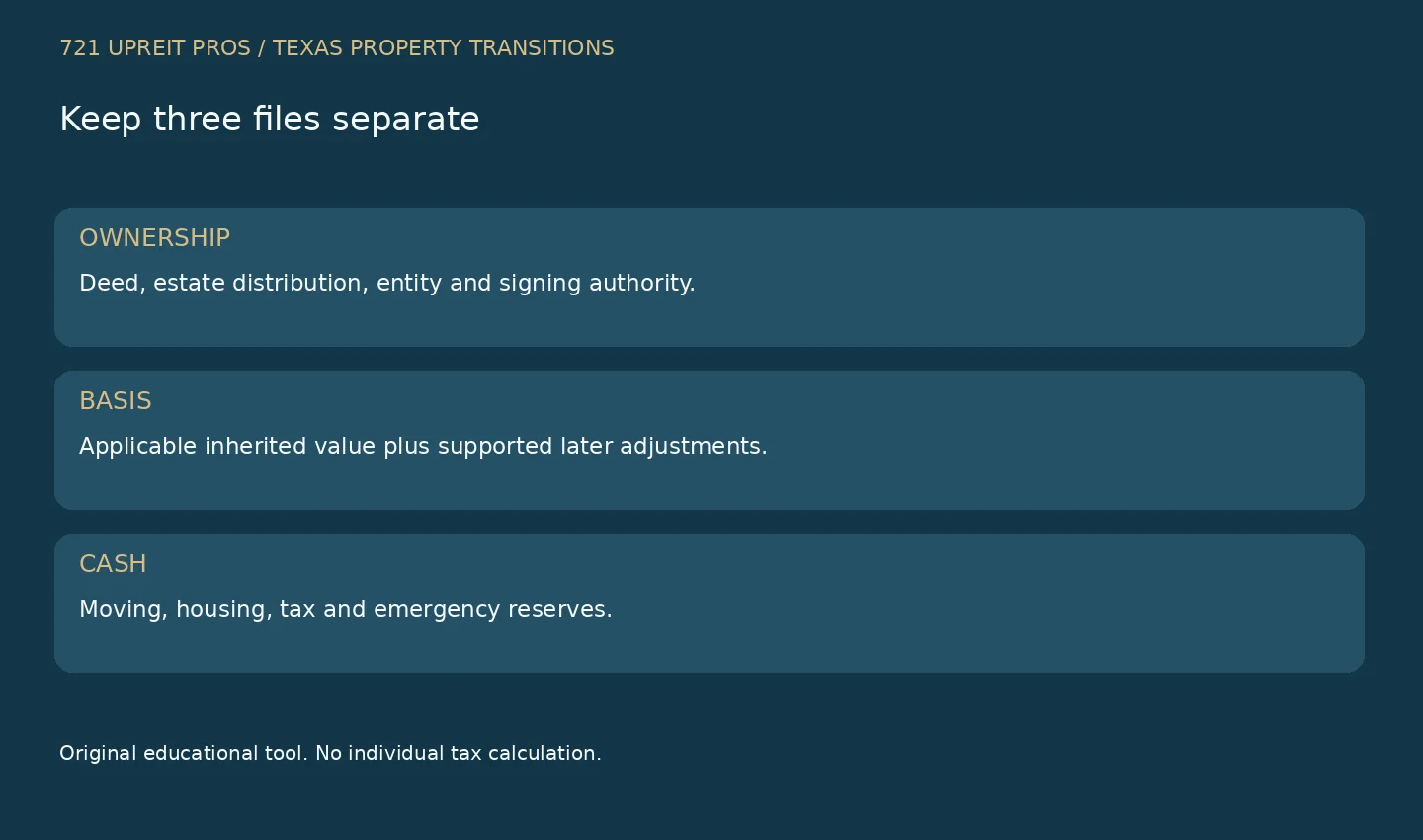
Make a simple ownership map: deed holder, federal tax owner, person authorized to sign and intended recipient of OP units. An estate still administering property, a family LLC and three individual co-owners can present different transaction structures. A proposal addressed to one beneficiary does not prove that beneficiary can contribute the entire property. Obtain the actual title and entity documents.
A receiving operating partnership can reject land that does not fit its acquisition criteria. Tax eligibility does not establish sponsor acceptance, an agreed valuation, lender consent or suitable investment terms. Use the direct-property acceptance checklist before assuming an inherited ranch has a ready UPREIT buyer. Do not transfer title or distribute property merely to fit a marketing diagram without counsel reviewing the consequences.
| Layer | Evidence to collect | Decision it supports |
|---|---|---|
| Ownership | Deeds, estate distribution and entity authority | Who can sell or contribute which asset? |
| Tax basis | Applicable valuation and later adjustment schedule | What gain needs a CPA calculation? |
| Transaction value | Price or contribution valuation, costs and debt | What consideration would the owner receive? |
| Household cash | Moving budget, housing, tax and emergency reserves | How much must remain accessible? |
How can inherited basis change the decision?
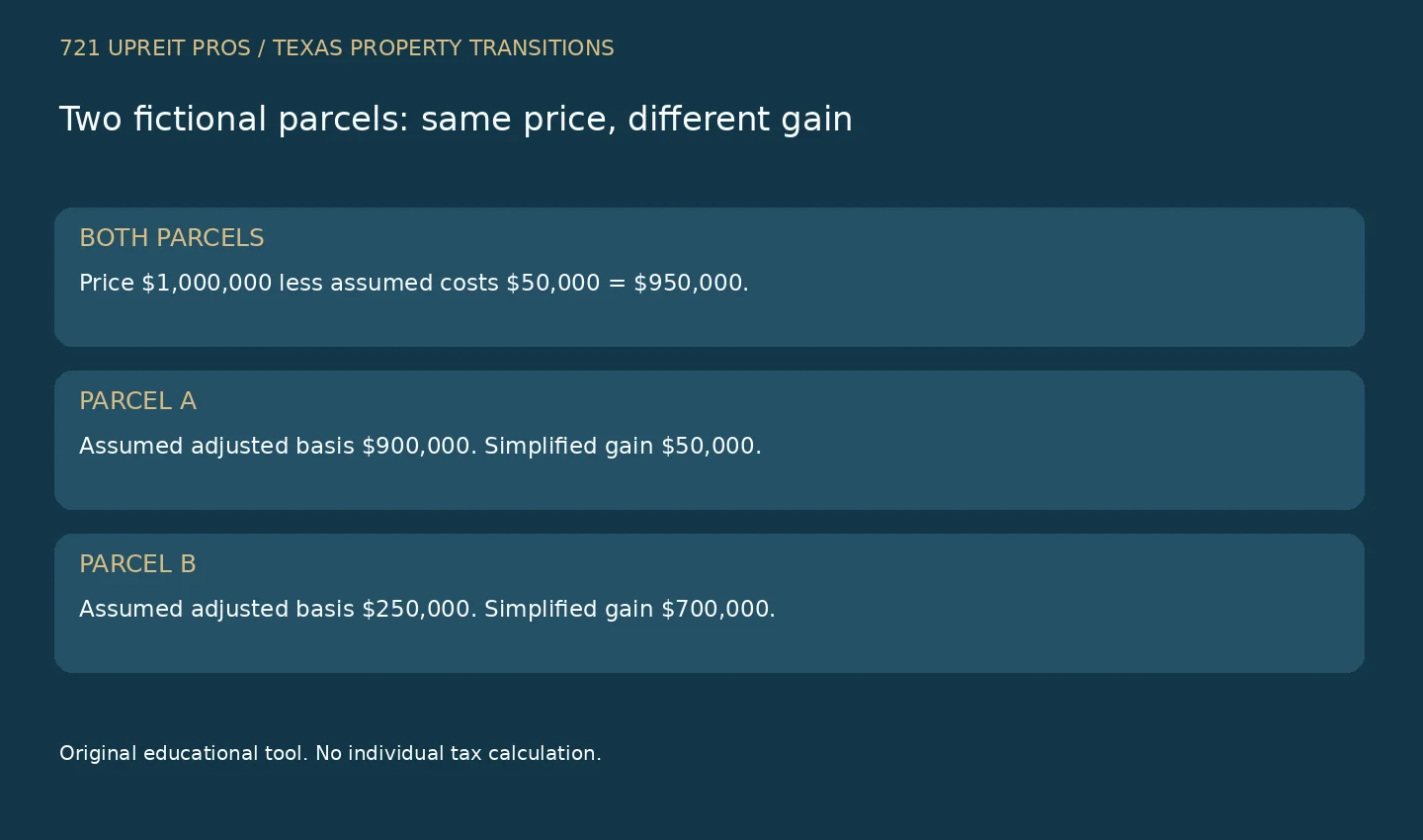
Consider two fictional, debt-free parcels, each with a proposed $1,000,000 sale price and $50,000 of assumed selling costs. For this simplified comparison, the CPA has already confirmed adjusted basis of $900,000 for Parcel A and $250,000 for Parcel B. Assume no residence exclusion, depreciation complications or other adjustments. These are invented inputs, not a valuation or tax estimate for your land.
The simplified amount realized is $950,000 for each parcel. Subtracting the assumed basis gives $50,000 of gain for A and $700,000 for B. Both produce the same gross cash before taxes, yet the potential gain to defer differs sharply. No tax rate is applied. A real calculation must address tax character, applicable taxes, expenses, debt and other facts.
For either owner, ask whether avoiding property management justifies the proposed fees, restrictions and loss of direct control. The comparison does not prescribe a taxable sale for A or an exchange for B. It shows why a decision based only on a seven-figure sale price can miss the household's actual trade-off. Compare after-tax accessible cash with an independently reviewed contribution proposal.
What does Section 721 change, and what does it preserve?
A qualifying property contribution for a partnership interest generally receives nonrecognition treatment under Section 721. In an UPREIT transaction the consideration often consists of OP units, not readily spendable cash. The inherited property's supported basis remains relevant to contribution and future tax records. An agreed contribution value does not automatically become a fresh tax basis. Review IRS Publication 541, Contribution of Property and the 721 UPREIT investor guide.
Cash or other consideration, liability changes, disguised-sale rules and the investment-company exception can change the result. Ask the CPA to model the actual proposed structure and counsel to review the agreement. Keep cash-and-other-property records with that analysis. A completed taxable land sale followed by investing its proceeds in a partnership does not retroactively defer the land-sale gain.
OP units can have transfer restrictions, lockups and limited redemption rights. Distributions can fall, fees reduce returns and the underlying real estate can lose value. A later property sale, unit redemption or conversion may create tax. Review the risk and due-diligence guide; tax deferral is not tax elimination, and contribution acceptance or future liquidity is not guaranteed.
Could a 1031 exchange or home-sale exclusion fit instead?
Section 1031 generally applies to qualifying real estate held for business or investment, not a property held solely for personal use or primarily for sale. Inheritance by itself proves neither qualifying use nor suitability. A ranch with a personal residence, leased acreage and equipment needs asset-by-asset review. IRS like-kind exchange guidance explains the basic eligibility distinction.
For a typical deferred exchange, arrange the qualified intermediary before the property transfers and before receiving or controlling sale proceeds. Identify replacement property within 45 days and complete the exchange by the earlier of 180 days or the return due date, including extensions, for the transfer year. The 45 days run inside the overall period. Cash received, nonqualifying property and debt relief can cause taxable gain. Ask the QI and CPA to confirm exact deadlines and any applicable relief. See the Form 8824 instructions.
A qualifying DST may be replacement real estate under the specific facts of Revenue Ruling 2004-86; the name alone does not establish qualification. A possible later DST-to-721 contribution is a separate transaction, not a guaranteed conversion. For that alternative's inheritance-stage records, see the inherited-property DST exchange explanation. Ordinary REIT shares and OP units generally are not replacement real estate for your own 1031 exchange.
A qualifying main-home sale instead may receive a Section 121 exclusion, generally up to $250,000 of gain or $500,000 for eligible joint filers, subject to ownership, use and other requirements. Inheriting a house does not automatically satisfy those tests. Your next personal home is not an ordinary 1031 replacement investment. Review IRS home-sale rules with the CPA.
What changes if you are moving after the election?
The Texas Secretary of State's November 3, 2026 returns, checked November 5 Pacific, are election reporting, not enacted tax legislation. This article makes no prediction about future tax rates, migration or land prices. A political result alone does not establish a new exchange deadline. Base a closing decision on actual law and effective dates, verified transaction facts and your own reasons for relocating.
Have a preparer familiar with your destination state review residency dates, source income and later recognition of deferred gain. Federal deferral does not settle every state obligation. California FTB Publication 1100 illustrates how residency and source rules affect deferred income. Keep housing and moving reserves outside any amount committed to an illiquid investment, and compare the same cash budget across each alternative.
What should your family bring to the first review?
- Identify each parcel, legal owner and authorized signer.
- Separate inheritance, gift and purchase histories.
- Collect valuation evidence and subsequent basis adjustments.
- Document investment, business and personal uses separately.
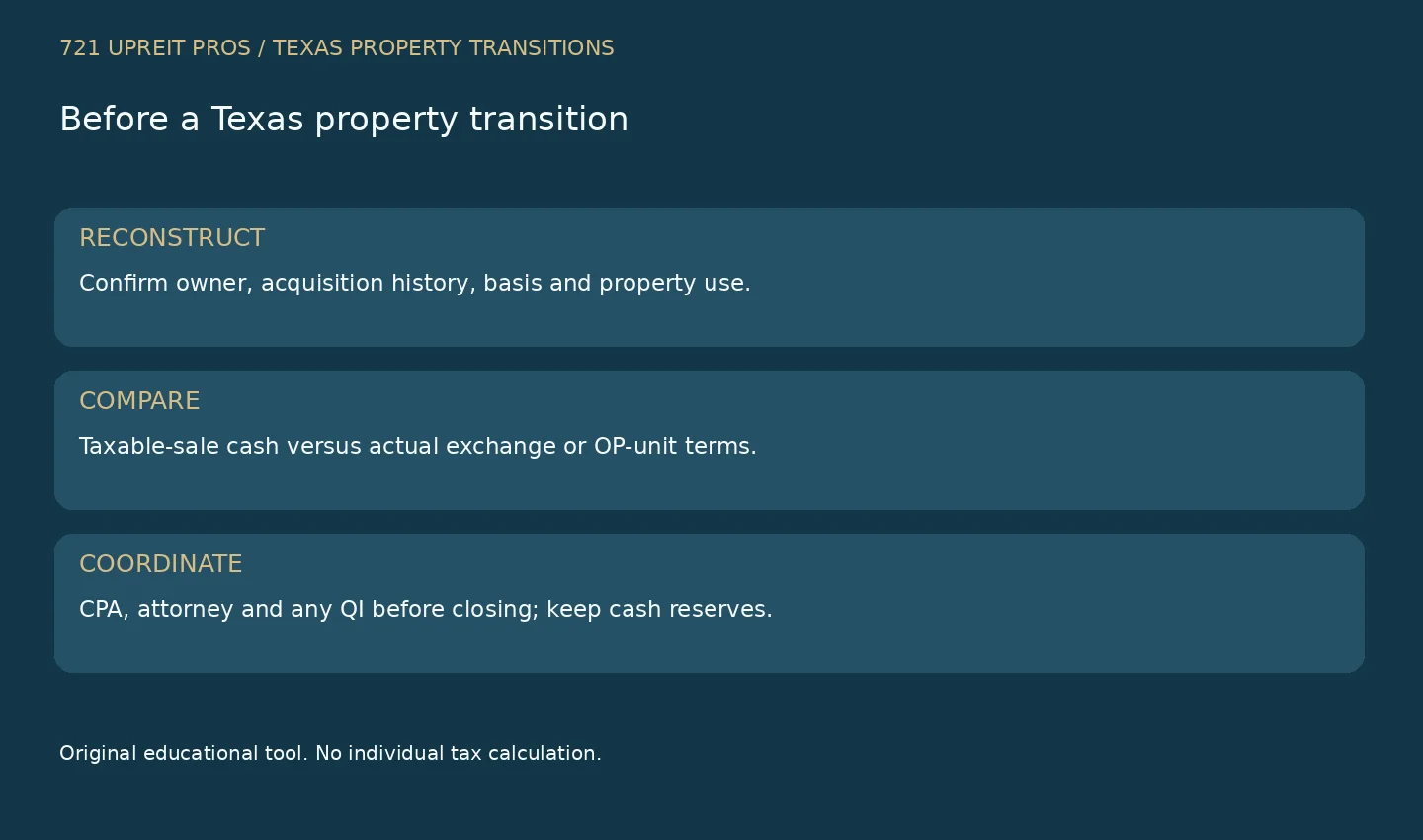
- Compare taxable-sale cash with the actual contribution proposal.
- Map debt, costs, possible taxable consideration and future restrictions.
- Reserve relocation cash and review destination-state obligations.
- Resolve the CPA, attorney and QI questions before closing.
Use the established advisor contact path for a planning conversation. Bring the property facts and questions, but use your professionals' secure channels for private estate and tax documents. This is general education, not a recommendation to sell, relocate or buy securities. No named professional review is represented.
One-minute inherited-land review
Original silent educational video with English captions and a complete matching transcript.
Read video transcript
0:00 · Start with the inherited records
Old family purchase price does not establish your current tax basis.
0:12 · Separate the evidence
Ownership, basis and cash needs answer different questions.
0:24 · Compare the actual gain
Equal sale prices can produce very different gains.
0:36 · Review the actual proposal
721 may produce illiquid OP units. 1031 requires its own qualification.
0:48 · Decide before closing
Use tax and legal professionals. Review state rules and cash reserves.
Download the inherited-land review checklist
Primary sources checked November 5, 2026 Pacific. The linked IRS publications are the currently posted editions, not a claim that every document was issued in 2026. Investments can lose principal. Tax, income, acceptance, conversion and liquidity outcomes are not guaranteed.
Frequently asked questions
Does inherited Texas land automatically need tax deferral?
No. First establish adjusted basis and potential gain. A taxable sale may produce different cash and risk outcomes from a contribution, and the family should compare both with qualified advisers.
Can I contribute land still owned by an estate?
The estate documents, tax ownership, fiduciary authority and receiving partnership terms need review. Do not assume an individual beneficiary can contribute land still owned by the estate.
Will a 721 contribution reset basis to the accepted value?
Generally no. Contribution value and tax basis serve different purposes. The CPA must determine the applicable carryover basis, liabilities and other adjustments under the actual transaction.
Can I reserve moving cash from a 1031 exchange?
Taking cash can create taxable gain. Ask the CPA and QI to compare a partial exchange with a taxable sale and full exchange before funds move; do not assume personal relocation spending qualifies.
Can an inherited personal home be exchanged into a DST?
Personal-use property generally does not qualify for Section 1031. Review any Section 121 exclusion separately, and have a CPA analyze mixed personal and investment uses.
Does leaving Texas eliminate future tax on OP units?
No. Residency, source-income rules, future transactions and partnership reporting can create federal or state tax obligations. Review the intended destination before making the ownership transition.
TALK TO A 721 UPREIT ADVISOR
Ready to discuss your 721 options?
Request a callback to discuss the questions raised by this article, your timing and what to ask before you commit. Share your name, email and phone below to start the conversation.
No investment commitment or financial documents required. A callback request does not book an appointment or establish an advisory relationship.