
721 UPREIT PROS / ACCOUNT PROTECTION
721 UPREIT Account Protection: Does SIPC Cover OP Units?
Do not assume 721 UPREIT OP units have SIPC protection because an advisor or brokerage firm is a member. Review the exact asset, the entity holding it and the event involved. SIPC does not insure investment performance, and unregistered limited partnerships are excluded. An account-statement entry alone does not establish coverage.
By 721 UPREIT Pros · Published October 31, 2026 · Original account-review matrix
Key takeaways
- A membership reference is not an individual OP-unit coverage determination.
- Identify the actual holding entity, exact asset and event.
- Read held-away labels and ownership records separately from statement totals.
- Keep investment performance and liquidity questions in their own review.
The investor decision is whether a description of account protection is being used correctly when you evaluate or already hold OP units. Before relying on a logo, statement footer or verbal explanation, identify what you own and where the ownership records sit. Use the 721 UPREIT risk framework for the wider decision about property exposure, fees, control and liquidity.
This guide organizes the evidence needed for a protection question. It does not decide a particular claim, recommend an account transfer or rank custodians. The advisor-selection checklist handles professional roles and services, while the worksheet below asks what a protection statement actually means for a specific holding.
TALK TO A 721 UPREIT ADVISOR
Talk to a 721 UPREIT advisor
Request a callback to discuss the questions raised by this article, your timing and what to ask before you commit. Share your name, email and phone below to start the conversation.
No investment commitment or financial documents required. A callback request does not book an appointment or establish an advisory relationship.

What problem does SIPC address?
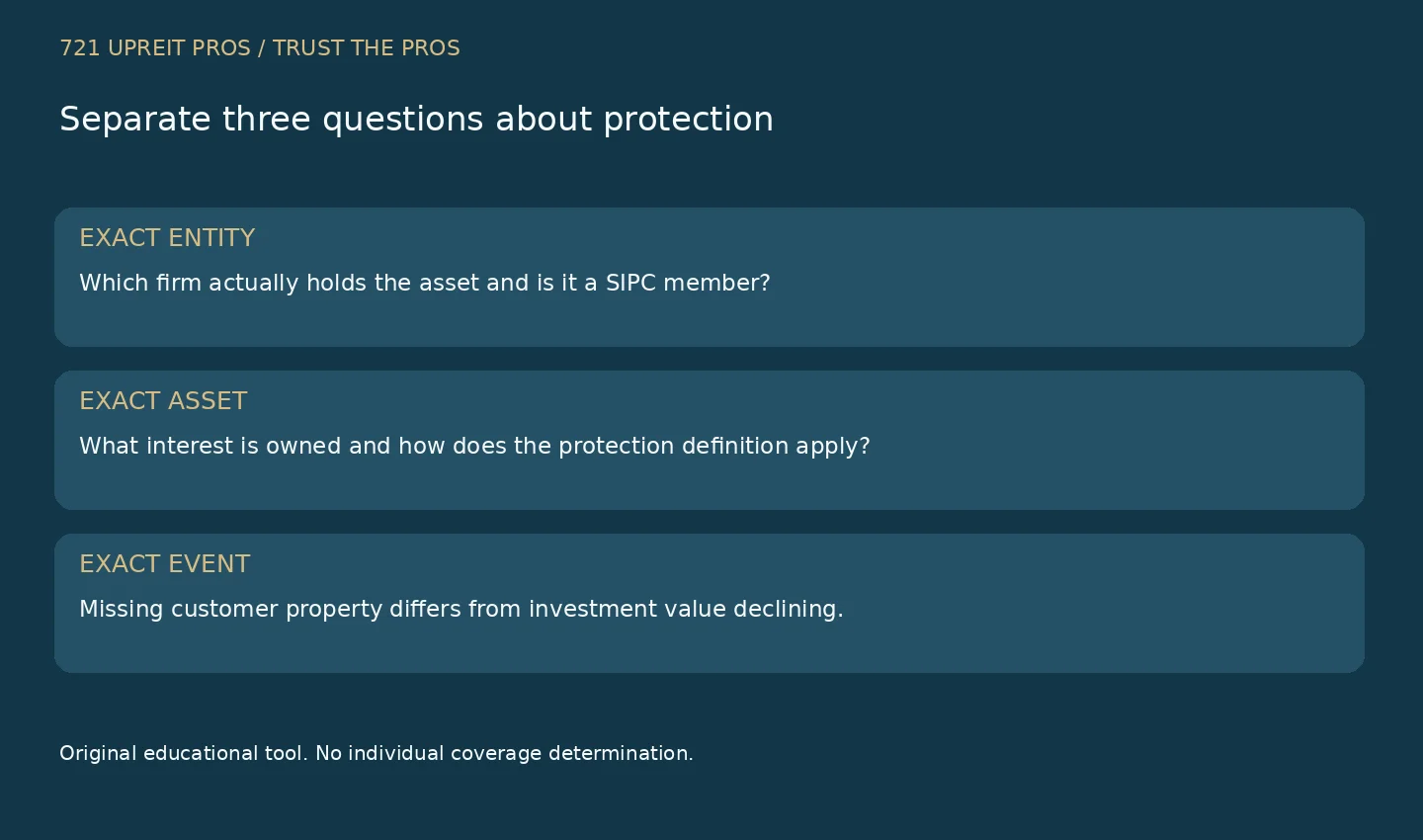
SIPC's explanation of what it protects concerns the custody function when a member brokerage firm fails. It does not protect against market-value declines, bad investment advice or a disappointing investment result. It also excludes unregistered investment contracts, including unregistered limited partnerships. The actual asset definition matters, not simply the use of the word security in a conversation.
Keep that distinction visible when asking about an OP interest. Obtain the exact legal issuer, class and documents, then ask the firm and appropriate counsel how the holding fits the applicable definition. This article does not characterize every OP-unit program as registered or unregistered. Do not infer one program's status from another program's marketing name.
If someone says an investment is protected, ask what event the statement addresses and which document supports it. A clear explanation should separate the protection being described from the investment's own risks. Record any limits or exclusions alongside the favorable description, rather than keeping a sales summary without the qualifications needed to understand it.
Why does the exact holding entity matter?
The SEC and SIPC investor bulletin on SIPC basics distinguishes introducing and clearing brokers and explains that an affiliate is a separate legal entity. It also warns that assets held outside a member brokerage firm are not protected by SIPC even when they appear on an account statement. Match the actual arrangement, not just a familiar brand.
Ask for the full name of each party involved: the professional providing advice, any brokerage firm, the firm identified as holding the account, and the issuer or administrator maintaining ownership information. Some names may belong to the same business group, but do not merge their roles without evidence. A common logo is not a completed explanation of which entity performs which task.
| Question | Evidence to request | Unresolved inference to avoid |
|---|---|---|
| What is the exact investment? | Issuer name, OP class and governing documents | Every real-estate holding has the same protection status |
| Who holds or records it? | Ownership confirmation and written custody explanation | The advisor's brand identifies the holding entity |
| What appears on the statement? | Footnotes, held-away labels and source of values | Every displayed asset is held by the statement provider |
| What protection is being claimed? | Applicable membership, asset definition and exclusions | A logo or headline resolves all conditions |
| What event is being discussed? | Specific missing-property, account or investment facts | Investment losses are the same as a custody shortfall |
For each row, keep the source date, responsible contact, answer received and next task. Use a status such as documented, awaiting explanation or requires legal review. An unanswered cell is not proof of misconduct, and a completed checklist is not an assurance that a future claim would be paid.
What does a held-away statement entry tell you?
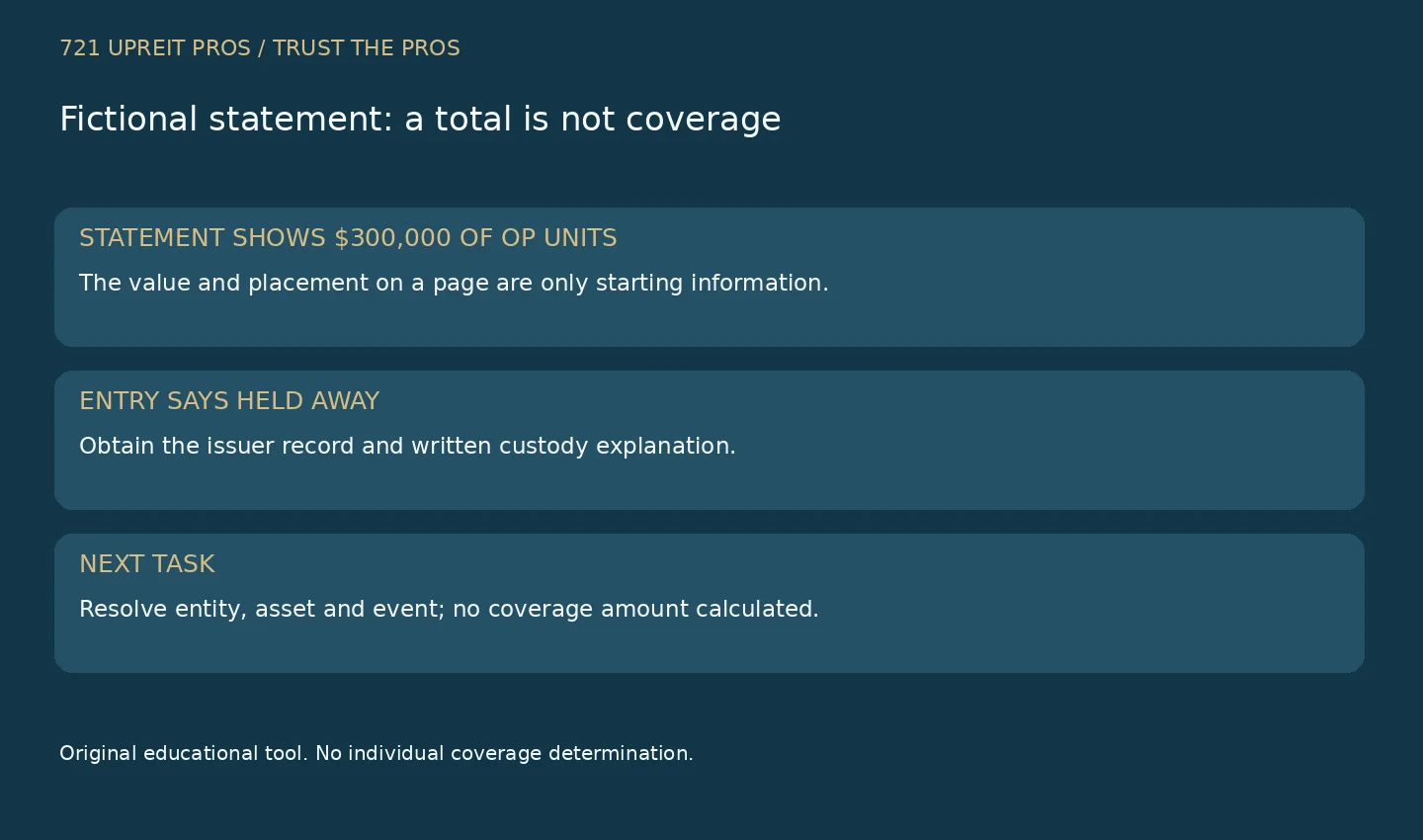
Consider a fictional household statement showing $300,000 beside an OP-unit entry. A footnote says the asset is held away and the value was supplied by another source. These invented details illustrate a reading exercise, not a real account, valuation or coverage determination. Start by retaining the complete statement, including its footnotes, instead of copying only the total into a planning worksheet.
The next task is to obtain the issuer ownership confirmation and a written explanation of who maintains the position. Ask which record establishes the unit count, class and registered holder, and which party supplied the displayed value. The appearance of a number on a consolidated page should not be used to answer a different question about custody or protection.
Suppose the household also has an advisor agreement and a membership reference for a brokerage firm. Put those in separate rows. The agreement helps identify the service relationship; the membership information concerns a named firm; the ownership record concerns the actual interest. None should be silently substituted for the others. No amount of the fictional $300,000 is labeled protected here.
Which risks stay in the investment review?
Evaluate the investment's economics on their own evidence: property performance, financing, charges, manager decisions and the rights attached to the units. Ask how a downside scenario would affect the household's cash plan. A protection discussion should not end the review of whether the commitment fits your objectives or whether you can tolerate a long period without accessible proceeds.
Use the third-party OP-unit offer review if someone proposes a purchase, and the issuer-redemption checklist if you are considering a request. Those are different transaction paths. Do not let a statement about account protection stand in for written answers about transfer permission, price or timing.
How should you handle unclear or conflicting answers?
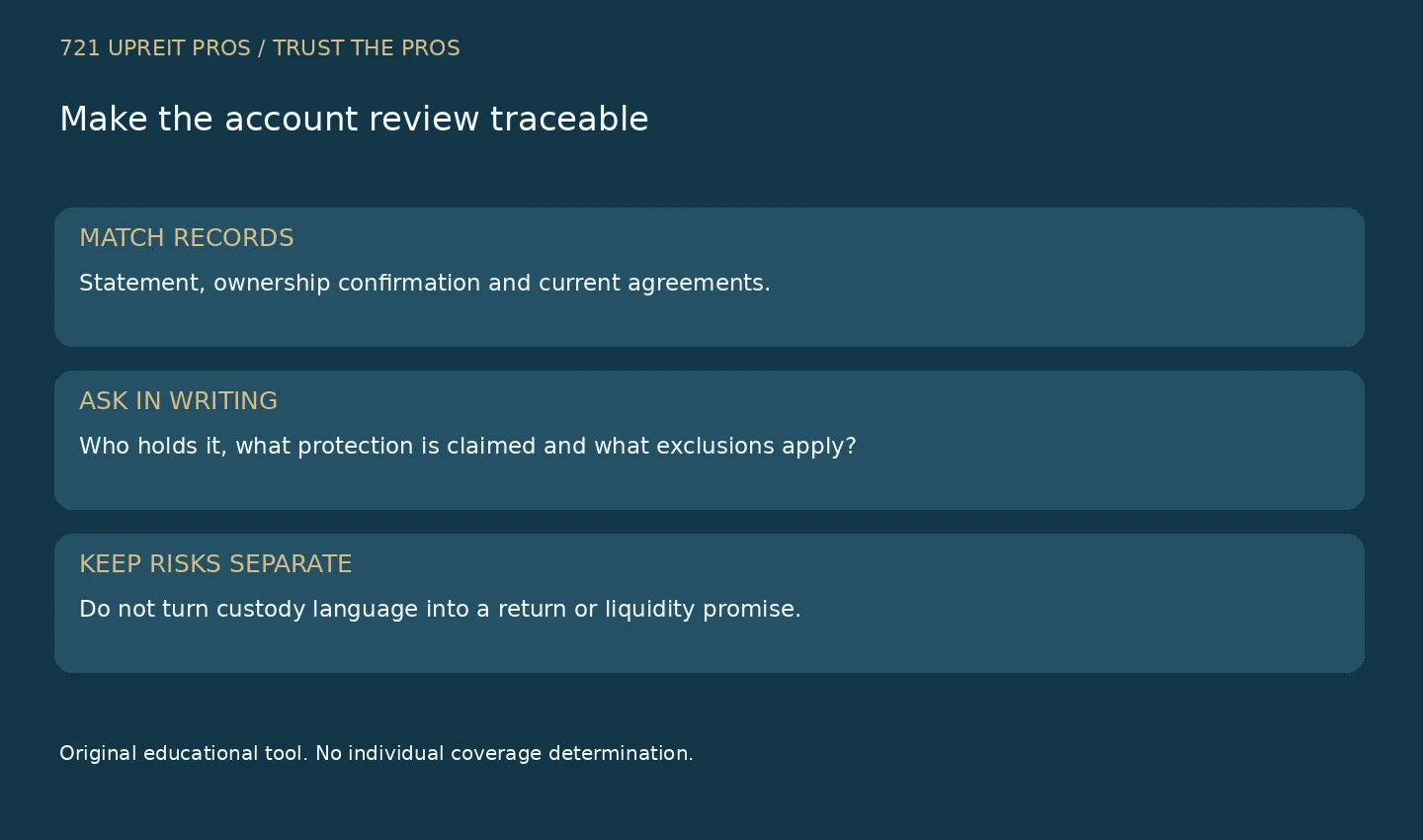
Keep both versions and ask the responsible firm to reconcile them in writing. A statement saying held away and a broad verbal assurance deserve clarification before you rely on either. Use independently obtained contact information to verify the firm and the relevant department. Describe the question precisely without sending private account numbers or documents to an unverified recipient.
If a specific discrepancy remains, preserve the statement, confirmation, correspondence and dates, then ask the appropriate professional or regulator about next steps. Do not describe an unresolved difference as a proven theft, valid claim or compensable loss. This worksheet identifies open questions; it does not conduct an investigation or replace claim procedures.
What changes between DST ownership and a later 721 contribution?
Identify the stage before reusing an earlier account explanation. A qualifying Section 1031 exchange into a DST and a separate Section 721 contribution involve different interests and documents. A later transaction may change the issuer, ownership record or service arrangement. The 721 UPREIT investor guide explains those stages; a planned transition is not a guarantee of conversion.
The related DST offering-document review and DST Experts' PPM reading guide help organize the earlier trust-stage disclosures. This article adds a different task: evaluating a specific claim about account protection for an OP-unit holding. Do not assume the answer follows unchanged from the initial DST purchase.
What should you ask before relying on a protection statement?
- What exact issuer and unit class do I own?
- Which entity holds the asset, and which entity only displays or services it?
- What current records establish ownership and the holding arrangement?
- Is the named brokerage firm a SIPC member, and how was that verified?
- How does the exact asset fit the relevant protection definition and exclusions?
- Which event and claim conditions does the explanation address?
- What investment, liquidity and tax questions remain outside that explanation?
Bring the open questions when you talk through a 721 UPREIT account arrangement with an advisor or request a callback. Use a verified secure channel if private records are needed. Public forms should contain a brief question, not account numbers, statements, tax returns or payment instructions.
Watch the one-minute account-review walkthrough
This original silent video includes English captions and the complete matching transcript below.
Read video transcript
0:00 · An account label is not a guarantee
SIPC questions require the exact entity, asset and event.
0:12 · Identify the holding arrangement
Match the ownership record with the actual custody explanation.
0:24 · Read the statement carefully
Our fictional held-away entry does not calculate coverage.
0:36 · Separate investment risks
A value decline is different from missing customer property.
0:48 · Record the remaining questions
Use current documents and appropriate professional review.
Download the account-protection checklist
Primary SIPC and SEC educational guidance checked October 31, 2026. No individual coverage, legal claim or expert-review determination is provided. Investments can lose value and be illiquid; returns, conversion and tax results are not guaranteed.
Frequently asked questions
Does a SIPC logo mean every investment is protected?
No. Membership is one part of the review. The particular asset, holding arrangement and applicable conditions still matter. Obtain an explanation for the exact interest.
Does SIPC insure an OP unit against a price decline?
No. Do not treat custody protection as a guarantee of principal, investment performance or a future sale price.
Is an OP-unit entry on a statement enough evidence?
No. Read footnotes and obtain the ownership confirmation and custody explanation. A displayed asset may be held outside the statement provider.
Are all OP-unit programs registered or unregistered?
No universal classification is made here. Identify the exact issuer, unit class and documents and obtain appropriate review of its status and treatment.
Does changing advisors establish new protection?
Do not assume that result. Separate a service change from a change in ownership or custody, and review the actual arrangement after any completed transition.
Should I send statements through the public form?
No. Describe the question briefly and arrange a verified secure channel for private records. Keep account numbers, financial documents and payment instructions out of public forms.
TALK TO A 721 UPREIT ADVISOR
Ready to discuss your 721 options?
Request a callback to discuss the questions raised by this article, your timing and what to ask before you commit. Share your name, email and phone below to start the conversation.
No investment commitment or financial documents required. A callback request does not book an appointment or establish an advisory relationship.