
721 UPREIT PROS / THIRD-PARTY OFFER REVIEW
721 UPREIT Secondary Sales: Can You Sell OP Units?
Selling 721 UPREIT operating partnership units to a third party may be restricted or unavailable. Before relying on an offer, verify transfer permission, the buyer and the complete closing terms. Compare net proceeds after costs and obtain individual tax advice. An unsolicited purchase proposal does not establish a liquid market or an approved transfer.
By 721 UPREIT Pros · Published October 29, 2026 · Original offer-review matrix
Key takeaways
- Verify transfer permission separately from buyer interest and closing terms.
- Distinguish a third-party purchase from issuer redemption or share conversion.
- Compare proceeds after costs without treating them as after-tax cash.
- Keep conditions, approvals and ownership-record completion documented.
You already own OP units and someone offers to buy them. The immediate decision is whether that proposal can be completed on acceptable terms, rather than whether the original contribution was attractive. Begin with the actual unit class, registered owner, partnership agreement and amendments. The 721 UPREIT risk framework remains the broader due-diligence resource.
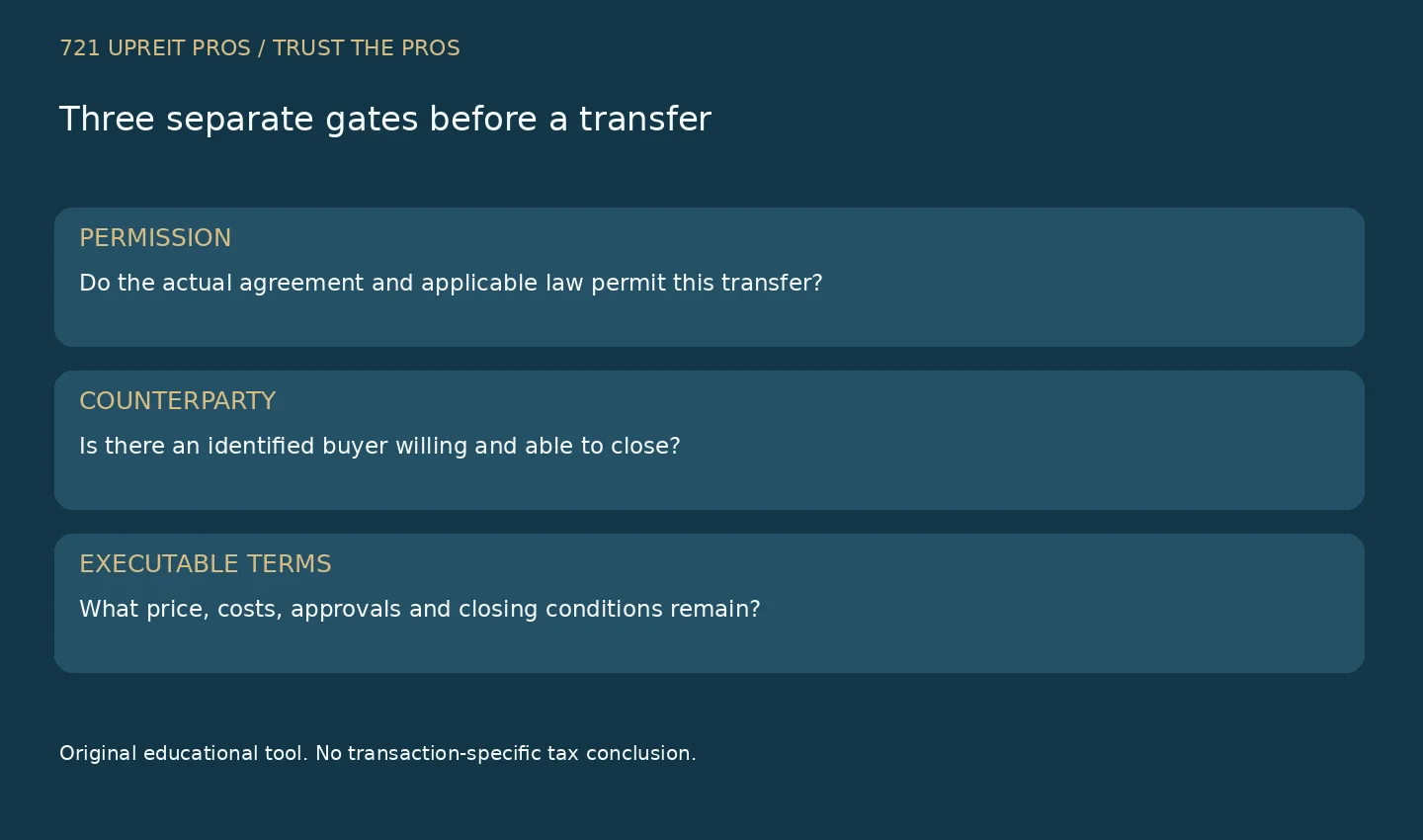
Keep three questions open independently: is this transfer permitted, is there a verified counterparty, and what conditions stand between the offer and usable funds? A favorable answer to one does not resolve the others. The review below is a document tool, not a marketplace, buyer referral, valuation or recommendation to sell.
TALK TO A 721 UPREIT ADVISOR
Talk to a 721 UPREIT advisor
Request a callback to discuss the questions raised by this article, your timing and what to ask before you commit. Share your name, email and phone below to start the conversation.
No investment commitment or financial documents required. A callback request does not book an appointment or establish an advisory relationship.

Which liquidity route is actually being proposed?
A third-party purchase changes who owns the interest if a valid transfer closes. An issuer redemption invokes a different contractual process. Exchanging OP units for REIT shares introduces another set of rights and restrictions, and a property sale occurs at a different ownership level. Ask the sender to name the proposed transaction precisely before comparing timing or price.
| Route | First evidence to locate | Question that remains |
|---|---|---|
| Third-party purchase of OP units | Transfer provisions and complete buyer proposal | Is this exact transfer permitted and executable? |
| Issuer redemption request | Redemption right, eligibility and response terms | What settlement form, amount and timing apply? |
| OP-unit exchange for REIT shares | Exchange provisions and receiving share terms | What restrictions apply to the shares received? |
| Partnership property disposition | Partnership authority and transaction notices | What does the event mean for the investor's units? |
Use the pending-redemption checklist for an issuer request and the unit-to-share conversion checklist for an exchange. A delayed redemption does not establish a right to sell units elsewhere. Equally, a purchase letter does not prove that an issuer redemption is available or that shares will be publicly tradable.
What can the partnership agreement restrict?
A dated example shows why permission must come first. The HGIT Properties LP agreement dated January 5, 2026, Section 9.2, generally requires prior general-partner consent for transfers, subject to its exceptions and conditions. It addresses securities and tax restrictions, supporting documents and possible transfer costs. Section 9.3 separately addresses admission as a substitute limited partner.
For this question, Section 9.2(e) restricts transfers through an established securities market or secondary market as described there under Section 7704. Calling a proposal a secondary sale does not make it permissible. This filing illustrates one dated agreement, not your rights, current offering availability or a permitted route around restrictions. Ask the administrator and counsel to assess the actual proposal under current governing documents and applicable law.
Record the relevant clause and required approval in writing. Distinguish permission to assign an economic interest from admission as a partner where the documents make that distinction. Do not assume a family-transfer exception applies to an unrelated buyer, or that administrative acceptance of a form resolves every contractual, securities-law or tax issue.
How should you evaluate the buyer and offer conditions?
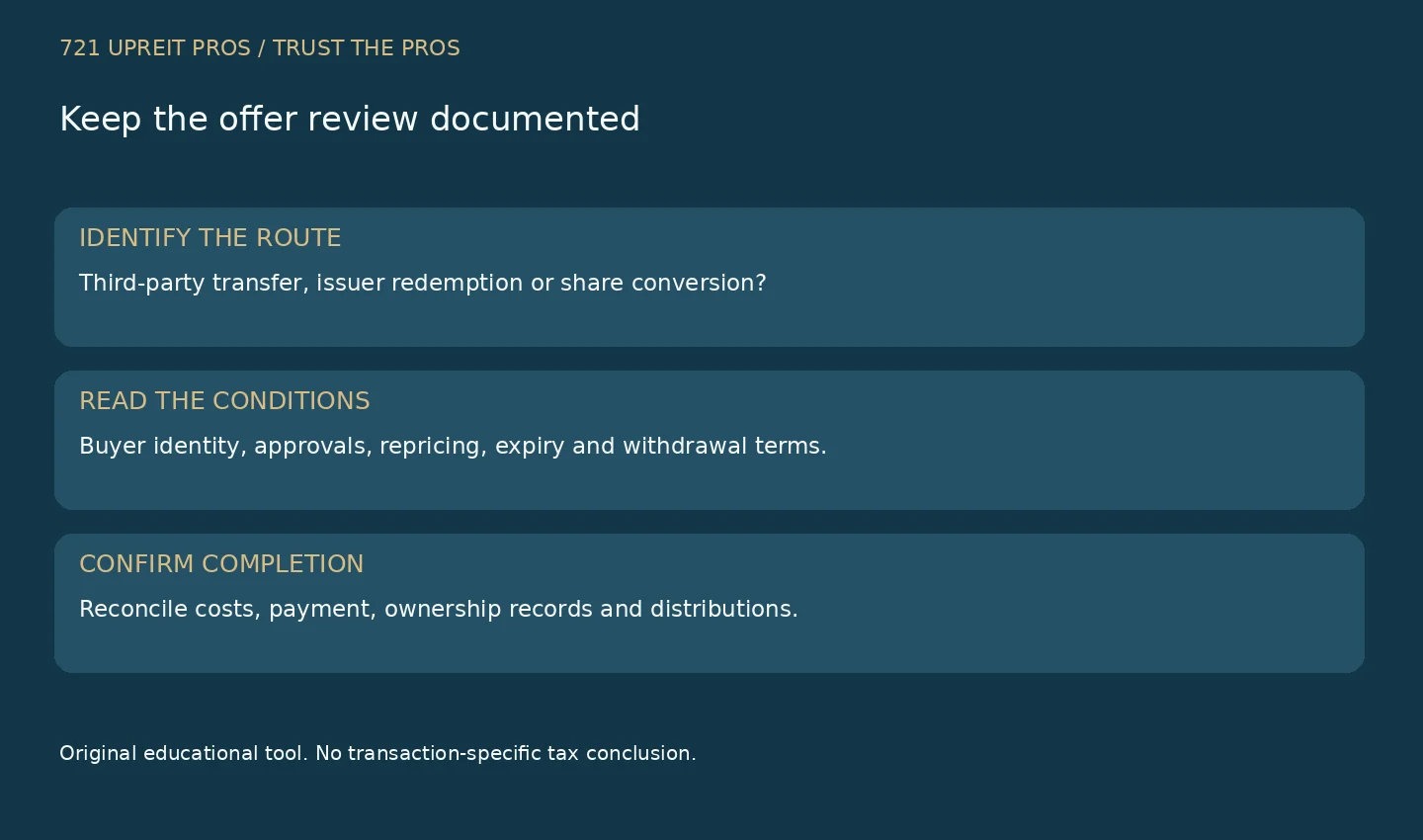
Obtain the complete proposal, including attachments, amendments and the identity of the legal buyer. Verify the sender through independently obtained contact information before sharing sensitive records or payment instructions. Ask who bears costs if approval is refused or closing fails. Keep the original offer and every later change so that a headline price cannot hide revised terms.
Read the expiration date, acceptance procedure, closing conditions, price-adjustment language and any withdrawal provision. Note whether the buyer can extend the offer or reduce the number of units purchased. If a term is unclear, have counsel explain it before you sign. Do not assume you can revoke an accepted proposal or that silence preserves a right the document does not grant.
The SEC's Investor.gov explanation of mini-tender offers warns about pricing and reduced protections in that category, including potential limits on withdrawal. This does not classify every OP-unit purchase as a mini-tender. The relevant lesson is to examine the actual offer and applicable rules with counsel, rather than infer protections from a familiar label.
Can a higher unit price leave less cash?
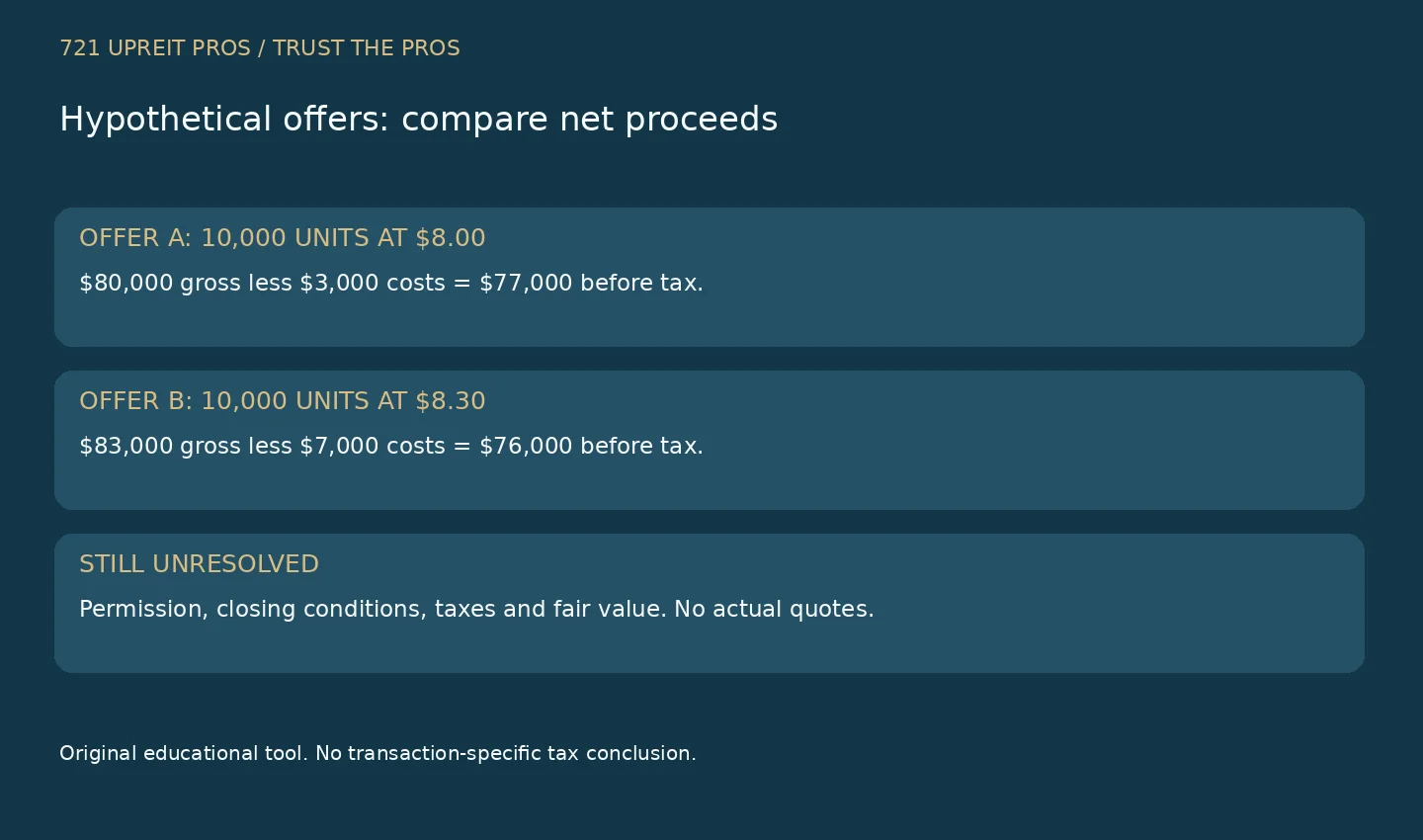
Yes, when other terms differ. Consider two entirely fictional proposals for 10,000 units. Offer A pays $8.00 per unit and imposes $3,000 of assumed total seller costs. Offer B pays $8.30 and imposes $7,000 of assumed total seller costs. These are educational inputs, not current bids, expected fees, NAV estimates or evidence of fair value.
| Input or result | Offer A | Offer B |
|---|---|---|
| Units assumed sold | 10,000 | 10,000 |
| Price per unit | $8.00 | $8.30 |
| Gross proceeds | $80,000 | $83,000 |
| Assumed seller costs | $3,000 | $7,000 |
| Proceeds after these costs, before tax | $77,000 | $76,000 |
Offer B has the higher gross price but leaves $1,000 less before tax under these assumptions. That does not make Offer A preferable. Permission, buyer performance, closing conditions, tax effects and value remain unresolved. Compare proposals using the same unit count, dates and cost definitions, then identify every missing input instead of filling it with a favorable estimate.
Why do valuation and tax questions stay separate?
A statement value, appraisal date and buyer's offered price may measure different things for different purposes. Record the source, effective date, interest valued and limitations of each number. A discount to a reported value does not prove unfair dealing, and a price above another quote does not establish fair value. Ask what information supports the comparison and what remains unavailable.
The IRS's Publication 541, Partnerships discusses sales of partnership interests, including circumstances involving ordinary income and partnership liabilities. A simple price-minus-fees worksheet is therefore not an after-tax calculation. Have your tax professional review basis, liabilities, relevant partnership information and the proposed transaction before estimating spendable proceeds. No tax amount or outcome is calculated here.
What should be confirmed before ownership changes?
Document who receives distributions around the transfer date, who handles notices and tax information, and what establishes completion in the partnership records. Ask how a pending redemption or other election would be treated if a sale proceeds. Avoid conflicting instructions by having the responsible parties resolve the sequence. A signed offer, administrator acknowledgment and completed ownership update are separate milestones.
What is the next practical step?
- Identify the exact units, registered holder, buyer and transaction route.
- Locate current transfer restrictions, conditions and required consents.
- Obtain the complete offer and reconcile price, seller costs and unresolved taxes.
- Review conditions, amendments, expiration and withdrawal terms with the appropriate professional.
- Confirm payment, distributions, ownership records and remaining reporting responsibilities.
If your original investment was a DST, keep its exit process separate from OP-unit rights. The related DST holding-period and exit-timing guide covers the trust stage. DST Experts' investor-report worksheet helps organize dated information. Neither resource creates a later transfer right. The 721 UPREIT guide explains the different ownership stages.
Bring the unresolved decision to a professional when you discuss 721 UPREIT liquidity planning with an advisor or request a callback. Describe the question without uploading confidential agreements, account numbers, tax returns or wire details into public forms. No buyer, transfer approval, completed consultation or expert review of your offer is promised.
Watch the one-minute offer-review walkthrough
This original silent video includes English captions and the complete matching transcript below.
Read video transcript
0:00 · An offer is not completed liquidity
Verify transfer permission, buyer and executable terms separately.
0:12 · Identify the actual route
A third-party sale differs from issuer redemption or conversion.
0:24 · Compare proceeds after costs
A higher price can leave less cash before tax in this example.
0:36 · Read all remaining conditions
Check approvals, price changes, expiry and withdrawal provisions.
0:48 · Use verified documents
Ask the administrator, counsel and your tax professional. No guarantees.
Download the third-party offer checklist
Primary evidence checked October 29, 2026. Contract examples are dated and program-specific. Investments may lose value and remain illiquid; sale, conversion, distributions and tax results are not guaranteed.
Frequently asked questions
Does an offer prove my OP units are liquid?
No. A proposal does not establish transfer permission, a continuing market, an executable sale or available cash. Verify the actual documents, counterparty and remaining conditions.
Can I sell units because my redemption request is delayed?
A delay does not create a transfer right. Redemption and third-party transfers use different provisions; ask the administrator and counsel what the current agreement permits.
Is every OP-unit purchase proposal a mini-tender?
No such classification is made here. The security, buyer, offer structure and applicable rules matter. Counsel should assess the specific proposal and its protections.
Should I choose the highest per-unit price?
Compare the complete economics and conditions. Different seller costs can reverse a gross-price comparison, while taxes, approvals, execution and value may remain unresolved.
Does a statement value guarantee what a buyer will pay?
No. Identify what each value measures and its effective date and limitations. An account statement is not a binding third-party purchase commitment.
What documents should I gather first?
Collect the current partnership agreement and amendments, unit-class records, complete offer and changes, applicable notices and cost schedule. Use verified secure channels for confidential material and obtain individual legal and tax review.
TALK TO A 721 UPREIT ADVISOR
Ready to discuss your 721 options?
Request a callback to discuss the questions raised by this article, your timing and what to ask before you commit. Share your name, email and phone below to start the conversation.
No investment commitment or financial documents required. A callback request does not book an appointment or establish an advisory relationship.