
721 UPREIT PROS / TAX TREATMENT AND TITLE
721 UPREIT: Can a Single-Member LLC Contribute Property?
A single-member LLC can be the state-law title holder in a proposed 721 UPREIT property contribution, but its federal income-tax classification must be verified. By default, an LLC with one owner is generally disregarded for federal income tax unless it elected corporate treatment. Section 721 eligibility still depends on the actual contributor, property, consideration, liabilities and completed partnership transaction.
Prepared by 721 UPREIT Pros · Published November 20, 2026 · General education
Key takeaways
- A one-owner LLC is generally disregarded for federal income tax unless it elected corporate treatment.
- State-law title and federal tax ownership are separate records; reconcile both with the contribution agreement.
- Section 721 nonrecognition depends on the actual property-for-partnership-interest transaction and other facts.
- Debt, cash, elections and pre-closing changes require individualized tax and legal review.
This article addresses a different question from the property acceptance checklist, which covers sponsor, lender and closing readiness, and the accredited-investor article, which addresses securities eligibility. Here the task is to reconcile the deed, LLC records and tax classification before anyone describes a contribution as tax deferred. LLC letters alone do not answer the tax question.
What does the IRS mean by a disregarded single-member LLC?
The IRS single-member LLC guidance says a domestic LLC with one member is generally disregarded as separate from its owner for federal income tax purposes unless it elects corporate treatment on Form 8832. The LLC remains an entity under state law and can hold title, sign contracts and have its own liability and lender issues. Federal income-tax treatment and legal title therefore need separate rows in the transaction file.
TALK TO A 721 UPREIT ADVISOR
Talk to a 721 UPREIT advisor
Request a callback to discuss the questions raised by this article, your timing and what to ask before you commit. Share your name, email and phone below to start the conversation.
No investment commitment or financial documents required. A callback request does not book an appointment or establish an advisory relationship.
For example, a deed can name “Harbor Rental LLC” while the federal income-tax reporting owner is the individual who owns that disregarded LLC. That does not mean the individual can skip title, lender consent or entity authority. It also does not mean every transaction involving that LLC automatically qualifies under Section 721. The operating partnership must agree to accept the actual property, the correct party must execute the documents, and tax counsel must analyze all consideration and liabilities.
Do not assume an EIN decides classification. The IRS notes that a disregarded single-member LLC may obtain an EIN for banking or state-law reasons, while federal income-tax reporting may still use the owner's taxpayer identifier. Likewise, an LLC may have made an election that changes its default classification. Ask for tax returns, entity election history and ownership records rather than inferring the answer from an account number or a subscription form.

Who is contributing property under Section 721?
Section 721(a) generally provides nonrecognition when property is contributed to a partnership in exchange for a partnership interest. Its text does not say every transaction called an UPREIT exchange qualifies. The contributor, contributed property, consideration and recipient partnership must match the legal steps. Section 721(b) also includes an investment-company exception. Other rules can matter if money, debt relief or a related transfer is involved.
IRS Publication 541 states the usual nonrecognition rule for property contributed to a partnership and separately discusses liabilities, disguised sales and basis. Those issues can materially change the result. In particular, a mortgage attached to the rental should be listed with its borrower, balance, guarantees and proposed assumption or refinance. Do not label the property “debt-free” merely because the LLC rather than its owner appears on the note.
Obtain a draft transaction chart showing the deeded owner, federal tax owner, lender, proposed transferee partnership and the party receiving consideration. Have counsel identify which entity signs the contribution agreement and which deeds or assignments are actually required. A disregarded LLC may simplify one federal tax classification question, but it does not erase contract, state tax, transfer tax or title questions. The direct contribution closing-cost guide helps map those separate charges.
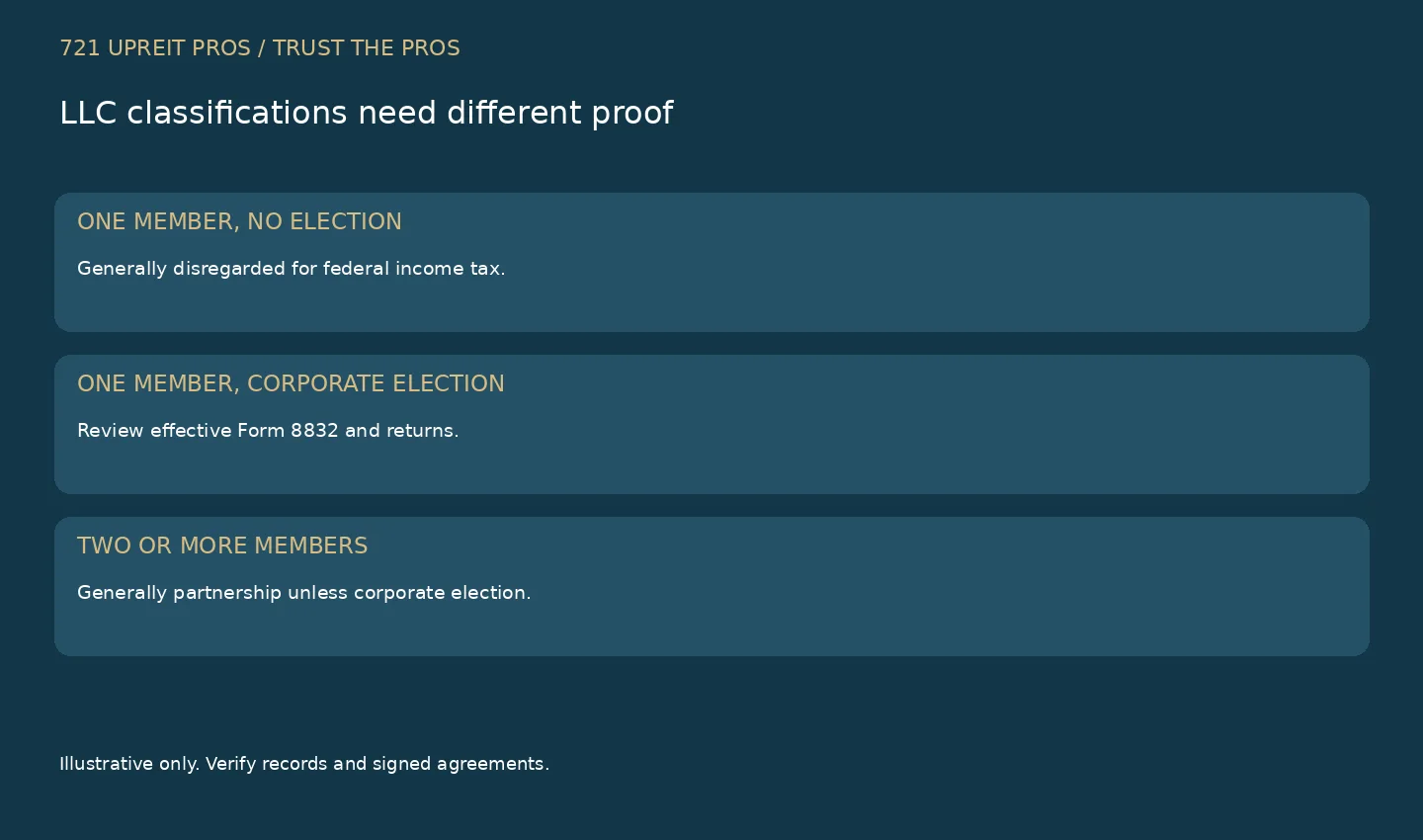
| Current holder | Federal starting point | Key evidence | Decision risk |
|---|---|---|---|
| One-owner LLC with no corporate election | Generally disregarded for income tax | Owner ledger, returns, election history, deed | Do not ignore legal title or debt |
| One-owner LLC with corporate election | Corporation treatment may apply | Form 8832 and effective date, returns | Do not use disregarded-entity analysis |
| LLC with two or more members | Generally partnership unless corporate election | Operating agreement, ownership, returns, election history | Different contributor and consent analysis |
This matrix is a starting classification check, not a conclusion on a particular LLC. If members changed, an election became effective, or an entity conversion is planned just before closing, ask the tax adviser to review the sequence. A pre-closing “cleanup” step can itself have legal and tax consequences. Keep the actual effective dates in the file.
How can a title name differ from the tax owner?
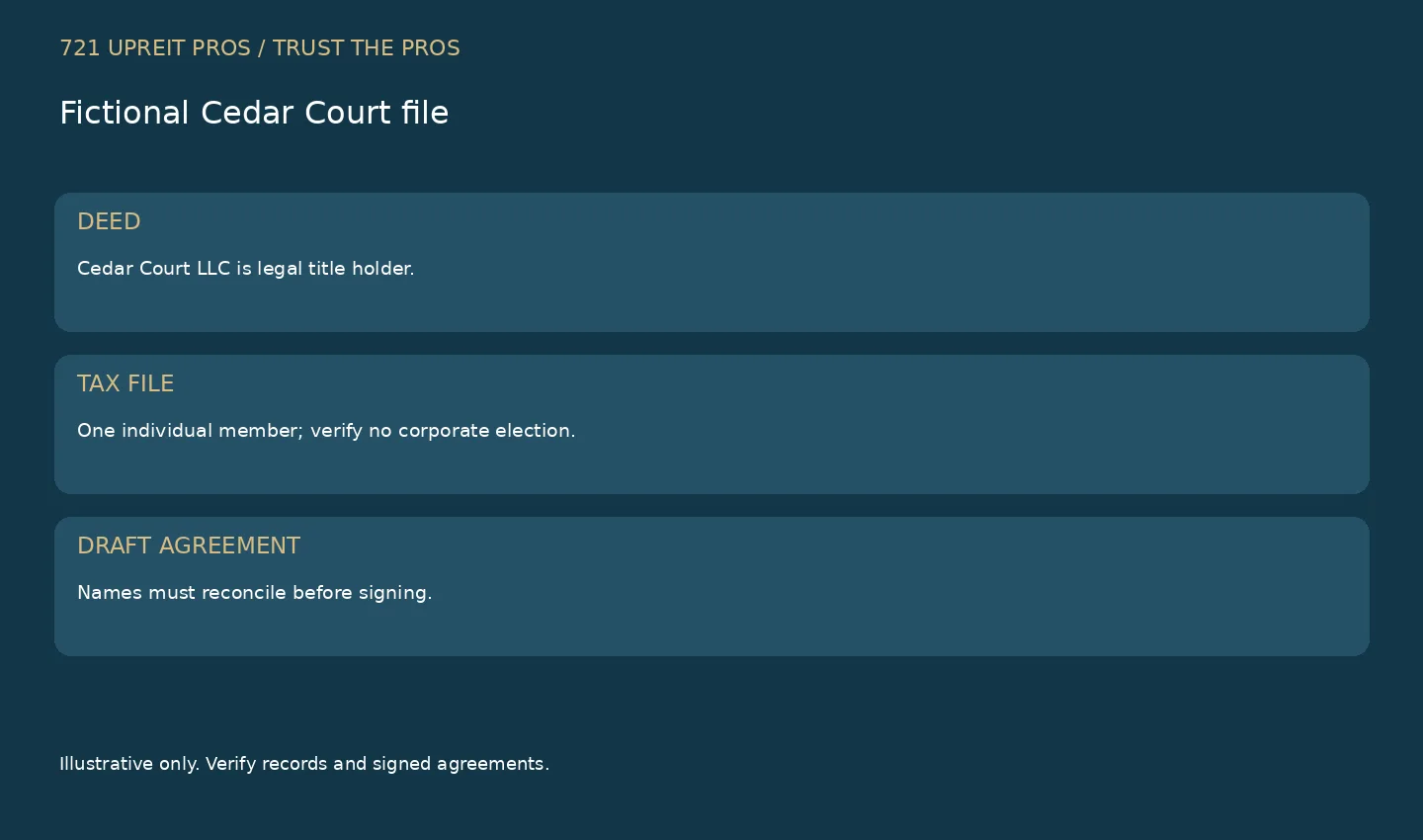
Suppose a fictional rental building has an agreed proposed contribution value of $2.4 million and a $700,000 mortgage. The deed lists Cedar Court LLC. Its records show one individual member, no Form 8832 election and rental activity reported on that person's federal return. For federal income-tax analysis, the LLC may be disregarded; for title and closing, Cedar Court LLC remains the named owner on the deed. The example's $1.7 million gross-value-minus-debt arithmetic is not a tax basis, partnership interest value or cash payment.
The draft contribution agreement instead names the individual as the sole transferor, while the lender records and title commitment name Cedar Court LLC. That mismatch is a question for counsel before signatures. The parties may need to correct the agreement, clarify signing capacity, obtain lender consent or take other documented steps. We cannot infer which remedy applies or whether the operating partnership will accept the building.
Now change one fact: Cedar Court LLC had filed a corporate election effective two years earlier. The default disregarded analysis is no longer a safe assumption. Its returns, election and ownership must be reviewed under the classification that actually applies. This one-fact test shows why a sponsor intake form asking only “Is the property in an LLC?” is insufficient. The tax adviser must identify the federal owner, and counsel must reconcile the legal transferor and title.
What should be checked before signing a 721 proposal?
- Current deed, title commitment and legal name of the owner that can transfer the property.
- LLC formation document, operating agreement, member ledger and authority to sign.
- Federal returns and any Form 8832 election with its effective date; ask the CPA to document the classification.
- Property tax basis, depreciation schedule, loan balance, guarantees and proposed debt treatment.
- Draft contribution agreement and entity chart naming the actual transferor, recipient partnership and consideration.
- Any cash, reimbursement, debt relief, related distribution or pre-closing transfer requiring separate tax review.
- Property-specific acceptance, lender consent, title and local transfer-tax questions.
A direct contribution differs from a qualifying 1031-to-DST route. A 1031 exchange involves relinquished and replacement real property and its own deadlines. A possible later DST contribution is separate. Neither route should be inferred from an LLC name. The 721 UPREIT guide explains the broad paths; the risk page frames the governing-document questions. For related education, see DST Experts' 721 overview and the property-sale route comparison. For a property-specific document review, Talk to a 721 UPREIT advisor.
Watch the title and tax-owner map
This original one-minute video separates legal title, federal classification and contribution documents.
Read video transcript
0:00 · Can an LLC contribute?
Check legal title and federal tax treatment.
0:12 · Default classification
One-owner LLCs are generally disregarded.
0:24 · Check elections
A corporate election changes the analysis.
0:36 · Match documents
The deed and agreement must be reconciled.
0:48 · Section 721 is conditional
Property, consideration and debt still matter.
Primary sources checked November 20, 2026: IRS LLC classification, IRS Publication 541 and Section 721. General education only. No named expert review, entity eligibility, acceptance, nonrecognition or tax result is represented.
Frequently asked questions
Does an LLC deed prevent a 721 contribution?
Not by itself. Confirm legal authority, federal tax classification, sponsor acceptance and the actual transfer documents.
Is every single-member LLC disregarded?
No. A one-owner LLC may elect corporate treatment. Check Form 8832, effective date and returns.
Does the LLC EIN prove it is a corporation?
No. An LLC may have an EIN for banking or state purposes while remaining disregarded for federal income tax.
Can the individual owner sign when the LLC holds title?
Do not assume so. Counsel must confirm the LLC’s authority and correct signing capacity against the deed and transaction documents.
Does Section 721 guarantee no tax on a mortgaged property?
No. Liabilities, consideration, investment-company rules and other facts require tax analysis.
Is a two-member LLC treated the same way?
Generally not under default federal classification; a domestic multi-member LLC is generally a partnership unless it elected corporate treatment. Verify current ownership and elections.
TALK TO A 721 UPREIT ADVISOR
Ready to discuss your 721 options?
Request a callback to discuss the questions raised by this article, your timing and what to ask before you commit. Share your name, email and phone below to start the conversation.
No investment commitment or financial documents required. A callback request does not book an appointment or establish an advisory relationship.