
721 UPREIT PROS / PROCESS DECISIONS
721 UPREIT Timeline: What If Your Property Closing Date Moves?
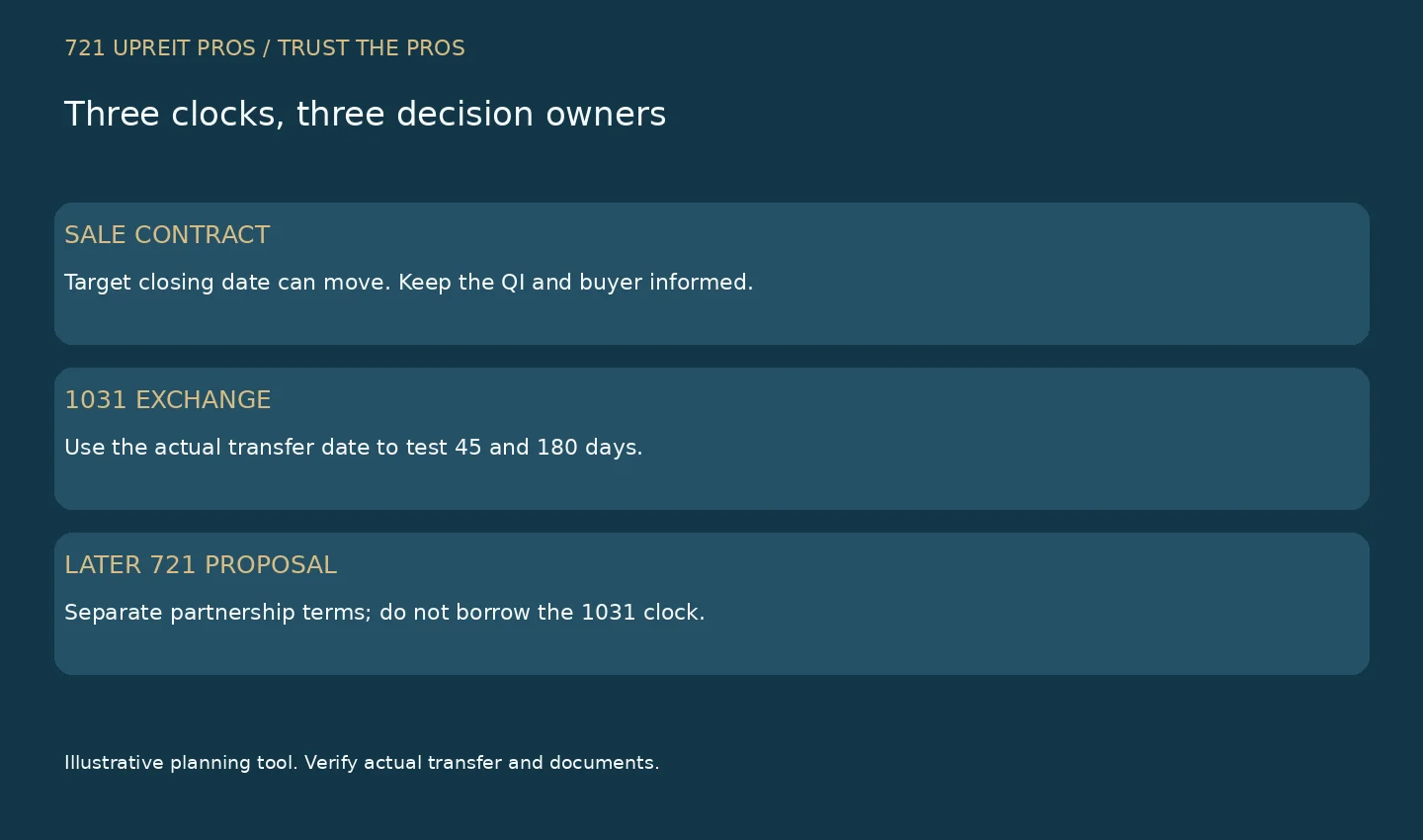
A postponed sale does not start a deferred 1031 exchange clock on the old target date. The identification and exchange periods generally run from the actual transfer of the relinquished property. Reconfirm the qualified intermediary's instructions, DST availability, and tax-return deadline before treating new dates as settled. A direct Section 721 contribution has separate negotiated closing conditions.
By 721 UPREIT Pros · November 16, 2026 · Original closing-date handoff comparison
Key takeaways
- A proposed sale date does not start the deferred 1031 clock; verify the actual transfer.
- Recalculate identification and exchange periods with the QI and CPA after closing moves.
- A DST reservation or later 721 proposal may have separate availability and closing constraints.
- Keep signed amendments, proceeds routing and current offering documents in one handoff file.
A seller may have a signed sale contract, a tentative DST reservation and an advisor's illustration when the buyer asks for ten more days. That change is operationally significant even if it does not itself start the statutory exchange period. Title, lenders, the qualified intermediary (QI), the DST sponsor and the tax preparer may now be using different dates. Put the revised schedule in one shared decision file before assuming the investment path is still feasible.
This article addresses a changed sale closing date before the property is transferred. The broader 721 UPREIT process timeline compares direct contributions with the 1031-to-DST route. The preclosing handoff checklist explains who must receive sale proceeds. A delayed closing after a completed property transfer, or a later proposed DST contribution to a partnership, requires a different analysis.
TALK TO A 721 UPREIT ADVISOR
Talk to a 721 UPREIT advisor
Request a callback to discuss the questions raised by this article, your timing and what to ask before you commit. Share your name, email and phone below to start the conversation.
No investment commitment or financial documents required. A callback request does not book an appointment or establish an advisory relationship.

Which date actually starts the 1031 periods?
For a deferred exchange, the IRS says replacement property must be identified within 45 days after the property given up is transferred. Receipt generally must occur by the earlier of 180 days after that transfer or the due date of the taxpayer's return for the transfer year, including extensions. The date on an unsigned schedule or an earlier purchase contract is not, by itself, the completed transfer date. Have the QI and closing counsel confirm the legal transfer and the applicable calendar in writing. IRS Form 8824 instructions and Publication 544 provide the underlying rules.
Do not assume every delay simply gives you extra time. If the sale moves across a tax year, the return due date may change; if more than one relinquished property is transferred as part of the same transaction on different dates, the IRS says the periods can begin with the earliest transfer. A purported closing delay may also leave a prior deed, beneficial interest or other transfer issue to resolve. The professional team must inspect the actual documents, not only the calendar invitation.
What must change before the postponed sale closes?
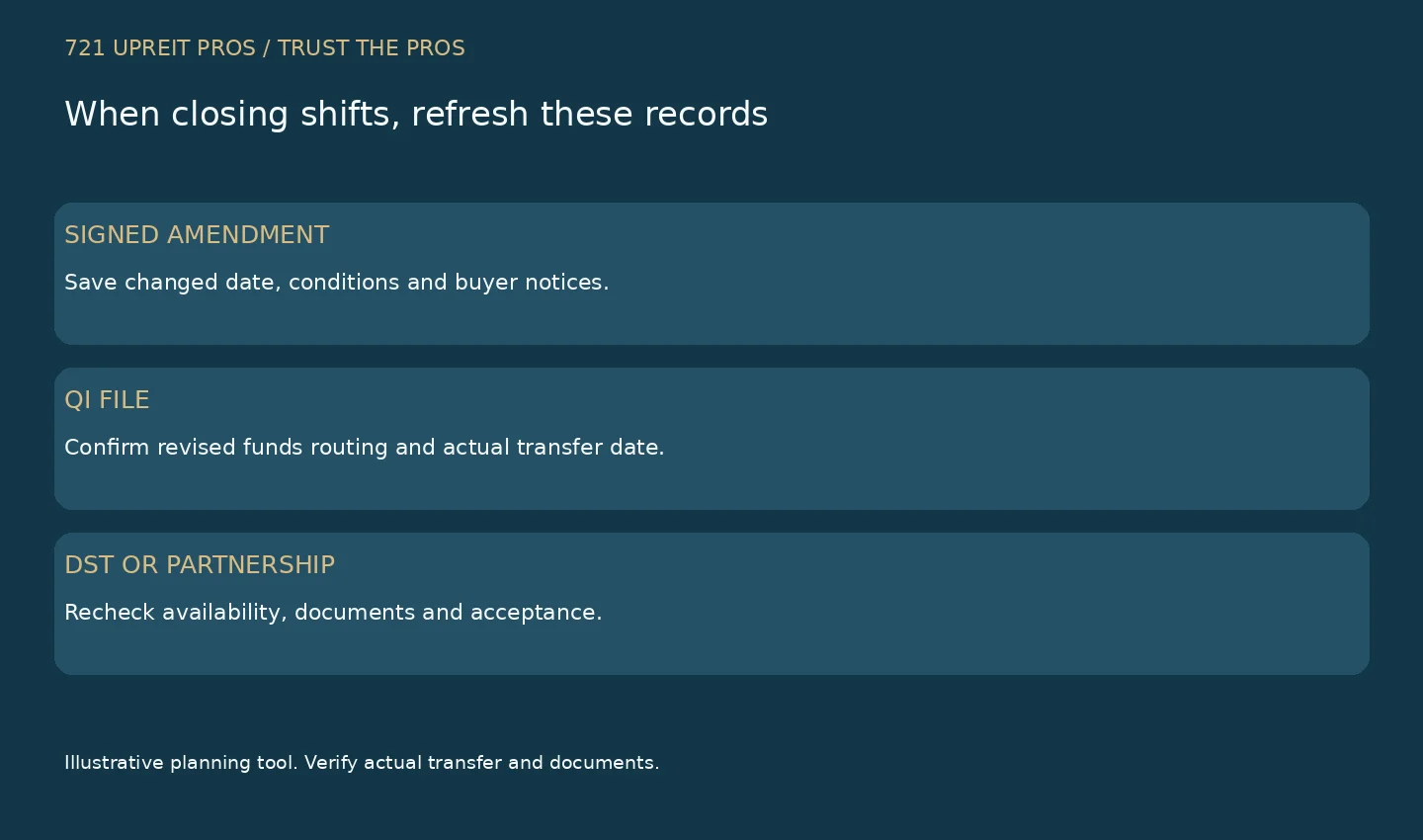
First, obtain the signed sale amendment and updated closing statement draft. Tell the QI the revised date and any changed buyer, escrow or funds-routing terms. Confirm that the exchange agreement and QI instructions will be effective before the relinquished property transfers. A seller taking the proceeds personally may compromise the intended deferred exchange; a last-minute wire change deserves independent confirmation through known contacts.
Second, ask the DST sponsor or selling team whether the identified investment remains available on the revised funding date. An indication of interest or soft reservation is not a completed replacement acquisition. Review current offering documents, minimums, subscription acceptance, financing, closing conditions and any material changes. A DST must qualify on its own terms; a hoped-for future 721 contribution is a separate transaction that may never occur. The DST contribution eligibility guide examines that later decision.
Third, align the tax preparer, QI and advisor on the revised transfer year, estimated gain, debt replacement and potential cash needed outside the exchange. Do not use a stale illustration from the first closing date. The QI can handle the exchange mechanics, while a CPA evaluates the seller's tax circumstances. An advisor can compare the investment choices, but cannot promise IRS treatment or sponsor acceptance.
How would a ten-day delay change the planning file?
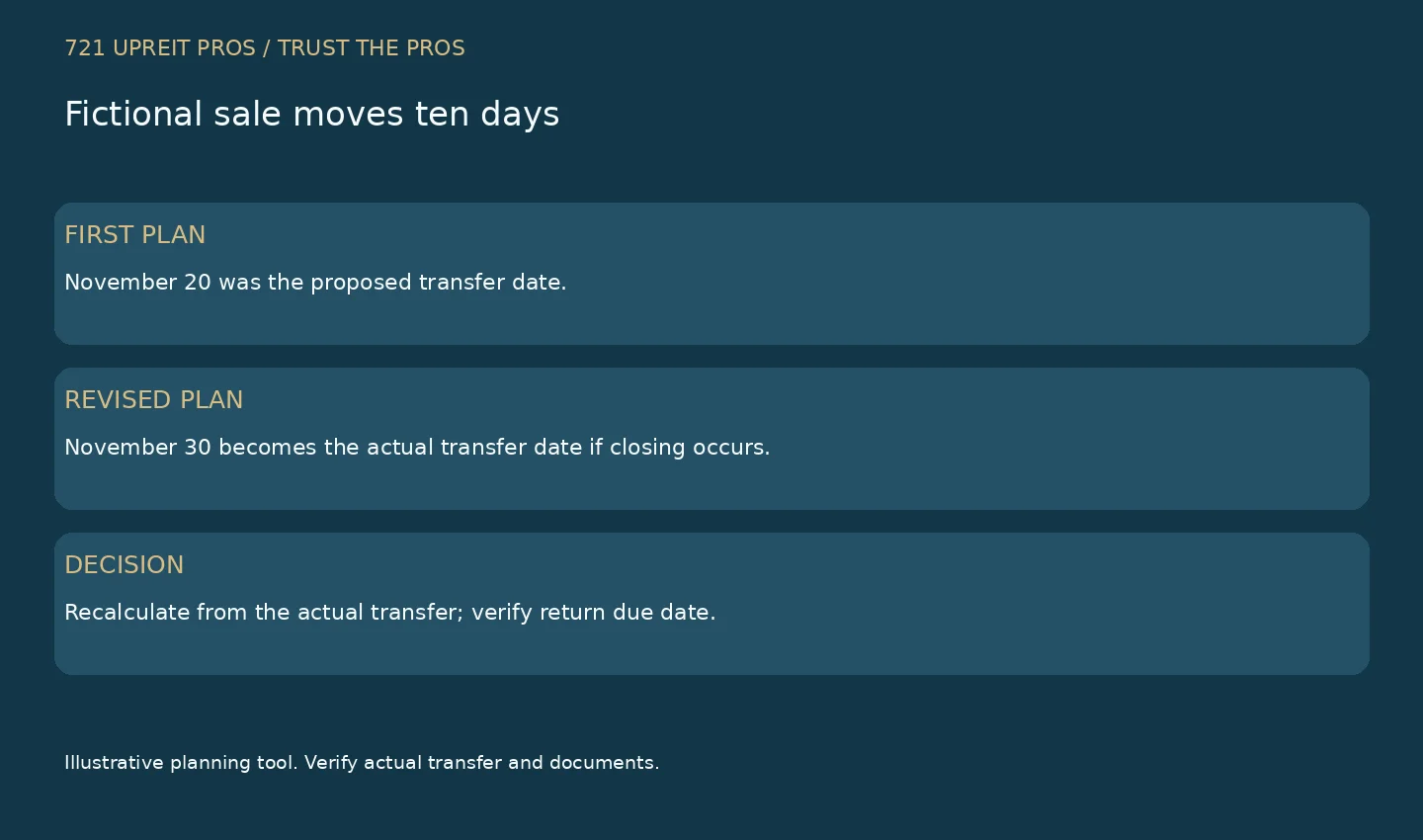
Assume a fictional rental owner planned to transfer a building on November 20, 2026. The buyer then requests November 30. If the actual legal transfer occurs November 30, the team should calculate the identification and exchange periods from November 30 under the applicable rules, while checking the tax-return due-date limit. This article intentionally does not give final calendar dates because the precise transfer, taxpayer return, extensions and any special facts are unverified.
The seller's DST packet is a separate constraint. Suppose the chosen offering had a subscription cutoff on November 25. Moving the sale to November 30 could make that offering unavailable even if the federal 1031 identification period begins later. The advisor must ask for a current written availability response and compare another suitable investment or an entirely different path. This is a decision example, not a claim that any named DST has such a cutoff or that a replacement is available.
| Decision | Earlier file | After delay | Who confirms? |
|---|---|---|---|
| Relinquished transfer | Proposed November 20 | Actual date pending | Closing counsel and QI |
| 1031 periods | Provisional calendar | Recalculate from actual transfer and return due date | QI and CPA |
| DST acquisition | Illustrative reservation | Recheck offering and funding cutoff | Sponsor and advisor |
| Later 721 | Potential scenario | Still conditional, separately documented | Partnership and counsel |
A direct 721 proposal is different. The text of Section 721 addresses a property contribution to a partnership in exchange for a partnership interest; the 1031 identification clock is not its general timeline. The operating partnership still must accept the property and negotiate valuation, debt, diligence, approvals, consideration and closing. If a buyer or partnership changes its dates, obtain an amended written schedule and reassess the economics. Do not call a tentative closing a completed contribution.
What should the owner verify before acting?
- Save the signed amendment, current title report, lender and buyer conditions, and revised closing statement.
- Have closing counsel and the QI confirm whether a transfer has already occurred and the exact date that controls the exchange file.
- Ask the QI and CPA for a dated 45-day and exchange-period calendar, including the return due-date limit and any multi-property issues.
- Confirm QI control of proceeds before closing, using independently verified wire instructions.
- Ask the DST sponsor for current offering and subscription status; review any changed disclosures rather than relying on a reservation.
- Keep any direct or later Section 721 proposal in its own file, with written partnership acceptance and conditions.
The sale date is only one part of suitability. Compare your cash needs, the property you would own, fees, holding period and ability to exit. The written advisor comparison provides a structured four-path discussion. For a separate 1031 question, see DST Experts' pre-exchange questions and the property-sale route comparison. For a property-specific discussion, Talk to a 721 UPREIT advisor.
Watch the date-change decision map
This original one-minute video shows which clocks and handoffs need a new written confirmation.
Read video transcript
0:00 · A closing date moves
Do not use a proposed date as a completed transfer.
0:12 · Separate the clocks
A direct 721 contribution has negotiated dates, not a 1031 clock.
0:24 · Recalculate from transfer
The 1031 identification and exchange periods use actual transfer.
0:36 · Refresh the handoff
QI, buyer, DST and advisor need the same current documents.
0:48 · Check the next action
Confirm funds routing, replacement availability and tax return date.
Download the closing-date handoff
Primary sources checked November 16, 2026: IRS Form 8824 instructions, IRS Publication 544 and Section 721 statutory text. General education only. No sponsor availability, individual tax result or named expert review is represented.
Frequently asked questions
Does the 45-day period start when I sign the sale agreement?
Generally no. IRS guidance measures the deferred exchange identification period from the transfer of the relinquished property. Ask the QI and counsel to confirm the actual transfer date.
Does a ten-day delay always give ten extra exchange days?
Do not assume so. Recalculate from the actual transfer and check the tax-return due-date limit, multi-property facts and signed documents.
Can I keep the same DST reservation?
Only if the current offering and sponsor permit it. Obtain a current written status and review changed terms.
Does the direct 721 contribution follow the 45-day rule?
A standalone Section 721 property contribution does not use the general deferred 1031 identification clock. Its parties and agreements set closing conditions.
What if the seller received the proceeds already?
Tell the QI and tax counsel immediately. A delayed or revised plan cannot simply undo receipt of proceeds or establish a deferred exchange.
Who should receive the amended closing date?
At minimum the closing team, QI, CPA and advisor. A proposed DST sponsor or operating partnership should be told when its offer or diligence timeline may be affected.
TALK TO A 721 UPREIT ADVISOR
Ready to discuss your 721 options?
Request a callback to discuss the questions raised by this article, your timing and what to ask before you commit. Share your name, email and phone below to start the conversation.
No investment commitment or financial documents required. A callback request does not book an appointment or establish an advisory relationship.