
721 UPREIT PROS / PROPERTY-RISK DILIGENCE
721 UPREIT Property Insurance: What Should You Check Before Contributing?
Before contributing property to a 721 UPREIT, compare insurance at the contributed building and the receiving partnership's existing portfolio. Check covered perils, limits, deductibles, exclusions, renewal costs and who bears an uninsured loss. A statement that a portfolio is insured does not show how much cash it could lose or whether distributions would continue after damage.
Prepared by 721 UPREIT Pros · Published November 21, 2026 · General education
Key takeaways
- Compare coverage at both the contributed building and the receiving partnership portfolio.
- Read limits, deductibles, exclusions and business-interruption terms, not only a certificate or marketing summary.
- An insured repair can still leave a deductible, lost cash flow, debt service and claim timing gap.
- Use current policies and dated financial disclosures; the cited SEC filing illustrates risk categories only.
The decision is whether the proposed contribution changes your exposure to casualty loss in a way you understand. A landlord knows the policy and deductible on one building. A partnership interest adds exposure to other assets, portfolio insurance arrangements and management's response to loss. Start with the 721 UPREIT risk framework and the exact current operating-partnership disclosures, not a marketing claim about diversification.
What does “insured” leave unanswered?
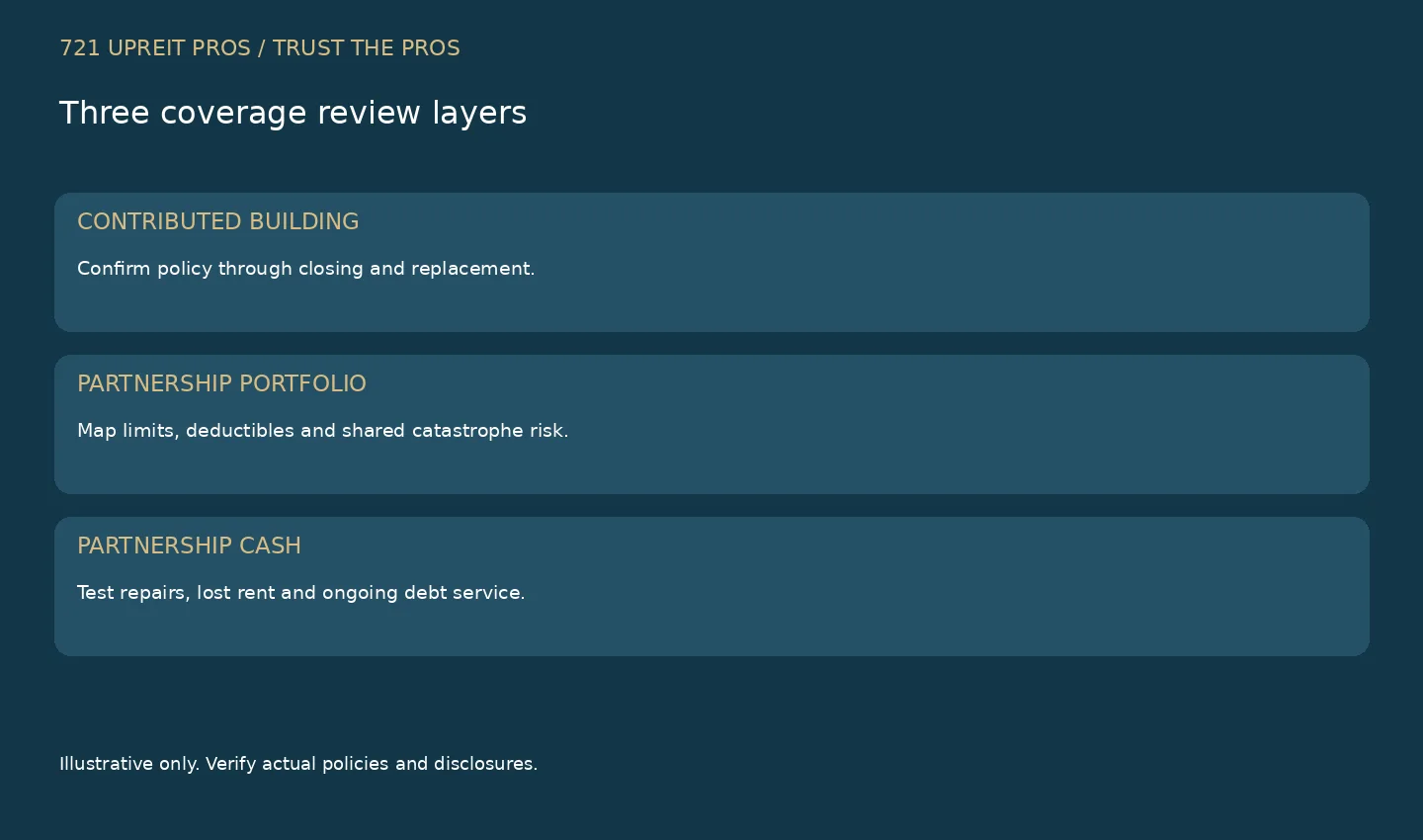
Insurance is a contract for stated risks, parties, limits and periods. Ask whether the contributed building's existing coverage remains effective through closing and when the receiving owner's policy attaches. A certificate can establish certain reported details, but it is not a substitute for the actual policy, endorsements and current exclusions. Confirm the named insured and lender requirements with the parties responsible for closing.
TALK TO A 721 UPREIT ADVISOR
Talk to a 721 UPREIT advisor
Request a callback to discuss the questions raised by this article, your timing and what to ask before you commit. Share your name, email and phone below to start the conversation.
No investment commitment or financial documents required. A callback request does not book an appointment or establish an advisory relationship.
Then ask about the receiving portfolio. Separate property insurance from business-interruption or rental-income coverage, liability coverage and any catastrophe layer. A flood, earthquake, wildfire or wind event may have a different limit, deductible or exclusion from an ordinary fire loss. Ask whether coverage is at a property, portfolio or program level and whether multiple damaged buildings share a limit.
The 2025 Brookfield Real Estate Income Trust Form 10-K, filed March 17, 2026, describes property losses that may be uninsured or exceed policy limits. It discusses natural disasters and the possibility that insurance costs or availability can change. This is a dated example of disclosure categories, not evidence about a candidate property, an insurance quote or today's coverage.
Who absorbs a loss before an insurer pays?
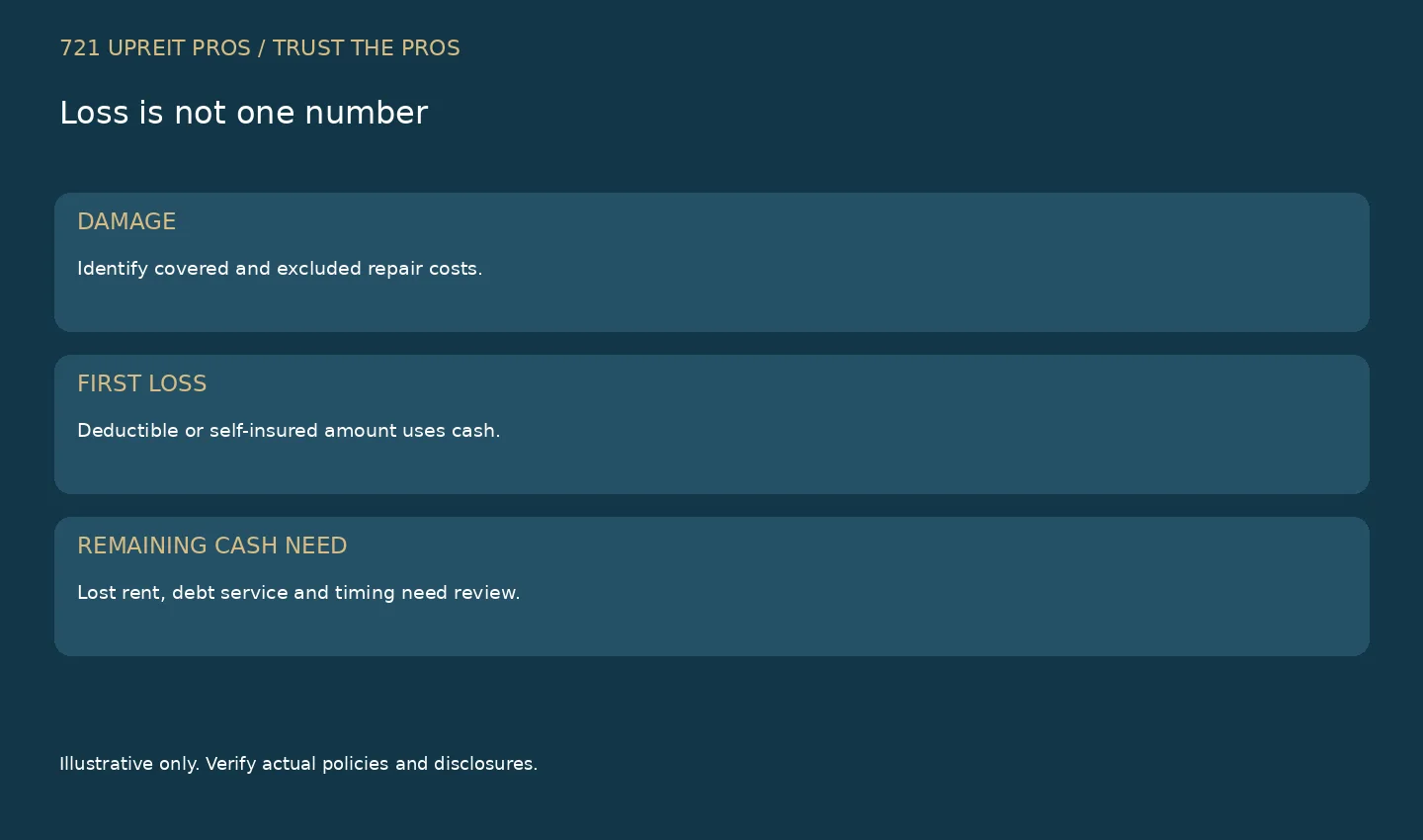
Work from the actual deductible and exclusions rather than the headline limit. A damaged property may first use its own cash, reserves or borrowing to cover a deductible, uninsured repair, temporary relocation or lost rent. The insurer may pay only after conditions and adjustment. A policy limit can cap the payment. The partnership may still owe debt service, taxes and other costs while a building is impaired.
Trace where the cost lands. If a subsidiary owns the damaged building, ask which borrower and legal entity bears each obligation. Check whether the property has recourse debt and whether a loss affects lender covenants. Do not infer that individual investors must write a check; personal funding duties depend on signed agreements. The capital-call review separates an economic shortfall from an actual investor payment obligation.
Also separate an insurance claim from a distribution decision. Management may preserve cash for repairs, debt or reserves even when a claim is expected. A declared distribution depends on the current governing documents and available cash, not merely a policy's existence. The distribution-reduction guide covers the separate step of checking what changed in a payment.
| Question | Document to request | Decision use |
|---|---|---|
| What peril is covered? | Policy, endorsements, exclusions and current renewal | Identify an uncovered event or narrowed coverage. |
| What is the first loss? | Deductible and self-insured retention schedule | Estimate cash needed before insurance pays. |
| What is the ceiling? | Property and catastrophe limits, shared-limit terms | Test a larger or simultaneous loss. |
| What income stops? | Business-interruption terms and lease/rent schedule | Distinguish repair payment from lost operating cash. |
| Who pays ongoing bills? | Debt, reserve and partnership documents | Map debt service, taxes and expenses during recovery. |
This matrix helps frame questions. It cannot price risk without current property schedules, actual policy wording and a credible loss scenario. A broad statement that the portfolio carries “comprehensive” insurance is not a replacement for those records.
How can a covered loss still create a cash gap?
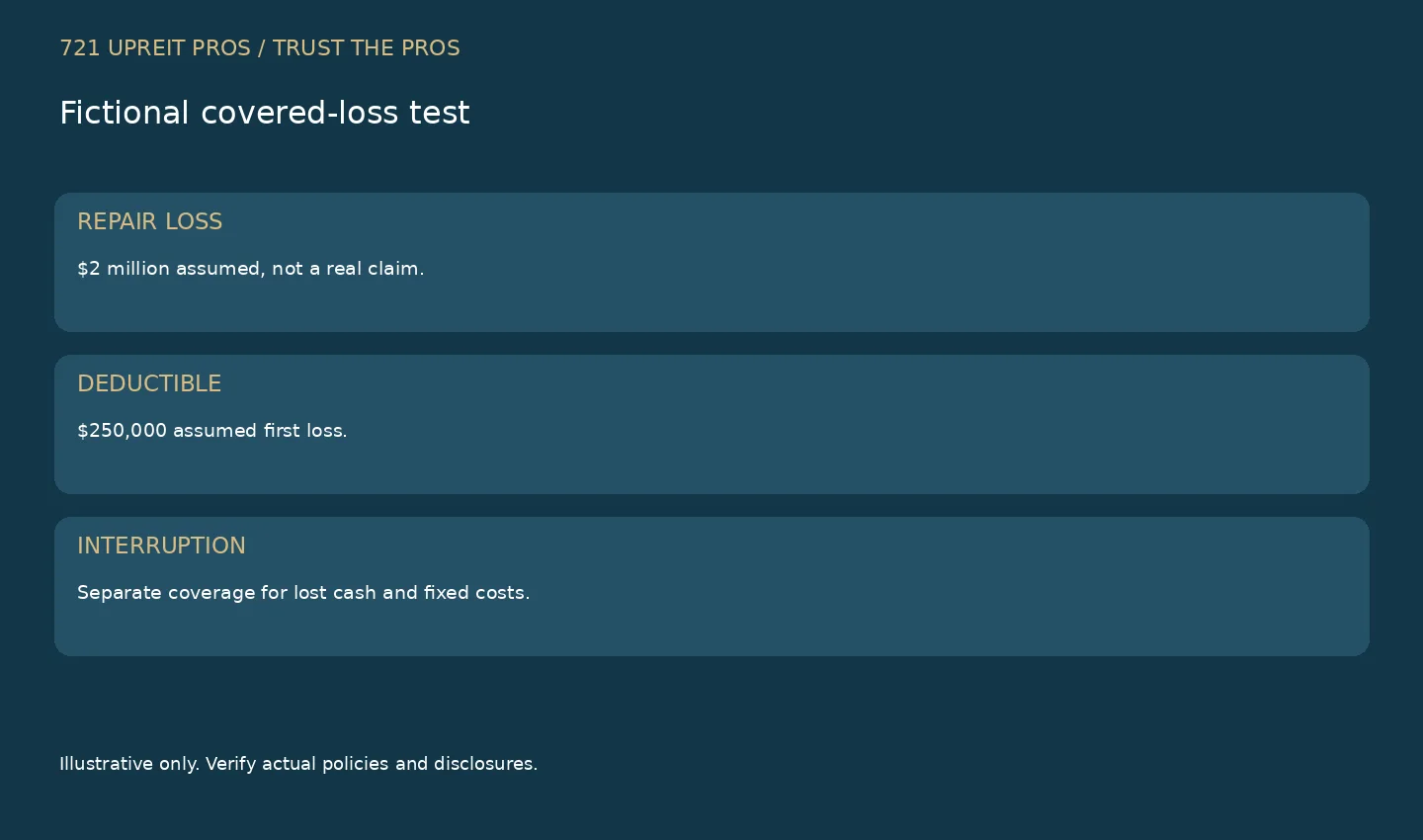
Consider a fictional apartment asset with an illustrative $2 million repair loss. Assume its policy covers the event, has a $250,000 deductible and pays the remaining eligible repair cost within its limit. On those simplified facts, the first $250,000 of repairs remains with the property owner. This is chosen arithmetic, not an insurance quote or an estimate for any 721 program.
Now assume repairs interrupt rental operations for three months. The example has $120,000 of lost net operating cash and $90,000 of debt service and fixed costs during that period. Do not simply add these numbers to the repair amount as if they were all uncovered: a business-interruption policy, reserves, tenant obligations or lender terms may change the result. The investor should request a coverage explanation and dated cash-flow bridge for each item.
Change one fact again: the event is excluded under the actual policy. The potential uninsured repair exposure could be much larger than the deductible, subject to any other coverage, contracts or recoveries. An earthquake, flood or wildfire label does not tell you whether a particular loss is covered. Location, endorsements, definitions and exclusions matter. The example is a question generator, not a forecast of loss, claim payment or investment return.
Which current records should an investor request?
- The exact operating partnership and property-owner entity chart, with the proposed contribution agreement.
- Current property schedule showing material locations and values, dated to the decision.
- Policy declarations, applicable endorsements, exclusions, deductibles, limits and expiration dates.
- A coverage map for flood, earthquake, wildfire, wind and other material local hazards, where relevant.
- Business-interruption terms, cash reserves and debt obligations during repair.
- Recent financial statements and risk disclosures describing insurance expense, material claims and uninsured exposure.
- Written explanation of policy transfer or replacement at contribution closing and who coordinates with lender and broker.
Ask the issuer or property manager which information can be provided and what is unavailable. If a material answer is missing, label it unknown rather than treating it as zero risk. Insurance brokers, counsel and tax advisers have different roles. A financial advisor can help compare the investment with alternatives and your cash needs but should not invent policy terms or certify coverage.
How should insurance affect the 721 decision?
Compare the risk you already bear as a direct owner with the risk in the proposed partnership. More buildings may diversify a single-property casualty, but shared regions, weather exposures or policy limits can still create correlated loss. The portfolio-concentration example shows why counting assets alone is insufficient. Compare insurance evidence alongside debt, fees, governance and the ability to access cash.
If a sale is being planned, coordinate broker, title, lender, CPA and counsel before property closing. A direct property contribution under Section 721 is separate from a qualifying 1031 exchange and any DST purchase. The process guide explains those paths; a proposed DST-to-721 transition is not automatic. For related education see DST Experts' 721 overview and the DST tenant concentration review. To discuss the comparison with an advisor, Talk to a 721 UPREIT advisor.
Watch the casualty-loss review
This original one-minute video maps coverage, deductible, cash-flow interruption and the documents to request. It makes no claim about a specific offering.
Read video transcript
0:00 · What does insured mean?
Check perils, limits, exclusions and dates.
0:12 · Where is the first loss?
Read the deductible and shared limits.
0:24 · What if rent stops?
Separate repairs from interrupted cash flow.
0:36 · Use a dated example
Two million repair, separate first loss.
0:48 · Before signing
Request current policies and financial records.
Sources checked November 21, 2026: Brookfield Real Estate Income Trust's 2025 Form 10-K, filed March 17, 2026, and SEC Investor.gov REIT guidance. Dated filing used only as a disclosure example. General education; no named expert review, current offering, coverage adequacy, tax outcome or distribution result is represented.
Frequently asked questions
Does a 721 UPREIT insure every building against every disaster?
No. Coverage, limits, exclusions and deductibles vary. Review current policies for the exact properties and hazards.
Does a certificate prove a loss will be paid?
No. Obtain the relevant policy and endorsements, then confirm claim conditions and limits with the responsible insurance professional.
Who pays a deductible after a property loss?
Identify the insured owner and applicable reserves or funding plan. Do not infer an individual payment duty without the signed partnership terms.
Is lost rent covered when a building is damaged?
Possibly, subject to business-interruption terms, waiting periods and exclusions. Check the actual policy.
Will distributions continue during repairs?
There is no guarantee. Review the current declaration, cash flow, reserves and governing documents.
Does portfolio diversification eliminate catastrophe risk?
No. Shared regions or policy limits can produce correlated exposure. Compare the dated property schedule and coverage.
TALK TO A 721 UPREIT ADVISOR
Ready to discuss your 721 options?
Request a callback to discuss the questions raised by this article, your timing and what to ask before you commit. Share your name, email and phone below to start the conversation.
No investment commitment or financial documents required. A callback request does not book an appointment or establish an advisory relationship.