
721 UPREIT PROS / REDEMPTION AND TAX PROTECTION
721 UPREIT: Can a partial redemption end tax protection?
A partial redemption can end some tax protections on the operating partnership units you keep if it crosses a threshold in your agreement. Check how the contract counts units, when a disposition becomes effective and which protections end. Separately, have your tax professional estimate the consequences of the redemption itself.
By 721 UPREIT Pros · November 8, 2026 · Original unit-count worksheet
Key takeaways
- Separate the tax estimate for the settlement from any loss of continuing contract rights.
- Find the exact threshold, which units count and whether equality triggers termination.
- Check the clause for each obligation, including property restrictions and debt provisions.
- Get a reconciled unit history and two settlement scenarios before relying on the expected cash.
Before submitting a redemption request, ask for two answers in writing. Ask the partnership administrator to reconcile your covered units before and after the proposed settlement. Ask your attorney to explain which obligations would survive under your signed agreement. A current account balance may include units the agreement does not count.
The practical decision is whether the amount of cash you want is worth any loss of protection on what remains. A smaller request may preserve an obligation under one contract, cross the line under another, or make no difference if the applicable period has already expired. Keep a funding option that does not rely on uncertain redemption proceeds.
TALK TO A 721 UPREIT ADVISOR
Talk to a 721 UPREIT advisor
Request a callback to discuss the questions raised by this article, your timing and what to ask before you commit. Share your name, email and phone below to start the conversation.
No investment commitment or financial documents required. A callback request does not book an appointment or establish an advisory relationship.

Which two events should you evaluate separately?
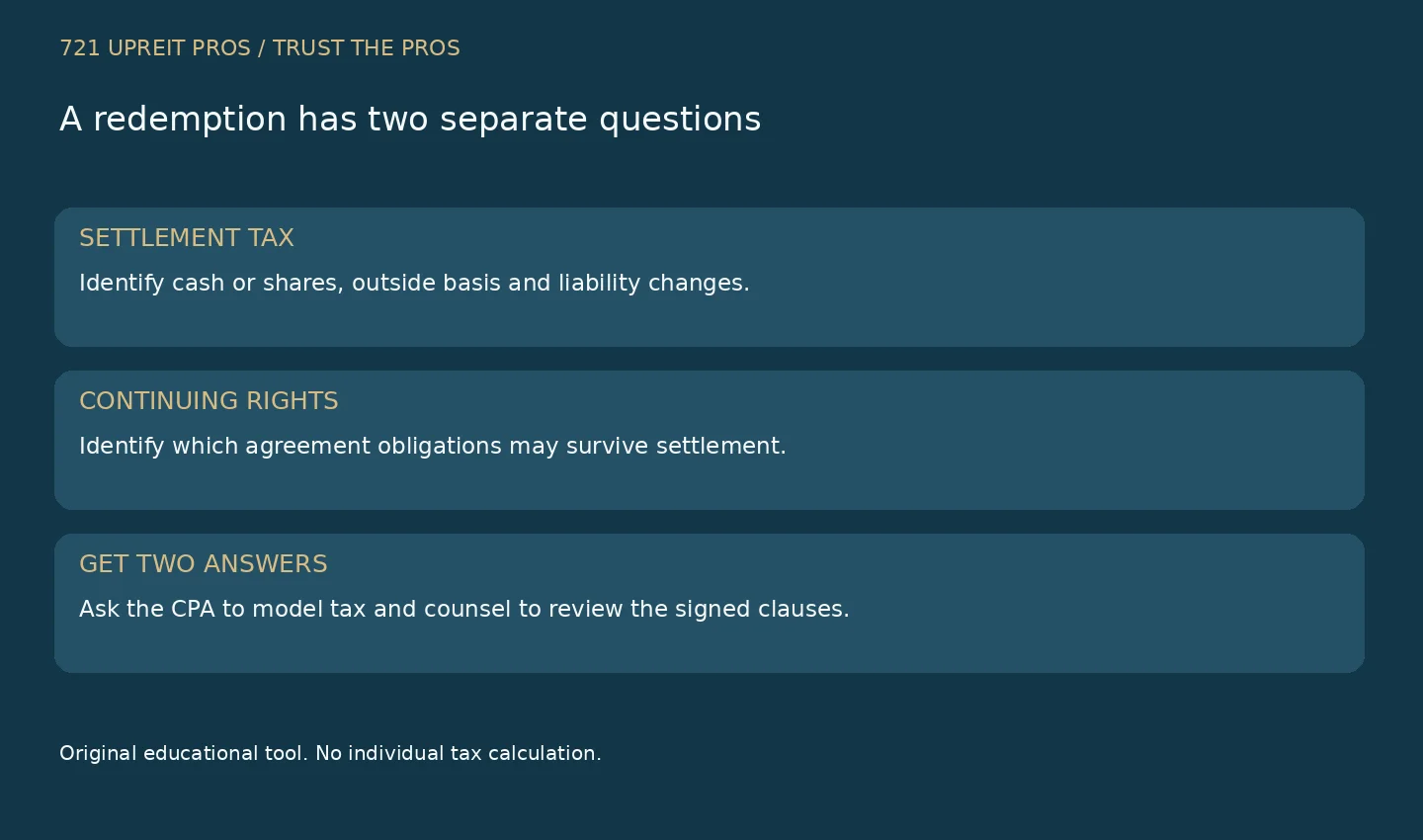
Your redemption: Identify who will acquire or cancel the units, whether you expect cash or REIT shares, and whether partnership liabilities allocated to you may change. The tax analysis depends on how the settlement is structured, your adjusted basis and other facts. IRS Publication 541 discusses distributions and sales of partnership interests separately. Ask your CPA to model the actual settlement and reporting instead of applying a single tax rule to any transaction called a redemption.
What happens after you redeem: A tax protection agreement may restrict a later disposition of contributed property, prescribe liability allocation procedures, or provide another remedy for defined events. Ask which obligations still apply to you after the redemption. Losing protection against a future event is different from recognizing gain now. Keeping a contractual right does not determine the tax result of the units you redeem.
If you are still planning a sale, the sequence matters. A Section 1031 exchange into qualifying replacement real estate, potentially through a properly structured Delaware statutory trust (DST), is separate from a possible later Section 721 property contribution. Neither route establishes that you will receive contractual tax protection. The 721 UPREIT investor guide and this comparison of DST and UPREIT ownership after a property sale explain that earlier decision.
How can filed agreements handle the threshold differently?
The two SEC exhibits below are transaction-specific forms. They illustrate how to read a clause. Neither establishes current availability, how any transaction ultimately closed, or the terms of your signed agreement.
| Filed example | What to notice | What to check in your own agreement |
|---|---|---|
| 2026 Sachem Capital and IRG contribution exhibit | The form ends a holder's restriction period at the earlier of the tenth contribution anniversary or disposal of at least half the protected units originally held. The definition expressly includes redemptions. The restriction period appears in both the property disposition and debt articles. | Read the definition with Articles II and III and their exceptions. Confirm which units the final signed version counts and whether a specific obligation depends on that period. |
| 2012 Empire State Realty Trust form | The definition treats the Article II property disposition periods and Article III obligations separately. Its retained ownership test refers to Article III and can count specified OP units and REIT shares. | Find the exact article affected. A threshold tied to debt or guarantee provisions does not by itself show that protection against a property disposition has ended. |
Read the defined term alongside the obligation and remedy, then trace any notice, consent, exception or amendment that changes the answer. Do not substitute the issuer's normal redemption policy for the signed tax protection agreement. Use the broader tax protection coverage worksheet if you have not identified the protected holder, property and event yet.
What happens one unit either side of the line?
Suppose a fictional investor originally received 10,000 protected units and previously redeemed 3,500 of them. The remaining 6,500 are eligible units. The example assumes no qualifying transfers, no additional units, no prior expiry and that each new request shown is accepted and settled in full. The table compares two invented thresholds for the same obligation. It does not calculate tax or identify an available redemption amount.
| Additional units settled | Cumulative units disposed | Units retained | Ends at 50% or more disposed | Ends below 50% retained |
|---|---|---|---|---|
| 1,499 | 4,999 | 5,001 | No | No |
| 1,500 | 5,000 | 5,000 | Yes | No |
| 1,501 | 5,001 | 4,999 | Yes | Yes |
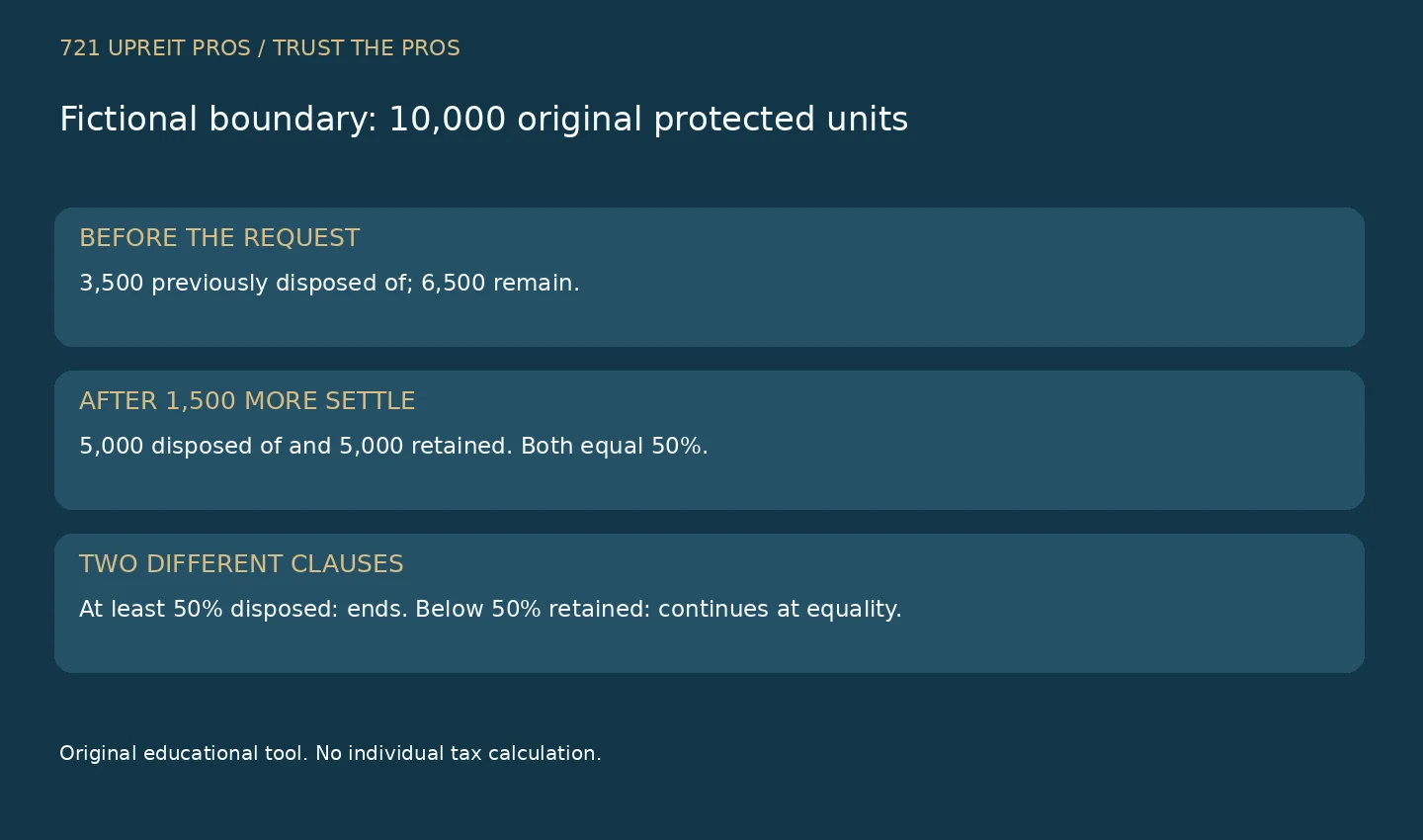
The difference at exactly 5,000 units is the point of the exercise. If the baseline is original protected units, do not reset it to the balance right before your latest request. If you also bought units later, ask whether they enter the calculation and how records identify the units being redeemed. Do not assume you can select the lot you prefer.
If the administrator expects a smaller settlement than requested, ask when and how you can confirm the actual quantity and effective date, and whether another settlement may follow. A pending request, confirmed settlement and effective disposition can be different steps. The redemption request checklist addresses availability, pricing and timing. If a distribution is due near settlement, use the separate distribution cutoff example.
What should you verify before authorizing a request?
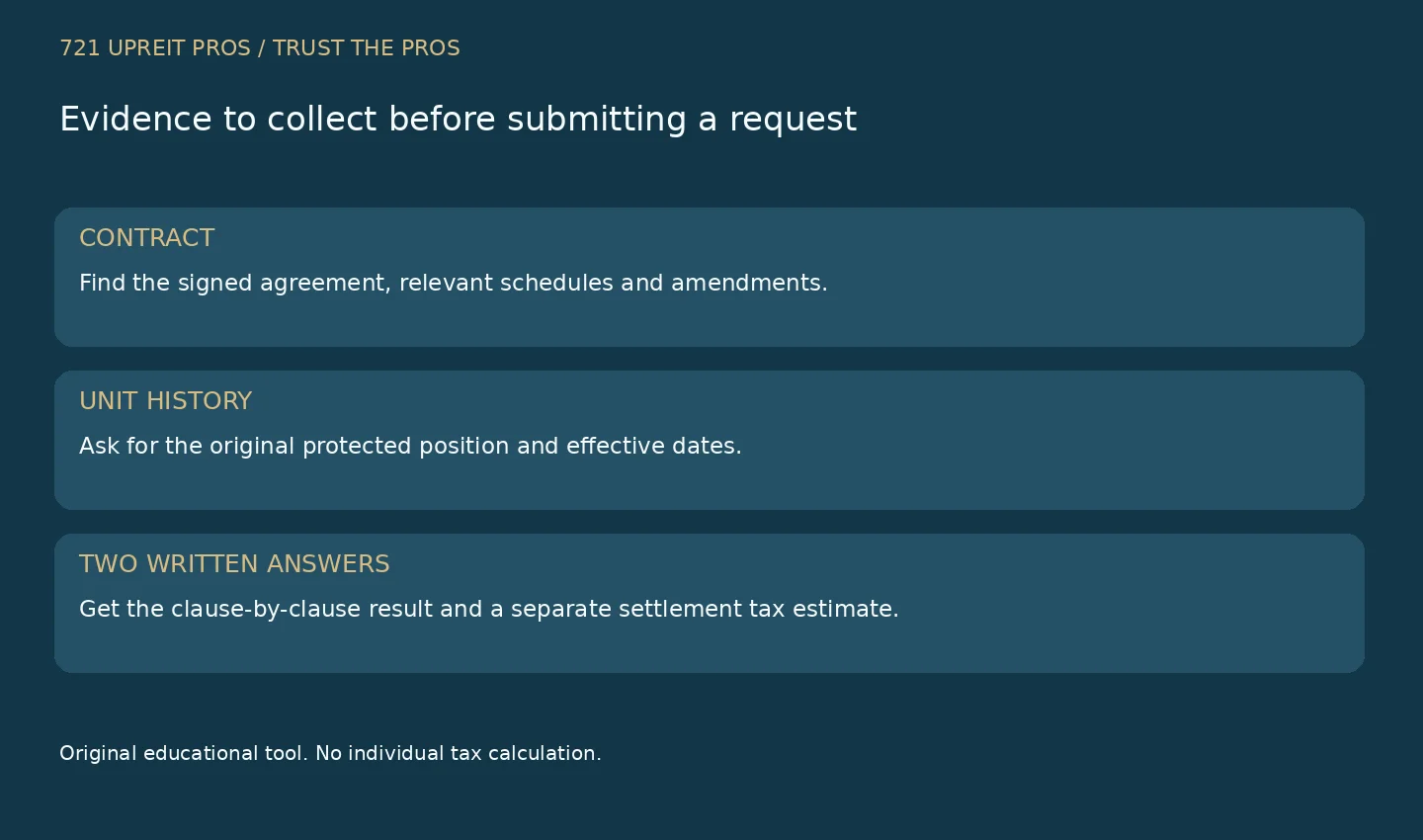
- Get the controlling documents: request the executed tax protection agreement, schedules, applicable amendments and the current partnership agreement. Identify the legal holder and applicable unit classes.
- Ask for a reconciled count: request the original protected position, current eligible position and dated history of prior transactions. Identify any permitted dispositions or countable REIT shares with a clause reference.
- Ask for two settlement scenarios: model the requested amount and a smaller possible fill. Identify the effective date under each relevant document, and the rules on changes or withdrawals before settlement.
- Confirm the impact obligation by obligation: record whether property disposition restrictions, debt provisions or notice rights continue, who confirms the decision, and what evidence you should retain.
- Estimate taxes and plan cash separately: ask your CPA to review the expected consideration, adjusted basis and liability changes. Compare net cash with the actual need and keep a backup for delays or a reduced fill.
See the broader 721 UPREIT risk review and an overview of OP unit liquidity and control risks if you are still weighing an exit. To discuss the investment decision and the records to gather, Talk to a 721 UPREIT advisor or request a callback. Share sensitive records only through an agreed secure channel.
Watch: test the threshold before you redeem
This one-minute visual walkthrough separates the unit count from the tax calculation and shows why equality matters.
Read video transcript
0:00 · Check rights before you redeem
A partial redemption may end an obligation on the units you keep.
0:12 · Separate two decisions
Estimate tax on this settlement. Review remaining contract rights.
0:24 · Count against original units
Fictional: 3,500 plus 1,500 equals 5,000 out of 10,000.
0:36 · Equality can change the answer
At least half disposed: ends. Below half retained: continues at half.
0:48 · Confirm before requesting
Get the signed clause, unit history and a separate tax estimate.
Download the unit-count worksheet
Filed examples and IRS guidance checked November 8, 2026. This is educational material from 721 UPREIT Pros. No independent expert review is represented.
Frequently asked questions
Does a 50% rule apply to every 721 UPREIT?
No. Review the executed agreement to see whether there is a threshold at all and what that threshold governs.
What if my statement includes units I bought later?
Ask the administrator to identify which units belong in the contractual count. An aggregate position may not show the original protected units or the applicable lot rules.
Does taking REIT shares always preserve the count?
No. Some definitions count particular REIT shares; others use different ownership or disposition language. Verify how your signed clause treats the specific settlement.
If I cross the line, do I immediately owe tax on the units I still hold?
Ending a contractual obligation and recognizing tax gain are separate questions. Have your CPA check the actual settlement, liability changes and other events.
Can I restore rights by buying more units later?
Do not assume a terminated right revives. Ask counsel to check whether the agreement provides any reinstatement or amendment mechanism.
Can I split the request across dates to stay below the threshold?
A cumulative test can count earlier transactions. Model the combined effect and confirm the applicable dates rather than assuming each request resets the count.
TALK TO A 721 UPREIT ADVISOR
Ready to discuss your 721 options?
Request a callback to discuss the questions raised by this article, your timing and what to ask before you commit. Share your name, email and phone below to start the conversation.
No investment commitment or financial documents required. A callback request does not book an appointment or establish an advisory relationship.