
721 UPREIT PROS / DISTRIBUTION TIMING
721 UPREIT: Who Gets the Final OP Unit Distribution?
To determine whether you receive a final 721 UPREIT operating partnership distribution, compare the distribution record date with the effective redemption and the unit balance the administrator recognizes on that date. The day you request redemption or see cash arrive may be different. Verify the agreement and the actual declaration before budgeting either payment.
By 721 UPREIT Pros · Published November 7, 2026
Key takeaways
- Find the distribution record date and the effective redemption in separate records.
- Use the units actually counted on the cutoff, including any remainder after a partial redemption.
- Track OP distributions, redemption proceeds and REIT dividends on separate lines.
- Confirm adjustments and tax reporting before budgeting the cash.
Start with the payment you are trying to reconcile. The last operating partnership distribution, proceeds from redeemed units and a later dividend on REIT shares can come from different entities or records. If one is missing or smaller than expected, use the documents to determine whether it was owed, delayed, reinvested or never included in the calculation.
This guide isolates the ownership cutoff. The distribution cash flow worksheet covers how to turn a declared amount into a cash estimate. The redemption checklist covers how to track the request itself. Use both as needed, then connect them through the dated unit ledger and applicable distribution notice.
TALK TO A 721 UPREIT ADVISOR
Talk to a 721 UPREIT advisor
Request a callback to discuss the questions raised by this article, your timing and what to ask before you commit. Share your name, email and phone below to start the conversation.
No investment commitment or financial documents required. A callback request does not book an appointment or establish an advisory relationship.

Which dates belong on the same timeline?
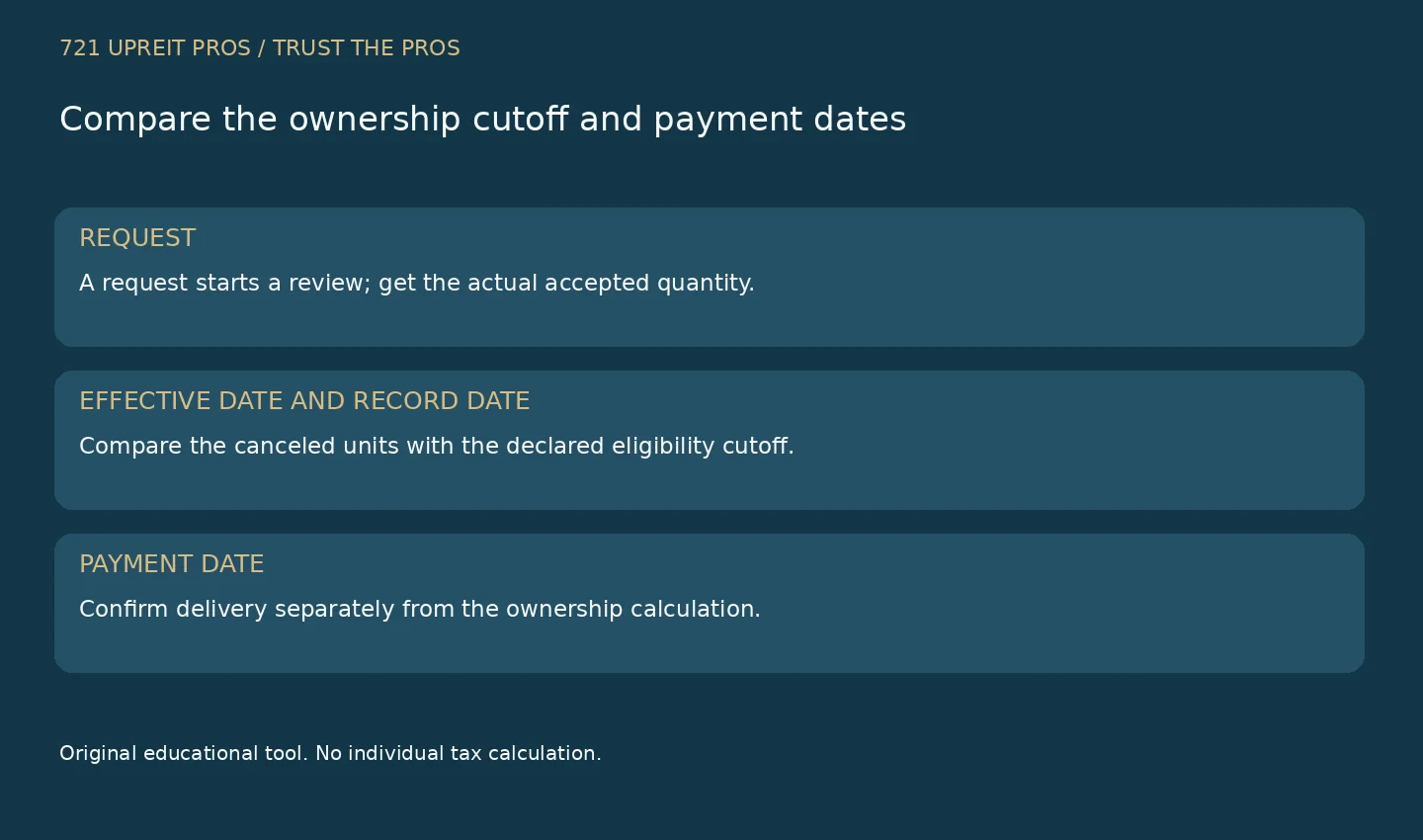
Write down the request date, the date the redemption takes effect, the distribution record date and each expected payment date. The request can start a review while units remain outstanding. A payment date tells you when money is scheduled to move. A record date identifies which holders qualify under a particular declaration and the governing terms. If two dates fall on the same day, ask which cutoff time or order of events controls.
The November 6, 2026 Blue Owl NLT Operating Partnership agreement provides a documented example. Section 5.2 uses the partnership record date to identify eligible partners and their unit positions for a cash distribution, with class-specific terms. Section 8.5 separately describes the redemption procedure and specified redemption date. Those clauses illustrate why the two dates must be read together. They do not establish a universal payment rule or a declared amount for any holder.
Get the current agreement and amendments for your exact units, plus the issuer’s distribution declaration and written settlement confirmation. A calendar from a sales presentation can help you ask questions, but it cannot establish that a distribution was declared or that a request was accepted in full. If your program specifies a special adjustment, class rule or side agreement, ask the administrator to show where it enters the reconciliation.
How can a partial redemption change the last payment?
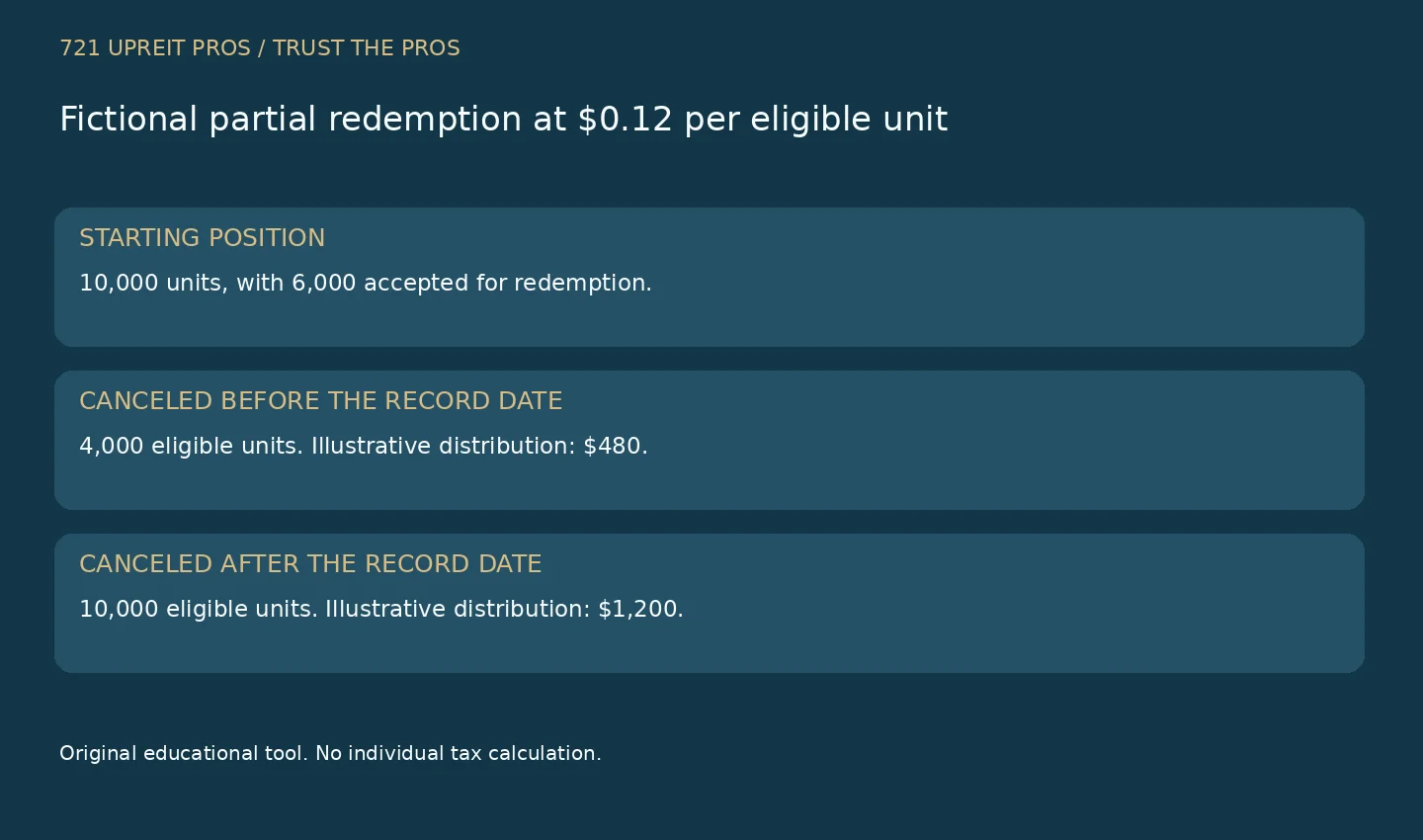
Consider a fictional holder of 10,000 units who requests redemption of 6,000. Assume the partnership has declared $0.12 per eligible unit and the governing rule counts units on the record date. The administrator accepts all 6,000 requested units, cancels them on the effective date and records the remainder correctly. Assume cash payments, no separate adjustment and no withholding. The example does not estimate a real investment’s return.
| Effective redemption | Eligible units on record date | Illustrative distribution |
|---|---|---|
| Before record date | 4,000 | $480 |
| After record date | 10,000 | $1,200 |
The $720 difference represents 6,000 units times $0.12 under the assumed rule. In the second scenario, a distribution payment can arrive after the units have been canceled because eligibility was measured earlier. In the first, only the remaining units count. Neither scenario calculates the proceeds from the 6,000 redeemed units. If the request is only partly accepted, replace the requested quantity with the units actually canceled by the cutoff.
Do not turn this comparison into advice to delay or accelerate a request. A later redemption could change valuation, proceeds, available liquidity and tax timing. An extra distribution, if actually earned, is just one entry in the comparison. Ask for estimates under each date using the actual contract, and consider the effect of a delay on expenses you must cover.
What changes if you receive REIT shares?
Keep a second line for the REIT share class. Ask when those shares were issued or registered to you and compare that evidence with the REIT’s own dividend notice. Even if one program aligns the partnership and REIT record dates, confirm each issuer’s cutoff and your status for that payment. A share delivery notice is not itself a dividend declaration. For the separate decision about eligibility to receive shares, see the share ownership limit review.
Separate cash reconciliation from tax reporting. IRS Publication 541 discusses partnership distributions and basis, and distinguishes distributions from a partner’s distributive share of income or loss. Give the preparer the actual unit settlement, distribution statements and any later share dividend records. Do not infer the taxable amount, basis adjustment or tax year solely from what arrived in your bank account.
How should you reconcile a missing or unexpected payment?
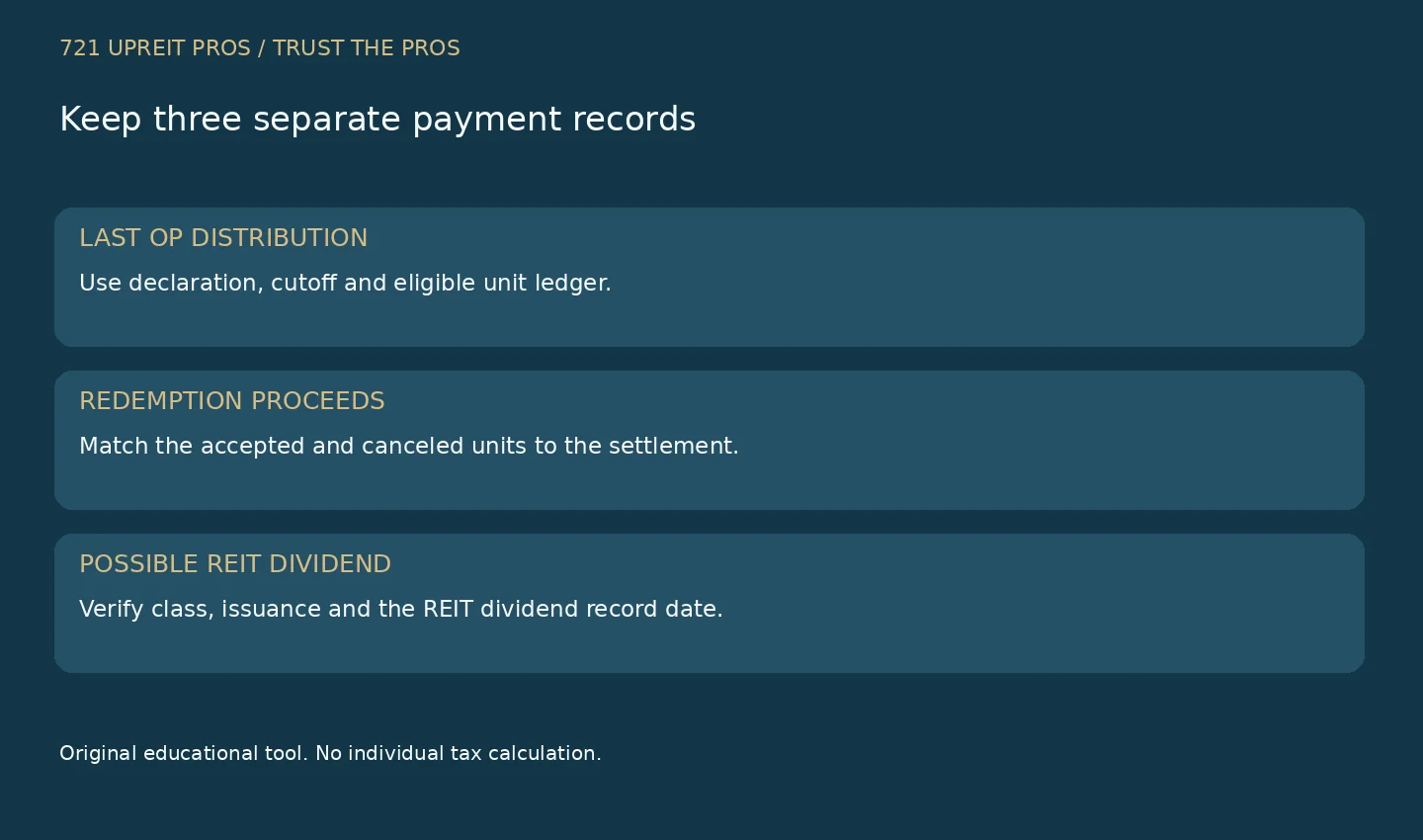
Use separate rows for the last OP distribution, redemption proceeds and any REIT dividend. For each, enter the source document, issuer, counted units or shares, relevant cutoff, gross amount, documented deductions or reinvestment and expected delivery. Match the actual payment against that row. If a settlement statement lists an adjustment for a distribution, ask what it covers before adding the same amount again as separate income.
Ask the administrator to identify the recorded unit count and the rule used if the numbers do not agree. Get a written answer before treating the amount as available spending money. Keep a reserve plan for bills due before a payment is confirmed. The main 721 UPREIT investor guide, rental and DST cash flow comparison and review of liquidity and control risks provide context for comparing income at different investment stages.
For example, if you expected $1,200 but received $480, do not immediately label the $720 difference a cut in the distribution rate. First compare the per-unit amount in the declaration with the per-unit amount used on the statement. If both are $0.12, ask why the counted units changed. If the unit counts match, look for a different class rate, a deduction or reinvestment. If the statement still shows the full amount but the cash did not arrive, compare the settlement status and delivery instructions. These are different issues, and each needs a different document. A clear reconciliation also helps an advisor decide whether the discrepancy is an administrative question or a change in the household’s ongoing income estimate.
- Obtain the actual declaration and record date.
- Confirm how many units were canceled and when.
- Match each expected payment to its issuer and statement.
- Resolve any proration, reinvestment, withholding or settlement adjustment.
- Review taxes and reserve needs independently.
Talk to a 721 UPREIT advisor about the records to request, or request a callback. Use a secure channel for private statements.
Watch the one-minute cutoff review
This original silent video includes English captions and a full transcript of the on-screen text.
Read video transcript
0:00 · Who gets the final distribution?
Compare the actual unit ledger with the declared record date.
0:12 · Separate four dates
Request, effective redemption, distribution cutoff and payment.
0:24 · Compare the fictional cases
Before cutoff: $480. After cutoff: $1,200.
0:36 · Keep separate records
OP distribution, redemption proceeds and REIT dividend.
0:48 · Confirm before budgeting
Resolve adjustments and review tax reporting separately.
Download the final distribution reconciliation checklist
Primary sources checked November 7, 2026. No individual determination or independent expert review is established. Investments may lose value and remain illiquid. Distributions, liquidity and tax outcomes are not guaranteed.
Frequently asked questions
Does submitting a request end distribution eligibility?
A request alone does not show when units were canceled. Compare the actual redemption confirmation with the record date and controlling terms.
Can a final payment arrive after my units are canceled?
It can if the applicable cutoff was earlier and those units were eligible. Verify the declaration, ledger and delivery details.
What if the administrator accepts fewer units than I requested?
Use the actual canceled quantity and remaining units at the cutoff, subject to the governing rule. The requested quantity is not the final ledger.
Will I receive a prorated amount for part of a month?
Do not assume proration. Ask whether the agreement or declaration specifies a record date, proration or another calculation.
Is a REIT dividend included in the OP distribution?
Treat it as a separate issuer and security. Verify the dividend declaration, share class and eligible position.
Does a smaller final payment prove the distribution rate was cut?
No. Compare the eligible quantity, class amount, withholding and reinvestment before attributing the change to the rate.
TALK TO A 721 UPREIT ADVISOR
Ready to discuss your 721 options?
Request a callback to discuss the questions raised by this article, your timing and what to ask before you commit. Share your name, email and phone below to start the conversation.
No investment commitment or financial documents required. A callback request does not book an appointment or establish an advisory relationship.