
721 UPREIT PROS / BORROWING AND LIQUIDITY
721 UPREIT Borrowing: Can OP Units Be Pledged as Collateral?
You cannot assume 721 UPREIT OP units can secure a personal loan. The partnership documents may restrict pledges, a lender may reject the units, and an approved lien may complicate redemption. Before relying on borrowing, obtain the necessary written permissions, actual loan terms and an independent repayment plan.
Key takeaways
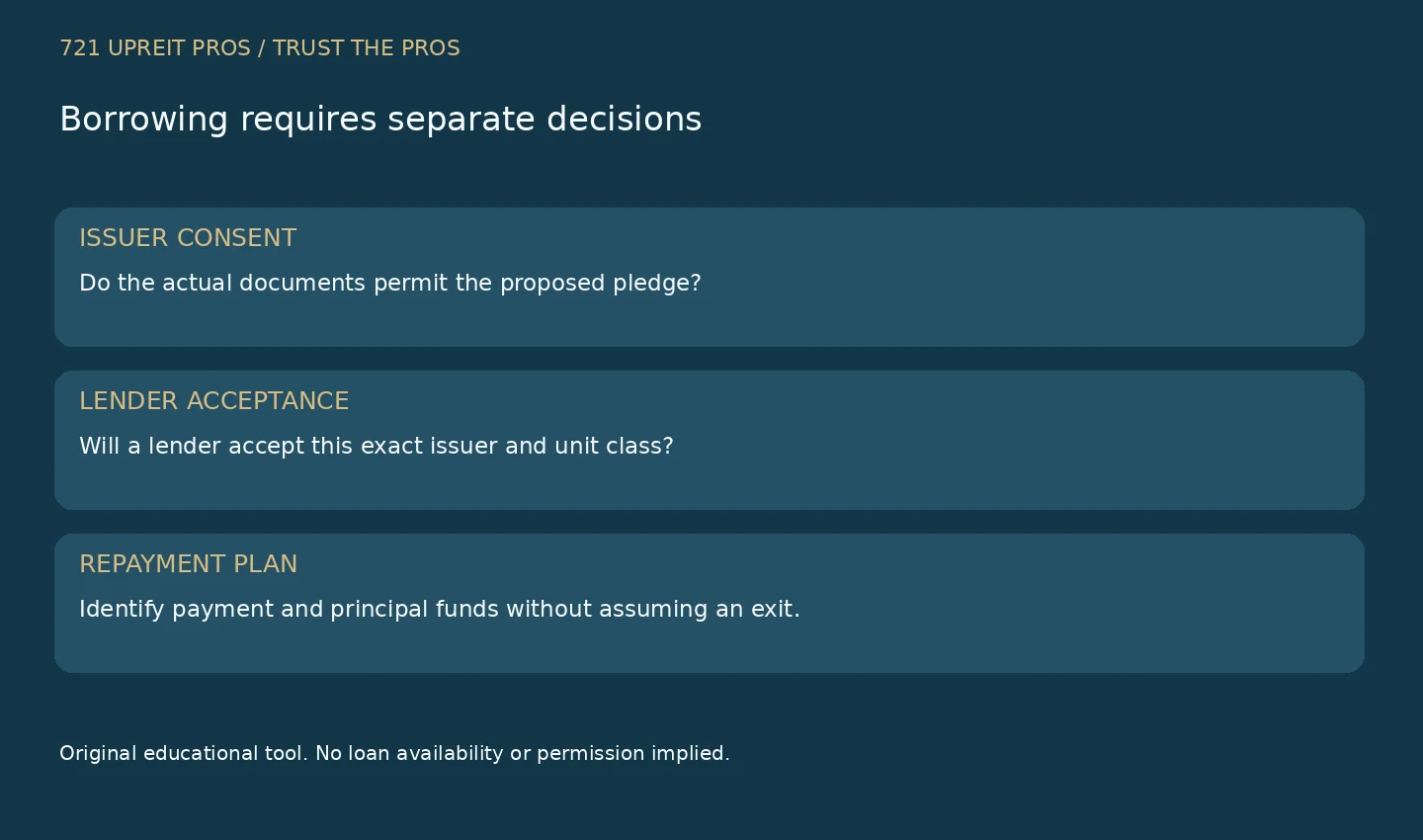
- Issuer permission, lender acceptance and household affordability require separate evidence.
- A reported unit value is not an available borrowing limit.
- Test interest and principal repayment without assuming investment distributions or redemption.
- Resolve lien-release and tax questions before relying on a loan.
An existing OP-unit owner facing a cash need has a financing question as well as an investment question. Borrowing does not itself turn the holding into readily spendable cash. Identify the amount, deadline and repayment source before treating a possible loan as part of the household's available reserves.
This guide provides an evidence matrix and a fictional payment stress test. It does not identify an available lender, quote an advance rate or determine whether your units can legally be pledged. The 721 UPREIT risk review supplies the broader due-diligence context; the redemption request checklist remains the primary resource for the request-to-payment process.
TALK TO A 721 UPREIT ADVISOR
Talk to a 721 UPREIT advisor
Request a callback to discuss the questions raised by this article, your timing and what to ask before you commit. Share your name, email and phone below to start the conversation.
No investment commitment or financial documents required. A callback request does not book an appointment or establish an advisory relationship.

Does permission to own units include permission to pledge them?
Start with the current partnership agreement, amendments, unit-class terms and any separate agreement affecting your holding. Ask counsel whether a pledge, assignment of distributions or lender enforcement falls within the transfer restrictions. An investor-service conversation is useful, but it should not substitute for the required decision from the party authorized by the documents.
A dated example illustrates the issue. The HGIT Properties LP agreement dated January 5, 2026, Section 9.2(a), includes pledges within its consent-based transfer restrictions, subject to its stated exceptions. It gives the general partner discretion and addresses unauthorized transfers and costs. This illustrates a possible restriction, not current permission for your holding or a universal UPREIT rule.
Keep four questions separate: may the interest be pledged, who must approve, what precisely does approval cover, and what happens after default? Have counsel explain the applicable law as well as the contracts. Do not sign on the assumption that a generic financing form overrides an issuer restriction or automatically permits a lender to become a partner.
What evidence belongs in a collateral-borrowing review?
| Decision | Evidence to obtain | Unresolved assumption |
|---|---|---|
| Issuer permission | Applicable clauses and required written consent | Ownership alone authorizes a pledge |
| Lender acceptance | Written acceptance of the exact issuer and unit class | A statement value equals an available credit limit |
| Loan obligations | Rate, maturity, fees, covenants and recourse terms | Distributions will always cover payments |
| Enforcement | Counsel's explanation of default and transfer conditions | The lender can sell restricted units immediately |
| Release and exit | Payoff, release and issuer-processing requirements | A pending redemption automatically clears a lien |
Record the document version, responsible party, answer and open condition beside each row. A preliminary expression of interest is different from final loan approval. An issuer consent is different from a lender commitment. Keep both separate from the tax review and from the household decision about whether taking on debt is sensible.
Does a securities-backed credit line establish that OP units qualify?
No. The SEC's investor alert on securities-backed lines of credit describes borrowing risks, including changing collateral requirements, repayment demands and potential liquidation. It discusses eligible securities and lender-specific underwriting. It does not establish that your restricted OP units are acceptable collateral. Do not apply a generic stock-account advance percentage to an OP-unit statement.
Ask a prospective lender to identify the exact asset it would accept, how it would determine lendable value and whether that value can change. Request the actual payment and default provisions. A conversation about loans secured by liquid brokerage assets should not be represented as a completed financing arrangement for an illiquid partnership interest.
What does a fictional repayment stress test reveal?
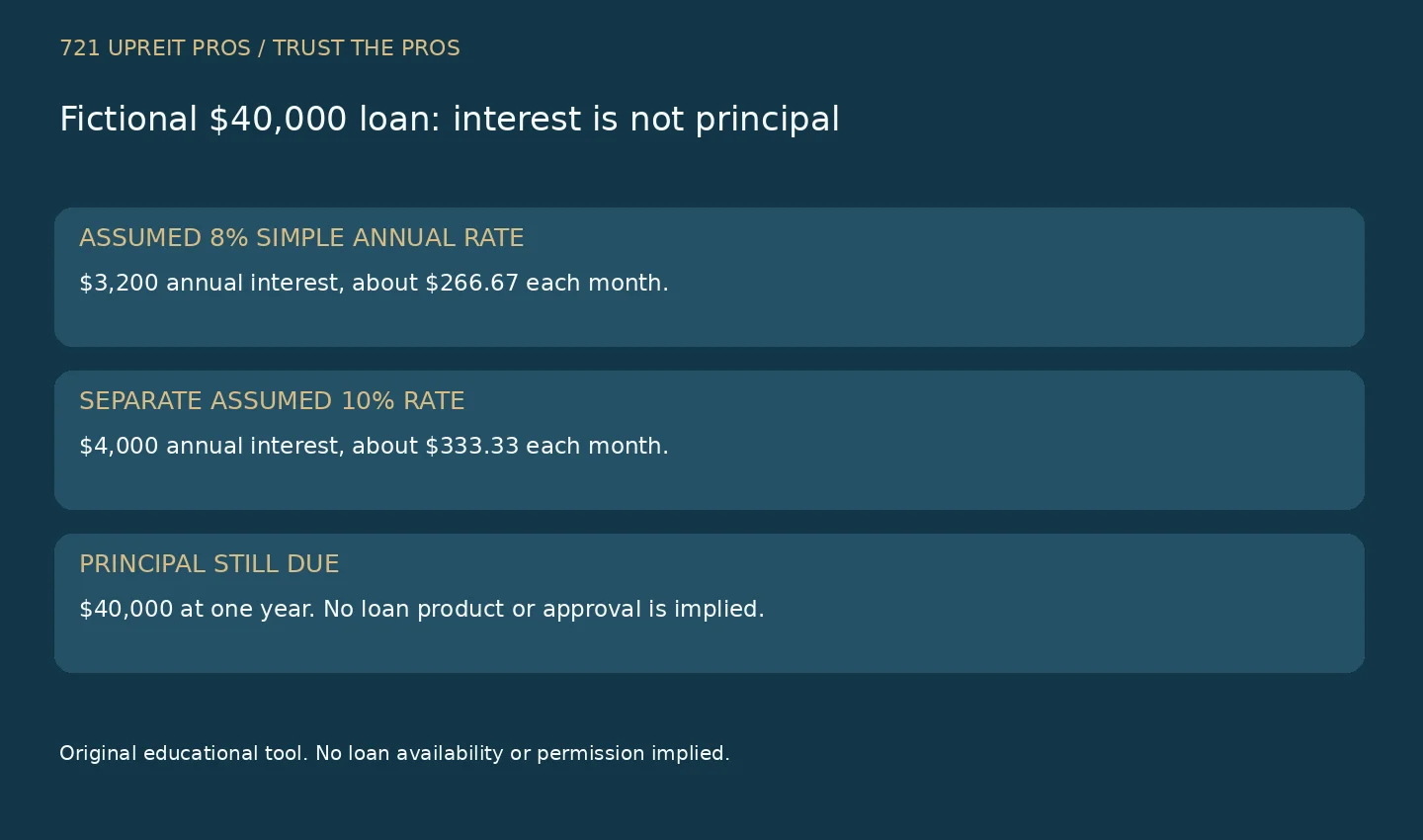
Assume, solely for arithmetic, a $40,000 personal loan at an 8% annual simple rate, interest-only payments and principal due after one year. These invented terms are not a lender quote, available product, approval or recommendation. Ignore fees and taxes for this limited example. Assume all required permissions and lender acceptance remain unresolved.
Annual interest would be $3,200, approximately $266.67 per month. Suppose the household expects $400 monthly from its investment and assigns that cash to interest. If receipts fall to $200, it needs approximately $66.67 per month from another source. If receipts stop, the outside requirement becomes the full $266.67. Principal still has to be repaid.
A second assumed rate of 10% produces $4,000 annual interest, approximately $333.33 per month. That comparison tests sensitivity; it does not predict a rate reset. At either assumed rate, identify a separate source for the $40,000 maturity payment. A hoped-for redemption or refinancing is an unresolved condition, not cash already committed to repayment.
Could a pledge interfere with a later redemption?
Review the release process before relying on exit proceeds. In the same dated HGIT example, Section 8.5(c)(v) requires an undertaking concerning units delivered free of liens and limits the obligation to acquire lien-affected units. This is a separate provision from pledge consent. An approval to establish a lien should not be read as a promise to redeem encumbered units.
Ask who supplies a payoff statement, who releases the interest and what the issuer must receive before processing a permitted transaction. Counsel should explain whether a coordinated release is possible under the actual documents. The OP-unit secondary-sale review addresses a different route: a proposed buyer and sale terms. Neither route guarantees funds by a personal deadline.
Which tax and ownership questions need separate answers?
Do not label a proposed loan a tax-free withdrawal from the partnership. Give the CPA the actual borrower, use of proceeds, related transactions and any contemplated sale or redemption. IRS Publication 550 explains that interest allocation depends on how borrowed funds are used, not simply the property securing the debt. It also explains that personal interest generally is not deductible, subject to applicable exceptions.
Keep personal borrowing separate from debt inside the operating partnership or its properties. The OP-unit liability and basis worksheet addresses those partnership records. A personal loan proposal does not answer that worksheet, establish an investment-interest deduction or remove the need to evaluate the actual transaction's tax consequences.
What if the original investment was a DST?
Identify what you own today. A qualifying Section 1031 exchange involving a DST and a separate Section 721 partnership contribution involve different interests and documents. A possible future contribution does not establish present borrowing rights. The 721 UPREIT investor guide explains the stages; IRS Publication 541 describes partnership-contribution principles and exceptions.
For property-level financing, the related DST loan-maturity guide addresses balloon-payment risk. DST Experts' cash-sweep reconciliation worksheet distinguishes retained collateral cash from loan-principal reduction. Those are trust/property questions, not evidence that an individual can pledge OP units. OP units and ordinary REIT shares generally are not direct Section 1031 replacement real property.
What should you verify before counting a loan as available cash?
- Confirm the exact issuer, owner, unit class and current governing documents.
- Have counsel identify required consents and the consequences of default.
- Obtain actual lender acceptance and complete terms without assuming a credit limit.
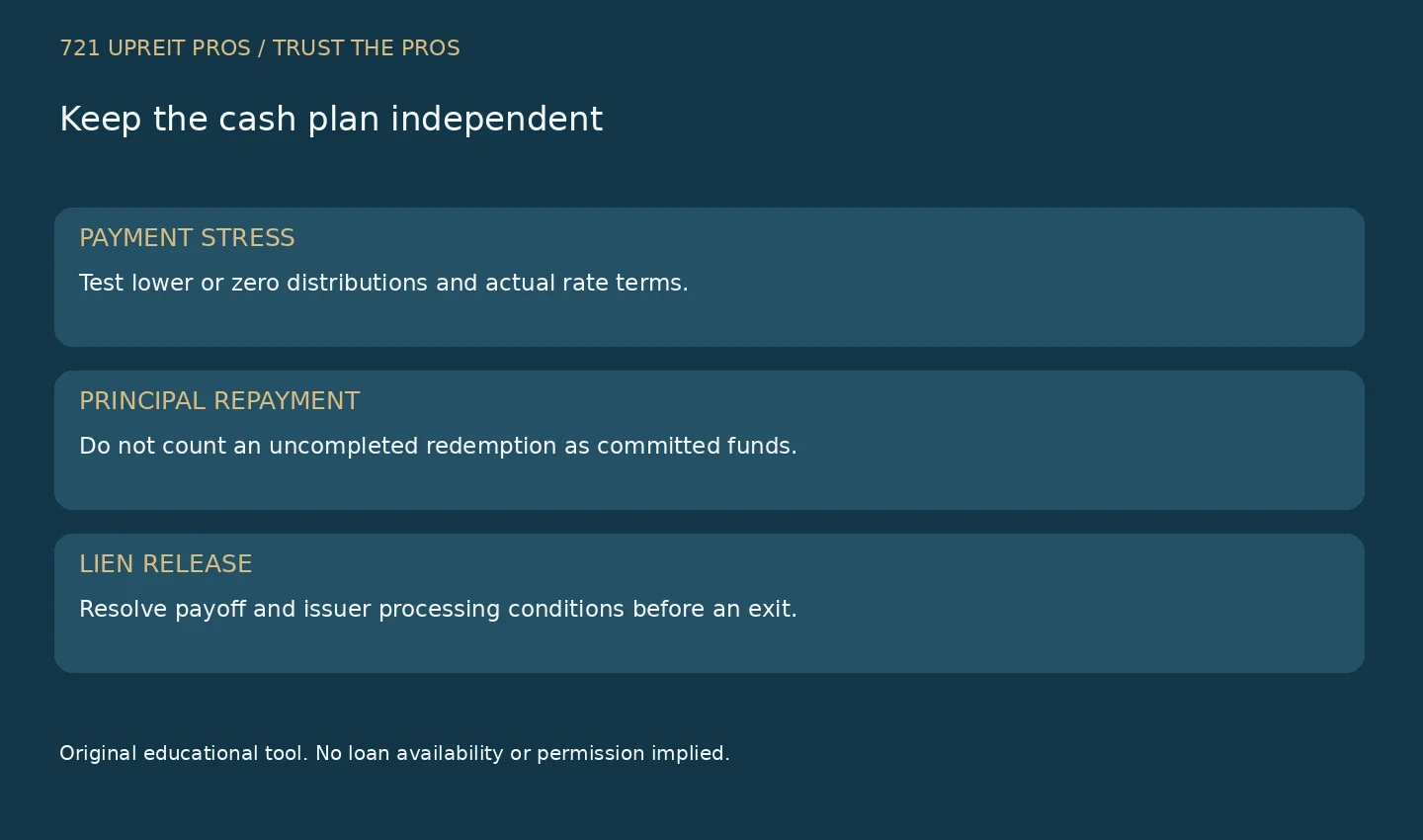
- Test payments using lower or zero distributions and the applicable rate terms.
- Identify principal repayment funds independent of an uncompleted investment exit.
- Resolve lien-release conditions and obtain a separate tax review.
If a required answer remains open, leave the proposed loan outside confirmed available cash. Compare the cash need and alternatives when you discuss 721 UPREIT liquidity planning with an advisor or request a callback. Describe the decision briefly. Arrange a verified secure channel for private agreements, statements or tax records; do not put them in public forms.
Watch the one-minute borrowing review
This original silent video includes English captions and the complete matching transcript below.
Read video transcript
0:00 · Can OP units secure a loan?
Do not assume permission, lender acceptance or available cash.
0:12 · Resolve separate decisions
Issuer consent differs from actual lender acceptance.
0:24 · Test the payment plan
Fictional $40,000 at 8 percent: $3,200 annual interest; principal remains.
0:36 · Plan without an assured exit
Test reduced distributions and independent principal repayment.
0:48 · Check release conditions
Review liens, payoff and taxes before relying on an investment exit.
Download the collateral-borrowing checklist
Primary evidence checked November 1, 2026. The contract example is dated and program-specific. No lender availability, legal opinion or expert review of your holding is established. Investments may lose value or remain illiquid; distributions, conversion, liquidity and tax outcomes are not guaranteed.
Frequently asked questions
Does every 721 UPREIT allow investors to pledge OP units?
No universal permission is established. Read the current documents and have counsel identify the applicable restrictions, exceptions and required decisions.
Does general-partner consent mean a bank will lend?
No. Lender acceptance and final credit terms are separate. An issuer decision does not establish a loan amount, rate or approval.
Can I apply a brokerage loan percentage to my OP-unit value?
Do not assume so. Ask the actual lender whether it accepts the exact interest and how it determines lendable value. This article quotes no OP-unit advance rate.
Is OP-unit borrowing the same as an issuer redemption?
No. A loan creates repayment obligations. Redemption follows its own contractual conditions, and a lien can create additional release questions.
Does pledging investment property make interest deductible?
Not by itself. IRS Publication 550 ties interest allocation to the use of borrowed funds rather than simply the collateral. Have the CPA review the actual use and applicable limits.
What should I do if borrowing or consent remains unconfirmed?
Leave it outside confirmed available cash. Identify another funding source or revisit the spending plan, and arrange appropriate document review before making a commitment.
TALK TO A 721 UPREIT ADVISOR
Ready to discuss your 721 options?
Request a callback to discuss the questions raised by this article, your timing and what to ask before you commit. Share your name, email and phone below to start the conversation.
No investment commitment or financial documents required. A callback request does not book an appointment or establish an advisory relationship.