
721 UPREIT PROS / INVESTOR TAX PLANNING
721 UPREIT Taxes: Does the 3.8% NIIT Apply?
A 721 UPREIT is not a blanket exemption from the 3.8% net investment income tax. Review the contribution, annual partnership income and any later disposition separately. For an individual, the calculation depends on net investment income and household modified adjusted gross income, not simply the cash distributed or the investment's tax-deferred label.
By 721 UPREIT Pros · Published November 3, 2026
Key takeaways
- A 721 UPREIT label does not establish blanket NIIT exemption.
- Compare classified NII with household MAGI above the applicable threshold.
- Separate contribution, annual-income and later-disposition events.
- Cash distributions and an individually calculated tax obligation are different inputs.
The investor decision is how much after-tax cash may be available and which assumptions belong in the reserve plan. An owner comparing a taxable property sale with a contribution needs an event-specific estimate. An existing OP-unit holder needs the annual tax information and household income picture. Neither should treat a distribution percentage as an after-tax spending rate.
This guide provides a two-number comparison and three fictional household scenarios. It supports the 721 UPREIT investor guide, which retains the broad tax and transaction overview. Use the taxable-income-without-cash worksheet for the different question of funding an obligation when investment cash is insufficient. This article does not prepare a return or determine your tax liability.
TALK TO A 721 UPREIT ADVISOR
Talk to a 721 UPREIT advisor
Request a callback to discuss the questions raised by this article, your timing and what to ask before you commit. Share your name, email and phone below to start the conversation.
No investment commitment or financial documents required. A callback request does not book an appointment or establish an advisory relationship.

Which two numbers enter an individual's NIIT calculation?
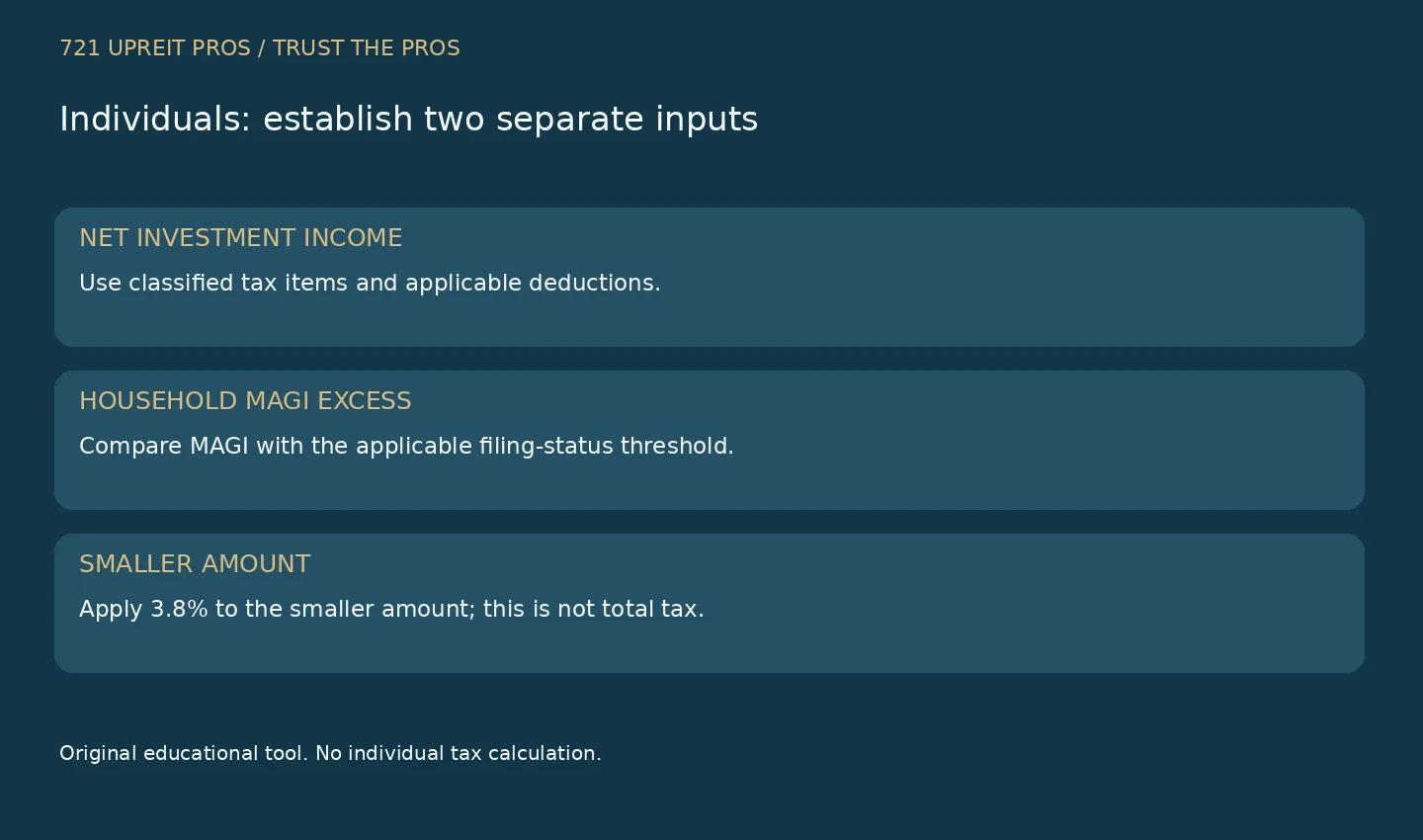
The IRS NIIT overview describes a 3.8% tax on the smaller of net investment income or the amount by which modified adjusted gross income exceeds the filing-status threshold. First establish the inputs. A portfolio value, gross property price or cash payment is not interchangeable with either number.
The individual thresholds are $250,000 for married filing jointly or qualifying surviving spouse, $125,000 for married filing separately, and $200,000 for single or head of household. The current 2026 Publication 505 lists those amounts. This article's numerical example uses married filing jointly only; it does not apply an individual's threshold to an estate or trust.
Use the applicable tax year's definitions and have the preparer reconcile the household total. Modified adjusted gross income, or MAGI, can differ from the taxable-income number on a planning summary. Net investment income, or NII, also needs classification and applicable deductions. Do not replace that work with a rough total of bank deposits.
Does a tax-deferred contribution settle every later tax question?
No. IRS Publication 541 explains the general partnership property-contribution framework and exceptions. That is the starting point for reviewing a proposed Section 721 transaction. It is not a promise about every payment, every liability shift or the annual income from the interest received.
Ask the CPA to identify what is recognized in the contribution year, what remains deferred, and which other household items enter that year's NIIT calculation. Then make a separate annual-ownership estimate. This is an event-separation method, not a conclusion that a particular contribution qualifies or a formula for its gain. Retain the signed terms and the CPA's assumptions beside the calculation.
If a taxable property sale is an alternative, compare it on its actual recognized gain and other tax facts. Avoid applying 3.8% mechanically to the gross sale price or the equity check. Likewise, do not describe a qualifying contribution as eliminating tax forever. A later transaction requires another review with the records then available.
Which OP-unit income needs the preparer's attention?
The IRS Topic 559 describes categories that can enter NII, including income from a business that is a passive activity to the taxpayer and certain gains. Classification depends on the actual activity and investor facts. The words passive investment in a brochure do not replace the tax analysis.
Give the preparer the complete Schedule K-1 and attachments, annual cash statement and other requested records. Ask which items enter NII and whether any adjustments apply. Keep the reported tax categories separate rather than converting every item into one assumed distribution rate. A change in cash receipts should prompt an updated review, not an automatic conclusion about tax treatment.
| Stage | Evidence to supply | Question to resolve |
|---|---|---|
| Contribution year | Executed terms, debt and consideration records | What is recognized, deferred or otherwise relevant this year? |
| Annual ownership | K-1, attachments and household income estimate | Which items enter NII and household MAGI? |
| Later disposition | Transaction record, basis schedule and final tax information | What gain, character and NIIT adjustments require review? |
What do three fictional households show?
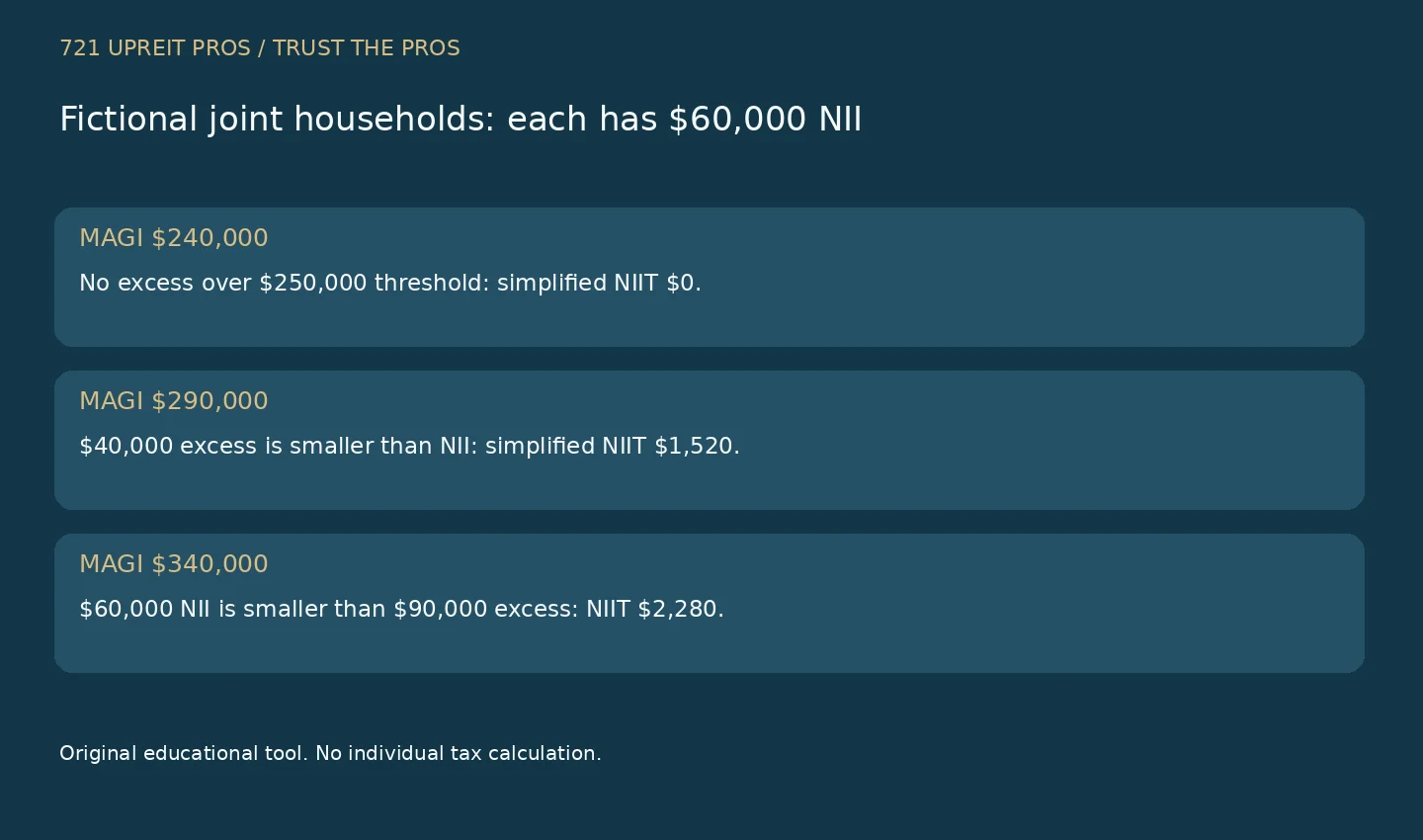
Assume three married-filing-jointly households, each with $60,000 of total NII after the applicable classification and deductions. Assume their respective MAGI amounts are $240,000, $290,000 and $340,000. MAGI is already the complete assumed household figure, including relevant investment income; do not add the $60,000 again. These are invented inputs, not an OP-unit forecast, tax recommendation or actual return.
At $240,000 MAGI, there is no excess above the assumed $250,000 threshold, so this simplified NIIT calculation produces zero. At $290,000, the excess is $40,000. The smaller of $60,000 NII and $40,000 excess is $40,000; multiplied by 3.8%, that produces $1,520. At $340,000, the $90,000 excess is larger than NII, so the calculation uses $60,000 and produces $2,280.
The same assumed NII produces different results because the other input changes. These amounts are only NIIT in this simplified exercise. They are not total federal or state taxes, and they do not establish the amount attributable to any one investment. The exercise assumes the inputs are correct; your preparer must first determine the real numbers.
Why can retirement planning affect the household picture?
The IRS NIIT questions and answers distinguishes income categories included in NII from excluded categories, including distributions from certain qualified retirement plans. Exclusion from NII does not mean an item can be ignored throughout the household return. Ask the preparer how the actual income affects MAGI as well as NII.
Bring the property decision into the broader income calendar without assuming that a specific withdrawal or conversion is appropriate. Review expected income sources, timing, taxes and accessible reserves together. This article recommends no retirement-account transaction. Its purpose is to avoid evaluating an OP-unit holding in isolation from the return on which its income is reported.
What changes if units are sold or redeemed later?
Obtain the actual transaction terms and basis records before estimating an exit's after-tax cash. The current posted Form 8960 instructions, for 2025, separately discuss dispositions of partnership interests and potential adjustments. Do not assume a prior annual-income calculation answers a later disposition, or apply the headline tax rate to gross redemption proceeds.
The OP-unit secondary-sale review and redemption request checklist address different execution paths. Tax analysis does not create a buyer, an issuer approval or a payment date. Avoid funding a tax or spending obligation with proceeds that remain contingent on an uncompleted exit.
How should the review fit a DST or 1031 pathway?
Keep a qualifying Section 1031 exchange, DST ownership and a separate Section 721 contribution identified as different stages. Use the related DST tax-reporting guide and DST Experts' CPA preparation resource for the earlier trust-stage records. Neither is an individual NIIT determination.
A possible later contribution may not occur. OP units and ordinary REIT shares generally are not direct Section 1031 replacement real property. Coordinate the property sale and any exchange with the appropriate professionals before closing or receiving proceeds. Preserve continuity of basis and transaction records while allowing each stage's tax treatment to be evaluated separately.
What should you verify before setting a tax reserve?
- Confirm the taxpayer, filing status, tax year and applicable calculation.
- Separate contribution, annual-income and disposition events.
- Obtain the preparer's NII and MAGI estimates without double-counting income.
- Reconcile the estimate to complete tax documents and household information.
- Review withholding or estimated payments and identify accessible outside cash.
- Update the plan when income or transaction facts change.
Discuss the unresolved investment questions when you review 721 UPREIT income planning with an advisor or request a callback. Have the CPA calculate the tax and any payment requirements. Use a verified secure channel for tax records and private statements; keep them out of public forms.

Watch the one-minute NIIT review
This original silent video includes English captions and the complete matching transcript below.
Read video transcript
0:00 · Does the 3.8 percent NIIT apply?
A 721 UPREIT label is not a blanket NIIT exemption.
0:12 · Establish both inputs
Classified net investment income and household MAGI threshold excess.
0:24 · Compare fictional households
Same $60,000 NII can produce different simplified NIIT amounts.
0:36 · Separate the tax events
Contribution, annual income and later exit need separate review.
0:48 · Plan the actual reserve
Have the CPA calculate tax; identify accessible payment funds.
Download the NIIT preparation checklist
Primary sources checked November 3, 2026. Individual calculations only in the hypothetical; estates and trusts require separate rules. No individual tax advice or expert review is established. Investments can lose value and remain illiquid; conversion, returns, liquidity and tax outcomes are not guaranteed.
Frequently asked questions
Does a tax-deferred 721 contribution eliminate NIIT forever?
No blanket exemption is established. Have the CPA evaluate the contribution and separately review annual income and any later disposition.
Is NIIT calculated on my property value or equity check?
The individual formula compares net investment income with MAGI above the applicable threshold. Do not substitute gross property value, a distribution or a proceeds check for those inputs.
Does the example add NII to MAGI a second time?
No. Each fictional MAGI figure already includes relevant investment income. Adding the assumed NII again would change the stated inputs incorrectly.
Do joint-filer thresholds apply to a trust?
Do not use that shortcut. Estates and trusts have separate rules. This article illustrates individual married-filing-jointly calculations only.
Does reinvesting a distribution establish a NIIT exemption?
No such result is established here. Give the preparer the actual tax categories and reinvestment records rather than deciding treatment from the cash election.
Does a zero NIIT example mean no tax is due?
No. The fictional calculation concerns NIIT only. Regular federal income tax, state tax and other obligations require separate analysis.
TALK TO A 721 UPREIT ADVISOR
Ready to discuss your 721 options?
Request a callback to discuss the questions raised by this article, your timing and what to ask before you commit. Share your name, email and phone below to start the conversation.
No investment commitment or financial documents required. A callback request does not book an appointment or establish an advisory relationship.