
721 UPREIT PROS / DIRECT PROPERTY AND DEBT
721 UPREIT Debt: Are Mortgage Guarantors Released?
A 721 UPREIT contribution does not, by itself, establish that an existing mortgage guarantor has been released. Separate the transfer of the property, assumption of the loan, any partnership indemnity and the lender's actual release. Have counsel verify the signed documents, effective dates and remaining obligations before treating personal exposure as ended.
By 721 UPREIT Pros · Published November 2, 2026
Key takeaways
- Property transfer does not establish a guarantor release.
- Loan assumption, indemnity and lender release require separate evidence.
- Verify parties, covered obligations, conditions and effective dates with counsel.
- Give guarantee changes to the CPA for a separate tax analysis.
A property owner may want relief from both management work and a personal loan obligation. Those goals need different evidence. A sponsor accepting the building or issuing OP units does not answer who remains responsible under a separate guaranty. Start this review before signing, while the proposed debt treatment can still be clarified.
This article supplies an original four-document matrix and a fictional closing-file comparison. It supports the 721 UPREIT risk framework and the direct-property acceptance checklist. It does not determine an individual's liability, recommend a guarantee or claim that a particular lender will approve a release.
TALK TO A 721 UPREIT ADVISOR
Talk to a 721 UPREIT advisor
Request a callback to discuss the questions raised by this article, your timing and what to ask before you commit. Share your name, email and phone below to start the conversation.
No investment commitment or financial documents required. A callback request does not book an appointment or establish an advisory relationship.

Which documents answer different questions?
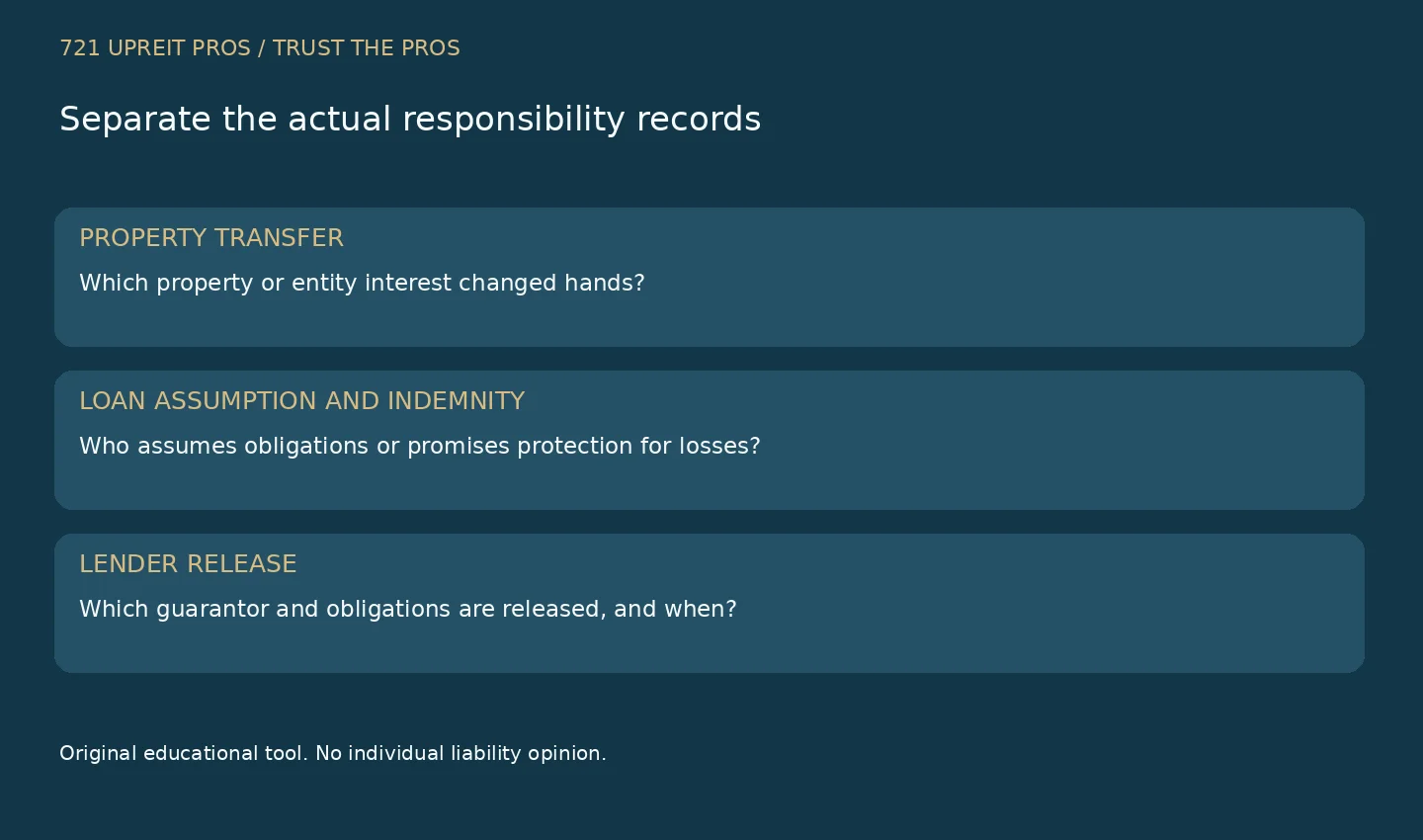
List every existing loan and identify the borrower, lender, guarantor and relevant agreement. Include amendments and any separate indemnities. Ask counsel which obligations concern payment, performance or specified events, and whether different people signed different documents. Do not reduce the file to a single mortgage balance and one signature page.
| Record | Question it addresses | What it does not establish alone |
|---|---|---|
| Contribution agreement | What property or entity interest changes hands? | The lender releases a guarantor |
| Loan assumption or consent | What debt obligations and transfer conditions are accepted? | Every existing guarantee ends |
| Indemnity agreement | Who promises protection for specified claims or losses? | The original creditor surrendered its rights |
| Guarantor release | Which obligations are released, by whom and when? | Unlisted obligations or other loans disappear |
For each record, enter the parties, version, execution status, effective date and unresolved condition. Have the closing professionals explain how the documents fit together. A draft is useful for negotiation, but it is not the same evidence as an executed document that has become effective under its terms.
Why is a partnership indemnity different from lender release?
Ask who is making the promise and who holds the original claim. An indemnity may provide a contractual response to specified losses, while a release addresses the creditor's rights against a named party. Counsel should explain each document's coverage, conditions, exclusions and enforcement. Do not infer that one has the legal effect of the other because both appear in a closing package.
A dated illustration makes this distinction concrete. The July 13, 2016 contribution agreement between American Housing Income Trust and Northern New Mexico Properties, Section 10.2.1, discusses attempted assumption of guarantee obligations, lender-consent conditions and indemnification limited to defined post-closing losses. It also describes a circumstance in which guarantors remain. This is historical contract evidence, not a statement of current program terms, availability or your rights.
The practical review is whether any protection comes from the lender, a replacement obligor or another contracting party. If it is an indemnity, ask about the indemnitor's financial ability, claim procedure, defense arrangements and limits. An agreement can allocate risk without removing the need to understand who might first receive a demand.
What does a fictional closing-file comparison show?
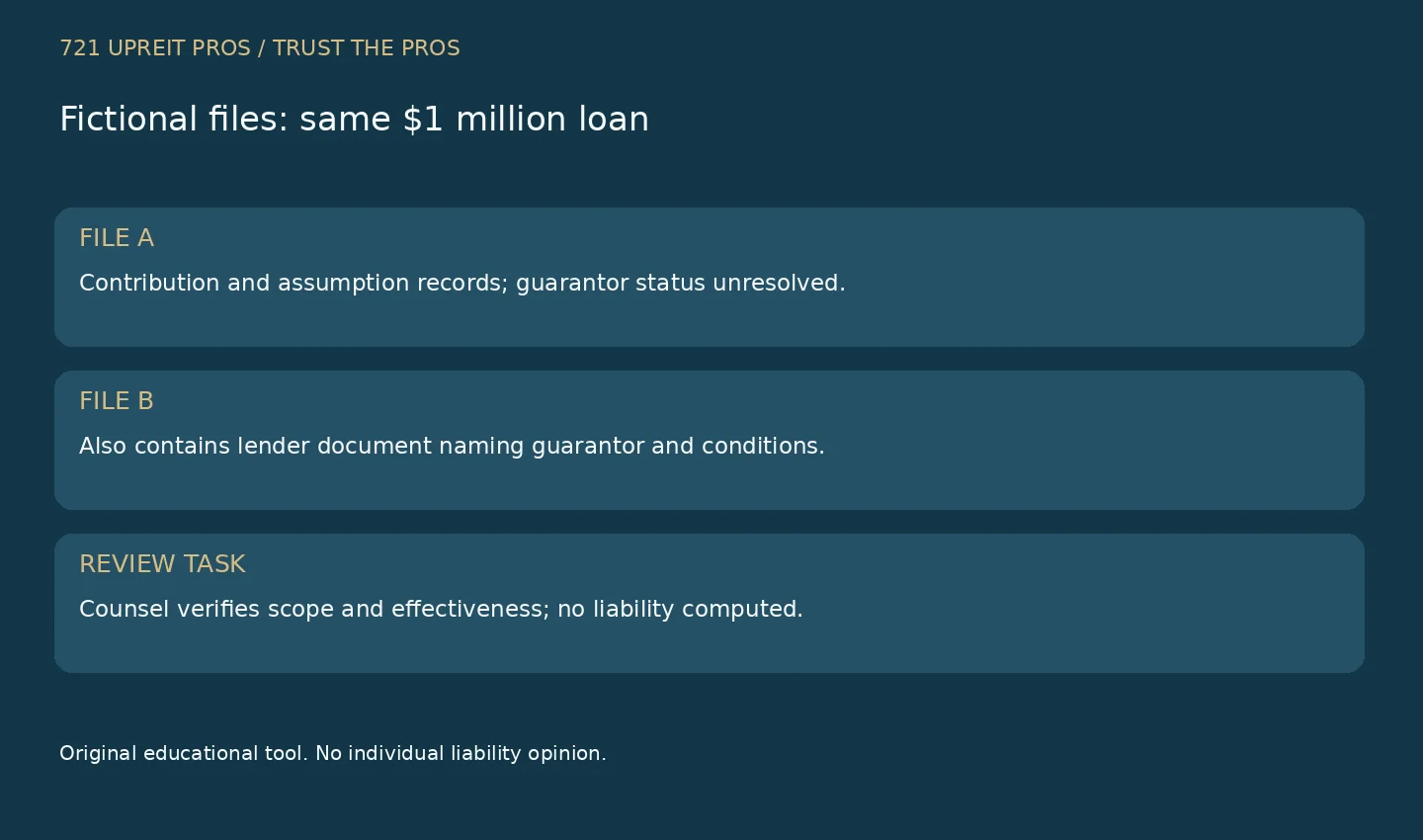
Assume a fictional owner contributes a property with a $1 million outstanding loan and receives OP units under a negotiated agreement. The amount is invented to label the file; it is not a valuation, loan quote, liability calculation or example of an available program. The owner previously signed a separate guaranty. No conclusion about its enforceability is assumed.
In File A, the closing folder contains a signed contribution agreement and an assumption document naming a new borrower. The folder also contains a partnership promise covering certain future losses. It contains no lender document addressing the original guarantor. The unresolved task is to ask counsel and the lender for the actual guarantor status, rather than mark the entire obligation released.
In File B, the same folder includes a signed lender document that names the original guarantor, identifies the relevant guaranty and specifies an effective date and conditions. Counsel checks whether those conditions occurred and whether anything is excluded. The result is a documented scope to analyze, not permission to assume every obligation on every loan has ended.
The $1 million balance is identical in both files. The evidence differs. Neither a unit statement nor a larger investment portfolio fills the missing cell in File A. In File B, retain the complete document and the evidence of effectiveness. This exercise does not estimate a claim amount or decide which transaction the owner should accept.
What should counsel check before you rely on a release?
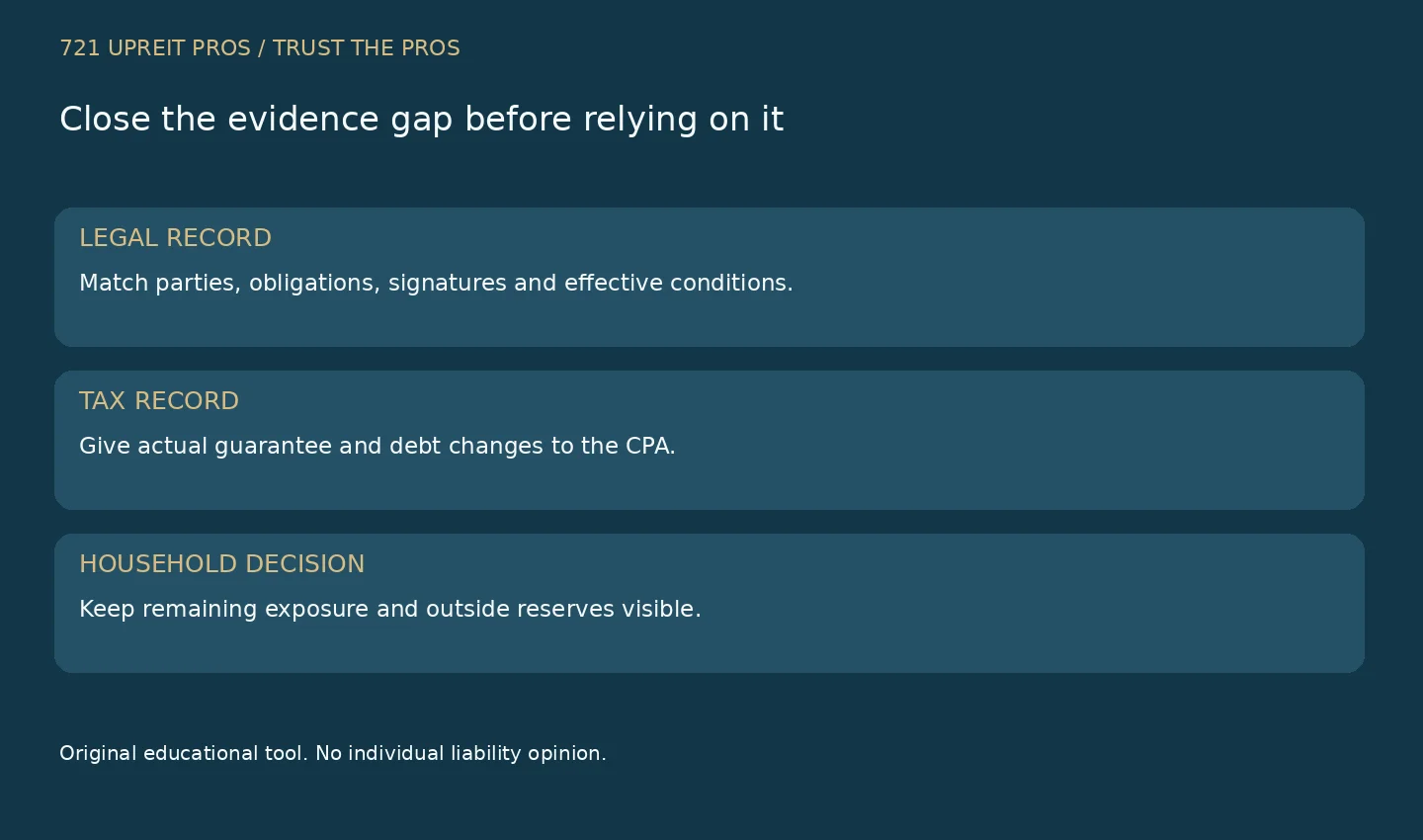
Ask for a written explanation of the named parties, covered loan and guarantee, effective date, conditions and any surviving obligations. If several owners, trusts or entities signed documents, review each signature capacity separately. A release naming one entity should not be casually summarized as a release of everyone associated with the property.
Also identify whether the proposed arrangement concerns existing obligations or asks you to undertake a new one. A replacement guarantee, tax-protection undertaking or other continuing covenant requires its own review. The tax-protection agreement checklist addresses that separate negotiation. A provision intended to support a tax objective is not automatically a household-risk reduction.
Use a status such as requested, draft received, executed, conditions outstanding or effectiveness confirmed. Assign a responsible professional and a follow-up date to every unresolved item. These are organizational labels, not legal findings. If counsel cannot establish the intended result, keep that uncertainty visible in the decision before committing to the transaction.
Does the tax treatment answer the lender-liability question?
No. IRS Publication 541, revised December 2025, explains partnership contribution and liability principles. A qualifying contribution can fall within a nonrecognition framework, but actual liabilities, other consideration and exceptions require analysis. A tax conclusion should not be used as the evidence that a creditor released a particular person.
Give the CPA the before-and-after debt schedule, guarantee changes, actual agreements and any other consideration. Keep that analysis separate from counsel's explanation of contractual exposure. The OP-unit debt and outside-basis worksheet organizes tax records. This article does not calculate basis, recognized gain, a deduction or the tax effect of signing or ending a guarantee.
How does this fit a property sale, DST or later 721 pathway?
If you are still comparing a sale with a direct contribution, coordinate the broker or sale professional, lender, attorney and CPA early. A contemplated Section 1031 exchange needs its separate qualified-intermediary planning before closing or receiving proceeds. The 721 UPREIT investor guide distinguishes the routes. A DST purchase and a later Section 721 contribution are separate decisions, and conversion is not assured.
The related DST debt-replacement explanation concerns exchange funding and attributable debt, rather than releasing a direct property's guarantor. DST Experts' loan-maturity checklist organizes the replacement investment's financing dates. Do not import those structures' terms into an existing loan. OP units and ordinary REIT shares generally are not direct Section 1031 replacement real property.
What belongs in the final responsibility checklist?
- Identify every borrower, guarantor, lender and applicable document.
- Separate property transfer, assumption, indemnity and actual release evidence.
- Have counsel explain the scope, exceptions and conditions for each party.
- Confirm effectiveness with supporting records rather than relying on a draft.
- Send the debt and guarantee changes to the CPA for separate analysis.
- Keep remaining exposure and household reserves visible in the decision.
Bring unresolved questions when you discuss direct-property 721 UPREIT planning with an advisor or request a callback. Use the public form for a brief question. Arrange a verified secure channel for confidential loan documents, tax records and account details.
Watch the one-minute guarantor review
This original silent video includes English captions and the complete matching transcript below.
Read video transcript
0:00 · Are mortgage guarantors released?
A property contribution alone does not establish that result.
0:12 · Separate the documents
Transfer, assumption, indemnity and lender release answer different questions.
0:24 · Compare the actual files
Same fictional loan balance, different evidence of guarantor status.
0:36 · Verify the remaining conditions
Counsel checks scope, parties and when a release becomes effective.
0:48 · Keep the reviews separate
Give changes to the CPA; keep remaining exposure visible.
Download the guarantor-review checklist
Sources checked November 2, 2026. The filed contract is a dated illustration. No individual legal opinion or expert review is established. Investments can lose value and remain illiquid; release, conversion, returns and tax results are not guaranteed.
Frequently asked questions
Does receiving OP units prove that my old guaranty ended?
No. A unit confirmation records an investment interest. Obtain and review the actual lender and guarantee documents before treating personal exposure as ended.
Is a partnership indemnity the same as a lender release?
Do not assume equivalence. Identify the party making each promise and the rights addressed. Counsel should explain scope, conditions, exclusions and enforcement.
Does a loan assumption release every guarantor?
The actual documents control. Ask whether each named guarantor and each obligation is addressed, rather than relying only on a change in borrower.
Can a release still have conditions?
Review its terms and effectiveness with counsel. Retain evidence that relevant conditions occurred; an executed document should not be summarized beyond its actual scope.
Does Section 721 decide my contractual liability?
A tax framework does not establish the lender action in your file. Keep the CPA liability and basis analysis separate from counsel review of guarantees and releases.
Should I send loan agreements through the contact form?
No. Use a brief general question and arrange a verified secure channel for confidential documents. Do not enter account numbers, private agreements or tax records in public forms.
TALK TO A 721 UPREIT ADVISOR
Ready to discuss your 721 options?
Request a callback to discuss the questions raised by this article, your timing and what to ask before you commit. Share your name, email and phone below to start the conversation.
No investment commitment or financial documents required. A callback request does not book an appointment or establish an advisory relationship.