
721 UPREIT PROS / ELIGIBILITY DECISIONS
721 UPREIT Eligibility: What If You Live in the Building?
Living in one part of a mixed-use building does not, by itself, answer whether a 721 UPREIT contribution can occur. Separate the residence from the rental or business use, identify who owns each interest, and ask whether a partnership will accept the actual property and proposed terms. A 1031 exchange has a different business-or-investment-use test.
By 721 UPREIT Pros · November 15, 2026 · Original mixed-use decision worksheet
Key takeaways
- Document personal, rental and business use before choosing a path.
- A qualifying 1031 exchange has a business-or-investment real property test.
- Section 721 text differs, but partnership acceptance and actual transaction terms still control feasibility.
- Allocate value, basis, costs and tax questions with the CPA rather than assuming whole-building deferral.
Consider a building with an apartment occupied by its owner and storefronts leased to unrelated tenants. The property's street address and one deed do not make every portion identical for tax analysis. Before a broker markets it or an advisor proposes a path, gather the floor plan, leases, occupancy dates, basis and depreciation records, debt documents and ownership documents. The investor decision begins with the facts, not with a promise that the entire building is tax deferred.
This guide addresses the mixed-use fact pattern, not every property that an UPREIT might accept. The broader direct-property acceptance checklist covers title, lender, valuation and closing readiness. Here the open question is how personal use and investment use change the comparison among a sale, a Section 1031 exchange and a separate Section 721 contribution.
TALK TO A 721 UPREIT ADVISOR
Talk to a 721 UPREIT advisor
Request a callback to discuss the questions raised by this article, your timing and what to ask before you commit. Share your name, email and phone below to start the conversation.
No investment commitment or financial documents required. A callback request does not book an appointment or establish an advisory relationship.

Which part is a home, and which part produces income?
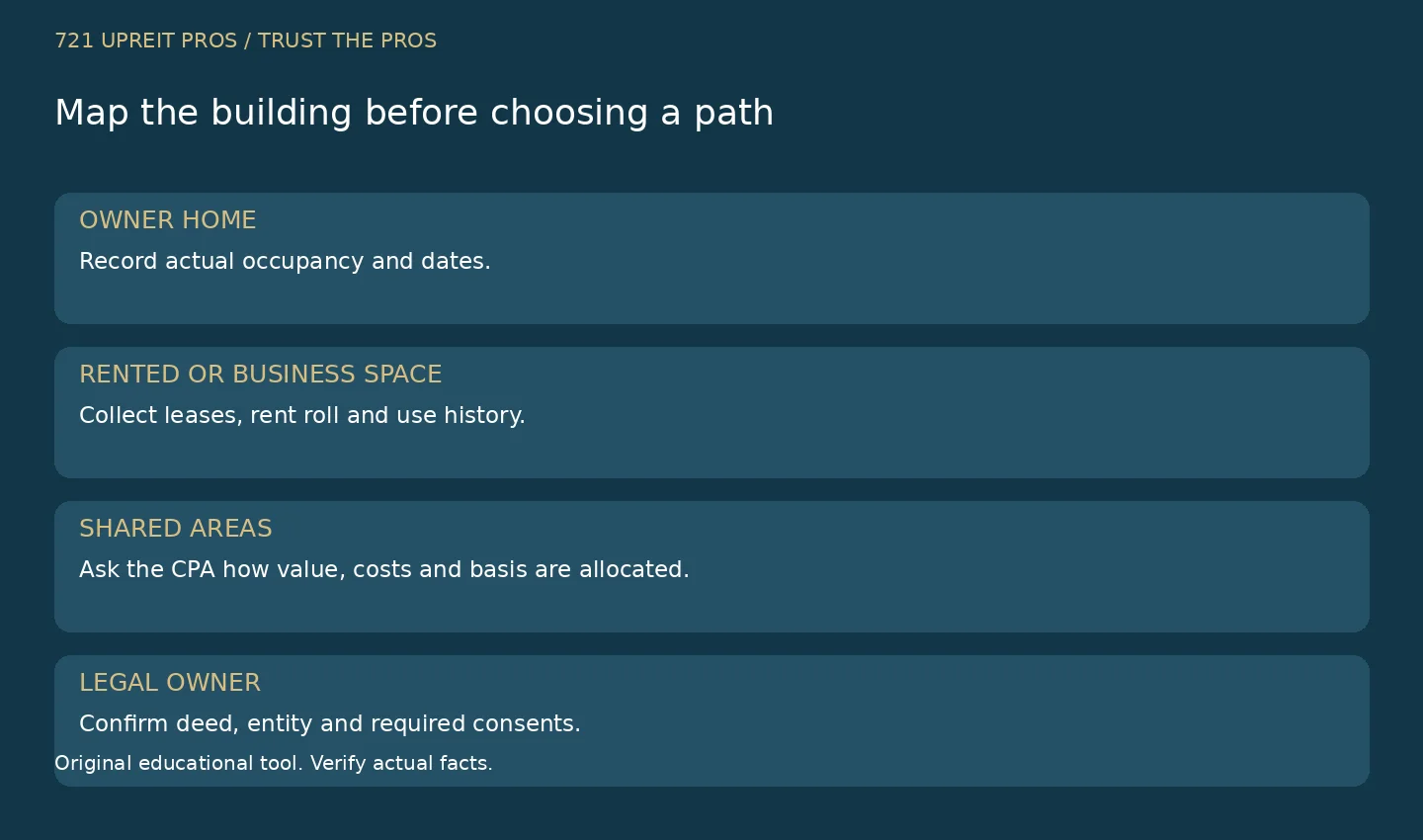
Document actual use by space and period. Ask whether the owner lives upstairs, rents another unit, operates a business in a separate portion, or merely works from a room inside the home. Save the leases, rent roll, expense allocation and prior returns. If ownership sits in an entity, identify its tax classification and every person whose consent may be required. These records help a CPA distinguish personal, rental and business uses; they do not themselves establish the tax result.
The IRS explains in Publication 544 that property used partly for business or rental and partly for personal purposes generally requires allocating selling price, expenses and basis between the portions. The treatment can also depend on whether the business or rental part is within the home or separate from it. Do not use floor area alone as a final tax allocation unless the tax professional confirms that method fits the facts.
What does Section 1031 require for the mixed-use building?
Section 1031 generally applies to qualifying real property held for investment or productive use in a trade or business and exchanged for like-kind real property held for those purposes. It does not apply to property used solely as a personal residence. The IRS instructions for Form 8824 expressly discuss property used partly as a main home and partly for business or investment, including separate worksheets for the two portions in the described circumstances. This is why the owner-occupied portion cannot simply be labeled exchange property because the ground floor earns rent.
If the seller considers a deferred 1031 exchange, arrange the qualified intermediary and exchange agreement before closing and apply the actual identification and receipt deadlines to the qualifying exchange portion. The IRS describes 45 days to identify replacement property and generally 180 days to receive it, or the return due date including extensions if earlier. Receiving sale proceeds first can defeat a planned deferred exchange. A DST may be considered as replacement property only when the particular interest and transaction meet applicable requirements; its later contribution to a partnership is separate and uncertain.
Section 121 may be relevant to a qualifying main-home portion, but it has its own ownership, use, exclusion and reporting rules. The IRS Form 8824 instructions discuss possible interaction with an exchange. The CPA should test both provisions and any depreciation attributable to rental or business use. Neither this article nor a sponsor illustration establishes how much gain, if any, can be excluded or deferred.
Does Section 721 have the same investment-use test?
The text of 26 U.S.C. Section 721 generally addresses a contribution of property to a partnership in exchange for a partnership interest. It does not state the same broad held-for-investment-or-business-use requirement that the IRS describes for Section 1031. That textual distinction is a reason to examine a possible direct contribution, not a conclusion that an owner-occupied building will be accepted or that its entire transaction is tax free. Section 721 has exceptions and other tax provisions can matter, including consideration received, liabilities and the particular structure.
An operating partnership must be willing to acquire the real estate on acceptable terms. Its underwriting may consider the property type, tenants, occupancy, continued owner use, title, financing, insurance, management, valuation and the timing of possession. A personal right to keep living upstairs could be inconsistent with the buyer's plans or need separate negotiated treatment. No statute forces a partnership to take a building or keep a former owner's apartment available.
Ask for the exact legal acquirer and a dated written indication of interest. Distinguish preliminary interest from due diligence, an approved agreement and a closed contribution. If there is a leaseback or separate occupancy arrangement, have counsel analyze the document and the tax professional review its effects. A proposal involving cash, property retained by the seller or debt changes needs transaction-specific analysis. Avoid assuming that a single label, “721 exchange,” determines the outcome.
What would a useful preliminary comparison look like?
Assume, purely as an illustration, that a three-story building is worth $3 million, with one upstairs apartment used as the owner's main home and two rented storefronts. Assume the owner wants to move out, and a potential buyer asks for vacant possession. The $3 million figure is gross value, not equity or proceeds. We do not assume a percentage allocation, tax basis, depreciation, debt, available sponsor or accepted contribution terms.
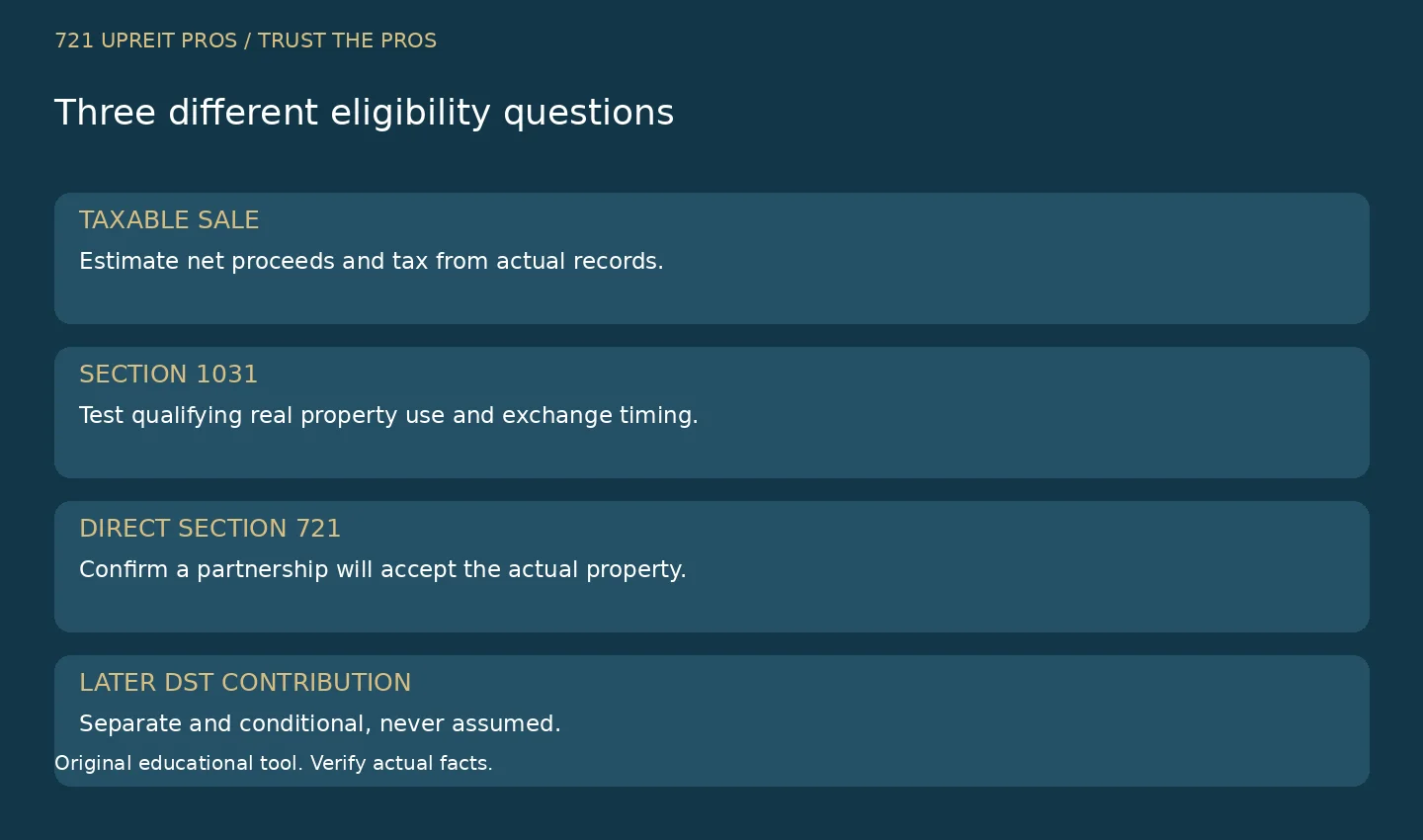
For a taxable sale, the CPA would allocate the applicable facts and estimate tax after reviewing the main-home and rental records. For a 1031 strategy, the CPA and qualified intermediary would identify whether and how the business or investment portion can be exchanged, and what happens to the personal portion. For a direct 721 proposal, the advisor would first confirm a real partnership's willingness to review the whole building and counsel would evaluate any continued occupancy or separate consideration. If no partnership accepts the building, that path is unavailable regardless of a favorable tax hypothesis.
| Question | Taxable sale | 1031 route | Direct 721 proposal |
|---|---|---|---|
| Use evidence | Home and rental allocation | Qualifying business or investment portion | Property and proposed occupancy terms |
| Required counterparty | Buyer | QI and qualifying replacement transaction | Willing operating partnership |
| Timing | Sale closing and tax reporting | QI setup and exchange deadlines | Diligence, negotiated agreement and closing |
| Unresolved | Net proceeds and tax estimate | Allocation and replacement eligibility | Acceptance, debt, consideration and use rights |
The table is a meeting tool, not a legal opinion. Change one fact, such as the upstairs apartment having been rented instead of owner occupied, and the analysis may change. Change the owner to a partnership with several members, and approval and tax allocation questions change again. Record each source and date so the team does not reuse a stale conclusion after a lease expires or the sale terms move.
What should the seller verify before signing?
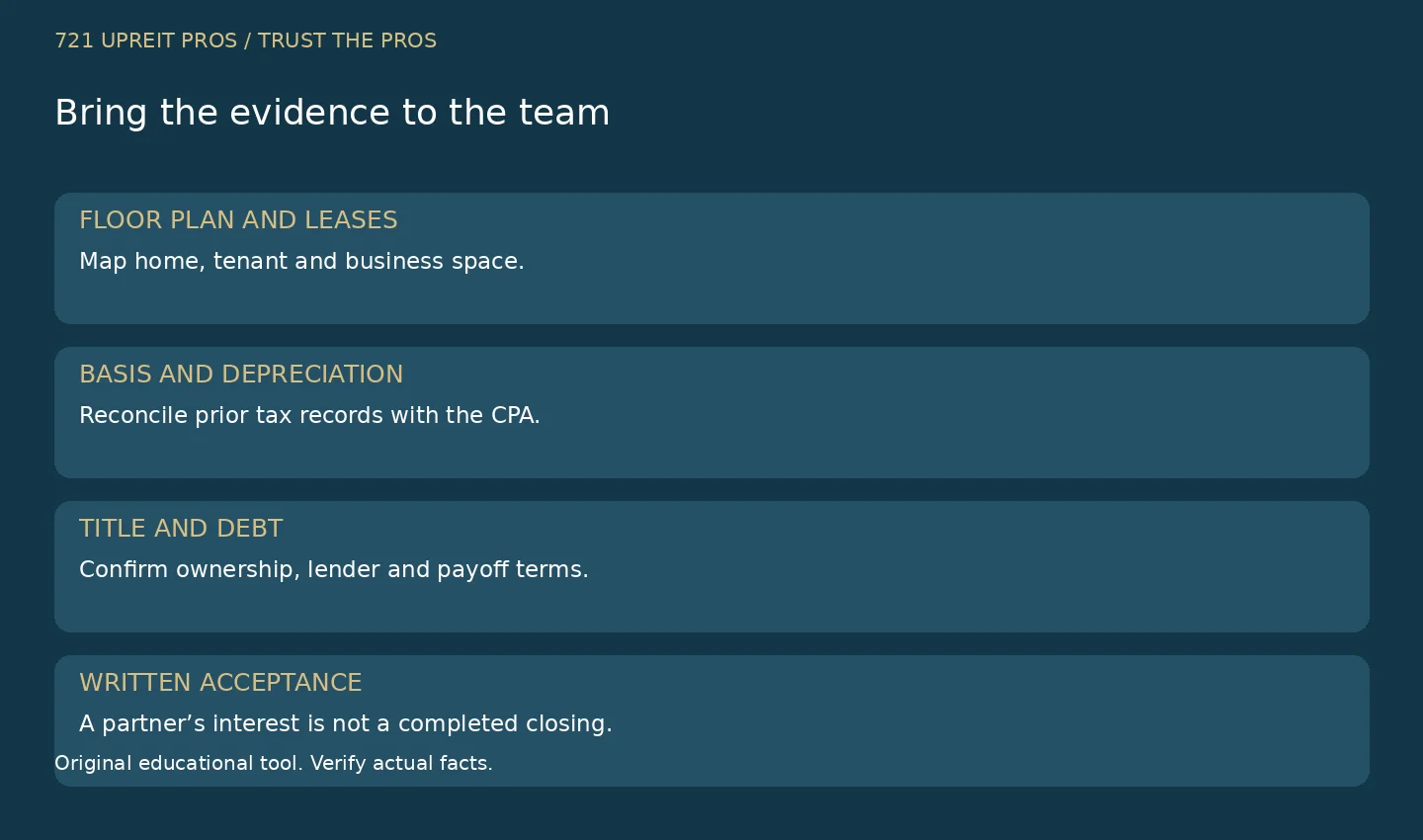
- Use and ownership: list each unit's actual use, lease, occupancy dates, legal owner and any co-owner approval.
- Tax records: give the CPA adjusted basis, improvements, prior depreciation, selling costs and any prior home-use history.
- 1031 readiness: if a qualifying portion may be exchanged, ask the qualified intermediary and counsel how the transaction and proceeds will be handled before the sale closes.
- 721 feasibility: request the partnership's property criteria, written response, proposed consideration, debt treatment and any occupancy terms.
- Cash needs: compare estimated net sale proceeds with the timing and restrictions of any proposed investment. Do not call a partnership interest spendable cash.
For the general Section 721 pathway, read the 721 UPREIT guide and process timeline. The property-value and equity guide addresses a separate sizing question, while the advisor comparison worksheet helps weigh the feasible paths. See DST Experts' pre-1031 questions and a DST-versus-721 sale comparison for further context. To discuss your own property, Talk to a 721 UPREIT advisor.
Watch the mixed-use eligibility map
This original one-minute briefing separates actual use, the 1031 exchange portion and a conditional direct contribution.
Read video transcript
0:00 · Map the actual use
An owner home and rented space need separate fact review.
0:12 · Separate the tax paths
Section 1031 and Section 721 answer different questions.
0:24 · Read the 1031 test
Identify qualifying business or investment real property.
0:36 · Test direct contribution
A partnership must accept the actual building and terms.
0:48 · Gather the records
Give the CPA, QI and advisor the documents before closing.
Download the mixed-use evidence worksheet
Primary sources checked November 15, 2026: IRS Publication 544, IRS Form 8824 instructions, and Section 721 statutory text. This is general education, not a determination of eligibility, partnership acceptance or an individual tax result. No named expert review is represented.
Frequently asked questions
Does an upstairs owner apartment disqualify the entire building?
The address alone does not settle eligibility. Map actual uses and have the CPA review allocations, while separately testing a partnership’s willingness to accept the property.
Can the owner-occupied portion be included in a 1031 exchange?
Section 1031 generally requires business or investment real property. The IRS gives separate instructions for a property used partly as a main home. Obtain transaction-specific tax advice.
Does Section 721 require the same use test as Section 1031?
The general Section 721 statutory text addresses a property contribution for a partnership interest and does not repeat the broad Section 1031 use formulation. Other rules and actual terms still matter.
Does Section 121 automatically exclude gain on the home portion?
No. A CPA must check ownership, use, depreciation, allocation and reporting requirements under the actual facts.
Will an UPREIT let the seller remain in the apartment?
Do not assume that. Any occupancy or leaseback needs a willing counterparty, written terms and legal and tax review.
Can a DST later convert if the building first goes through a 1031 exchange?
A later partnership transaction is separate and depends on the specific documents, parties and conditions; it is not guaranteed.
TALK TO A 721 UPREIT ADVISOR
Ready to discuss your 721 options?
Request a callback to discuss the questions raised by this article, your timing and what to ask before you commit. Share your name, email and phone below to start the conversation.
No investment commitment or financial documents required. A callback request does not book an appointment or establish an advisory relationship.