
721 UPREIT PROS / CONVERSION DUE DILIGENCE
Can a 721 UPREIT Ownership Limit Block Share Settlement?
Yes. A REIT’s charter can restrict whether shares may be issued to settle a 721 UPREIT operating partnership unit redemption. Check the proposed share class, the holdings counted under the charter, and the agreement’s alternative settlement terms before submitting a request. Passing the holding period does not settle those questions.
By 721 UPREIT Pros · Published November 6, 2026
Key takeaways
- Read both the OP agreement and the current REIT charter.
- Ask which direct and attributed positions count and which classes and tests apply.
- Check the denominator and ownership amount after the proposed issuance.
- Get written settlement and fallback terms before planning cash or taxes.
Start with what you need from the transaction. If you want shares, you need to know whether the REIT may deliver them to your specific account. If you need cash by a particular date, you need written evidence of the payment method and expected timing. A restriction on receiving shares does not establish either.
This article focuses on one decision: whether a proposed share settlement fits within the issuer’s ownership restrictions and what to ask if it does not. It supports the 721 UPREIT transaction guide and adds a calculation to the broader OP-unit conversion checklist. The figures below are fictional, not an assessment of any investor.
TALK TO A 721 UPREIT ADVISOR
Talk to a 721 UPREIT advisor
Request a callback to discuss the questions raised by this article, your timing and what to ask before you commit. Share your name, email and phone below to start the conversation.
No investment commitment or financial documents required. A callback request does not book an appointment or establish an advisory relationship.

Why can eligible OP units still face a share ownership limit?
An operating partnership unit and a REIT share are interests in different legal entities. The operating partnership agreement and any separate unit terms describe how a redemption request works. The REIT charter can restrict who may own its shares, how much they may own, and what happens when a transaction would breach a restriction. Both sets of rules can matter to one settlement.
Separate three questions. First, may the holder request redemption now? Second, who selects cash or shares under the contract? Third, if shares are selected, may this holder receive that number and class? A passed holding period answers only part of the first question. The redemption request checklist covers other conditions and expected timing.
A real example is the July 30, 2026 Empire State Realty Trust prospectus supplement and accompanying prospectus. Its summary describes an OP cash redemption right subject to the agreement and separate unit terms. The REIT can elect to acquire some or all tendered units for Class A shares, subject to charter ownership and other restrictions. This describes that issuer’s documents, not a universal cash fallback, current offering recommendation, or approval for any investor.
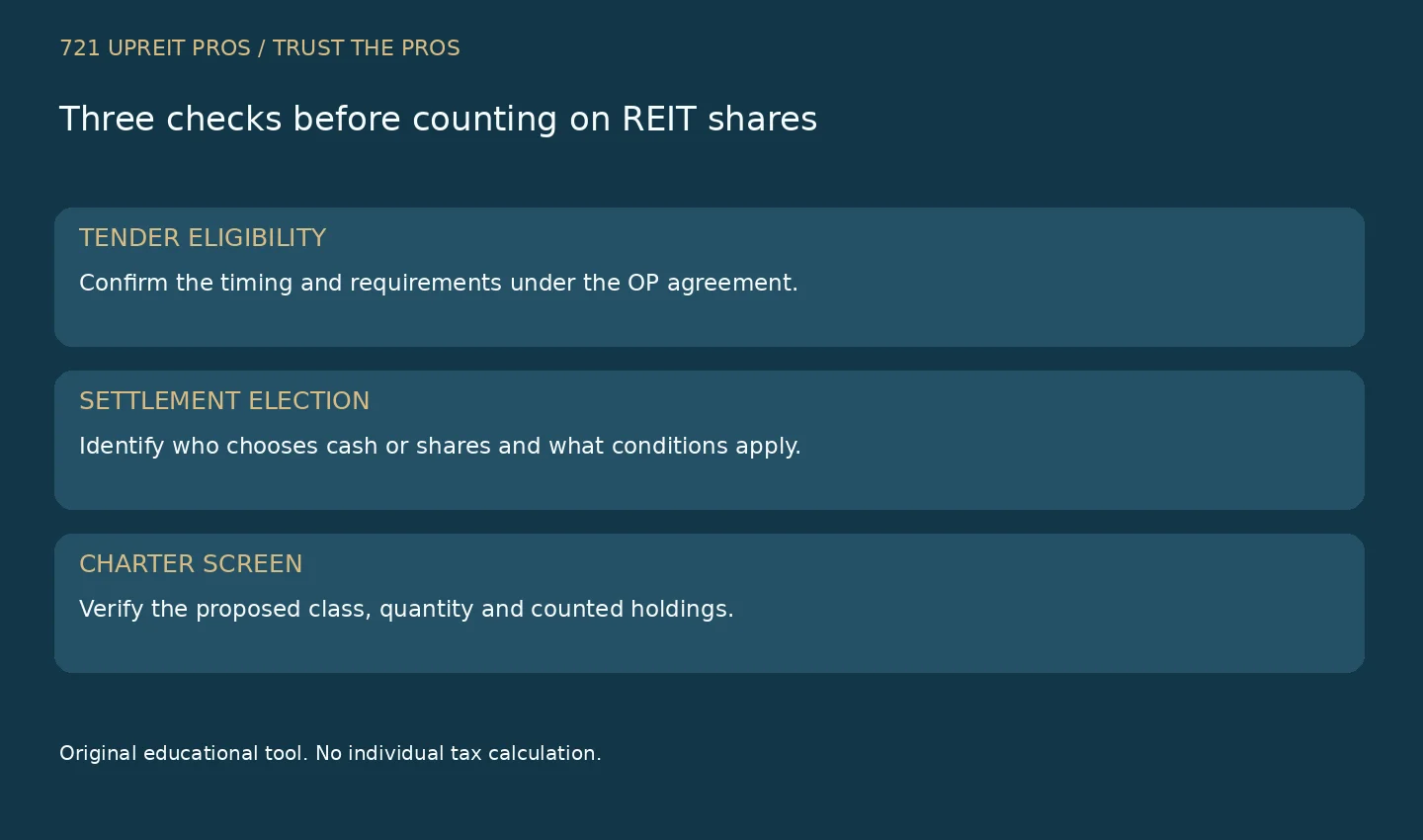
Which holdings count toward the cap?
The same filing describes separate common-stock and aggregate-stock limits. Each uses a 9.8% threshold measured by value or share count, whichever is more restrictive, subject to exceptions. The filing also discusses constructive ownership: holdings attributed through certain related individuals or entities can count even when an account statement does not show them under the recipient’s name. The issuer’s rules and the applicable attribution analysis matter more than an account nickname.
Ask the issuer for the actual ownership definition, relevant classes and denominator, the effective calculation date, and the form of ownership certification. Gather positions you already own and identify any related holdings that counsel or the issuer may need to evaluate. Do not assume every family or entity position counts, or that separating accounts removes attribution. The issuer may apply other tests independently of the headline percentage.
Ask who confirms the result, and when. A preliminary worksheet can flag a potential problem, but a dated confirmation for the named holder and proposed share amount is more useful than a general email about the program. If shares outstanding or your holdings change before settlement, ask whether a fresh review is required. A snapshot of yesterday’s shares outstanding is only an input.
How can the same holder pass one proposed amount and fail another?
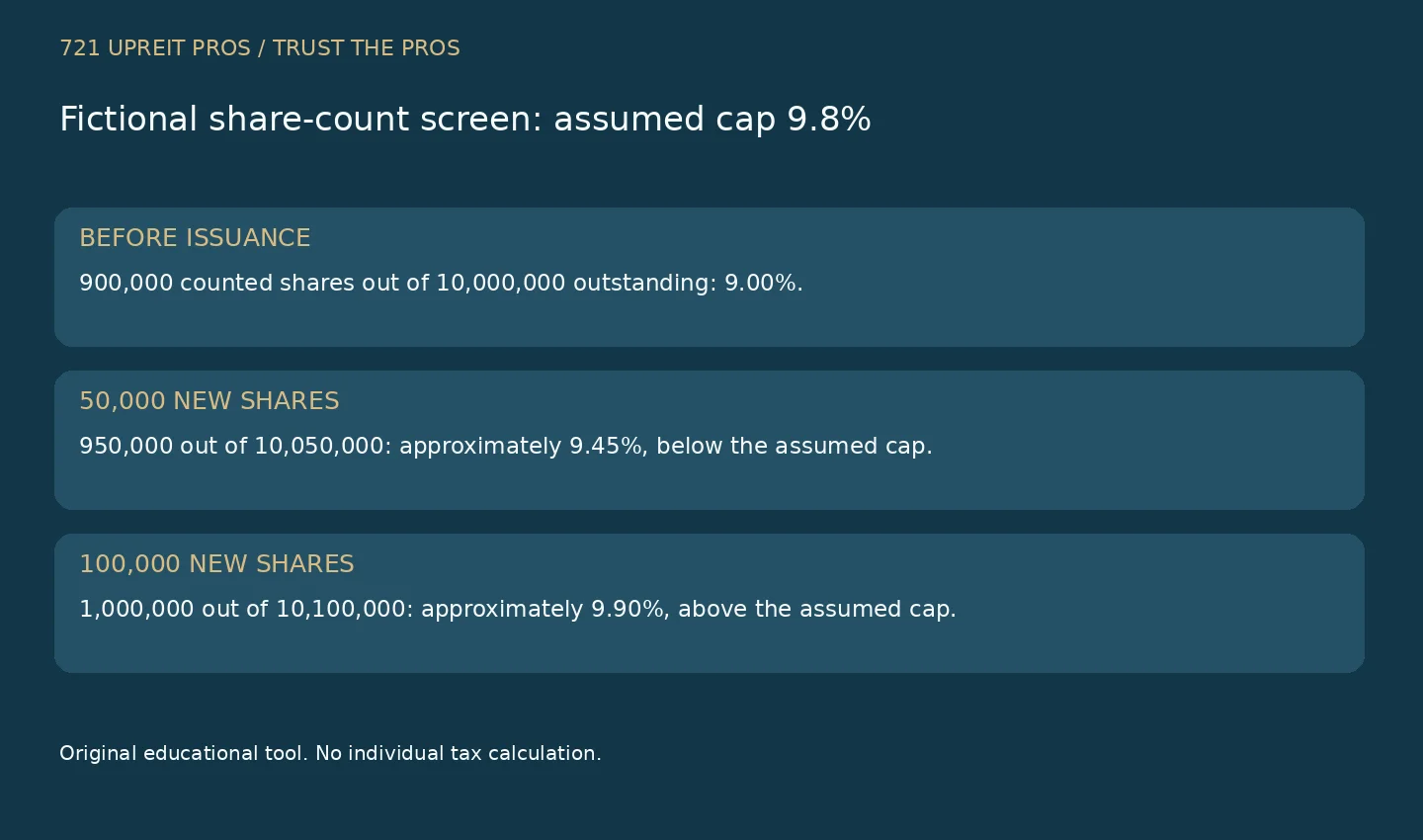
Assume a fictional charter applies only a 9.8% share-count cap for this exercise. Assume 10 million shares are outstanding before settlement and the holder is counted as owning 900,000, including existing attributed positions. Assume a one-for-one ratio, all settlement shares are newly issued, and no other shares or holdings change. This exercise ignores separate value and aggregate-stock tests; it is not a calculation for the named issuer above.
| New shares proposed | Counted shares after issuance | Total shares after issuance | Screening result |
|---|---|---|---|
| 50,000 | 950,000 | 10,050,000 | About 9.45%, below the assumed cap |
| 100,000 | 1,000,000 | 10,100,000 | About 9.90%, above the assumed cap |
Divide the counted holdings after issuance by the assumed total shares after issuance. The larger request crosses the screen even though the same holder was below the cap before settlement. If the contract uses another settlement ratio or the shares are already outstanding, the inputs can change. Even the smaller request is not cleared until the governing tests and other conditions are checked.
What should you do if the share route is restricted?
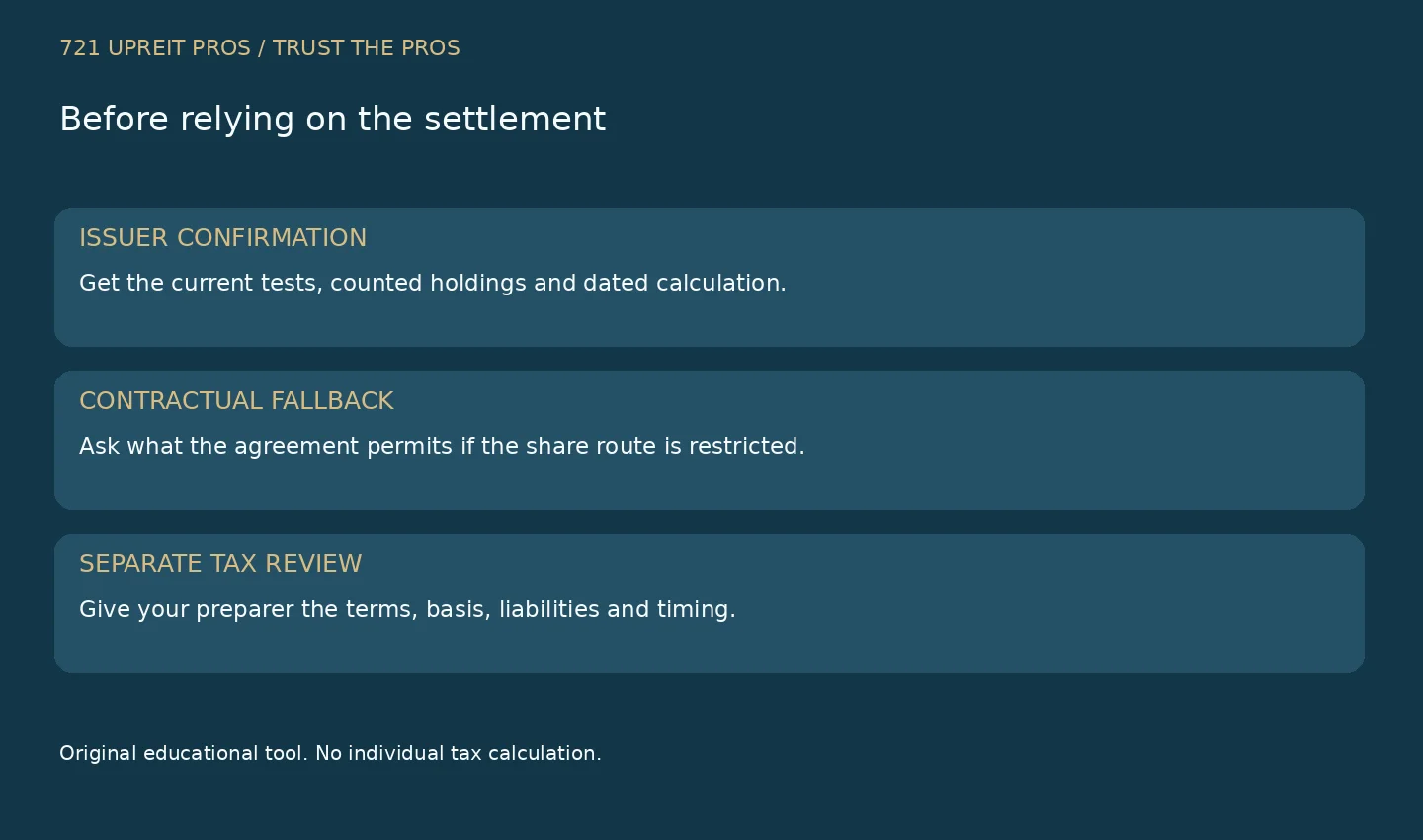
Locate the clause that connects an ownership restriction to the redemption procedure. Ask whether the agreement permits a smaller request, cash, a delay, withdrawal or another outcome. A cash right in one filing is not a universal substitute in another program. Ask who chooses the path, how any amount is valued, and whether timing, fees, queues or other terms change. Do not rely on a possible waiver. The Empire State filing describes discretionary exemptions subject to conditions, not a right to receive one.
Make a fallback plan based on cash you can actually access. Ask your tax preparer to evaluate settlement in cash or shares separately. The cited Empire State filing describes its share exchange as a taxable sale for federal purposes; that is different from evaluating nonrecognition on an earlier qualifying contribution. IRS Publication 541 explains the partnership contribution and disposition framework. A tax estimate needs actual basis, liabilities, transaction terms and investor facts.
For a prospective seller, coordinate the real estate sale and any Section 1031 exchange before closing. A qualifying DST can be evaluated as replacement property, and a later Section 721 contribution is a separate, conditional step. A later OP-unit redemption is another decision. See the main investor guide, the property-sale path comparison and the review of liquidity and control risks.
Write your request so that the answer can be checked later. For example: “For these units and this account, please identify the share class and number under consideration, the charter provisions used, the information needed from related holders, and who will confirm the result.” Ask whether the answer is an estimate, a conditional approval or a final determination. Save the dated response with the agreement version and any deadline for changing the request. If the response covers only your holding period, the share ownership check is still open. If it covers only share ownership, you still need the settlement election, pricing and expected delivery before you can use the result in a retirement cash plan.
- Identify the unit agreement, issuer and proposed share class.
- Request the current charter tests and counted holdings.
- Get a dated calculation for the proposed settlement quantity.
- Confirm the alternative in writing before relying on cash or shares.
- Review taxes and funding separately with your preparer.
Talk to a 721 UPREIT advisor about the documents to request, or request a callback. Keep private account and ownership records out of public forms.
Watch the one-minute share-limit review
This original silent video includes English captions and a complete transcript of its on-screen text.
Read video transcript
0:00 · Could a share limit apply?
A tender right does not alone permit delivery of REIT shares.
0:12 · Separate three checks
Tender eligibility, settlement election and charter limits.
0:24 · Use the right denominator
In this example new shares change both holdings and total shares.
0:36 · Compare the proposals
Fictional results: 9.45% and 9.90% against an assumed 9.8% cap.
0:48 · Verify the fallback
Get written terms and a separate tax review before relying on cash.
Download the ownership-limit review checklist
Primary sources checked November 6, 2026. No individual determination or independent expert review is established. Investments may lose value and remain illiquid. Conversion, distributions, returns and tax outcomes are not guaranteed.
Frequently asked questions
Is 9.8% a universal ownership cap?
No. It is the threshold described in the cited example and the fictional worksheet. Read the actual charter and any applicable exemptions.
Does holding fewer than 9.8% in one account clear the test?
No. Confirm whether constructive ownership or additional tests change the result. Account balances alone do not prove eligibility.
Does a lockup ending give me the right to receive shares?
Not by itself. Check who chooses the method and whether the charter permits that amount of the specific class.
Can the holder request fewer shares?
Ask whether the OP agreement permits a smaller tender or partial share settlement, and what minimums, deadlines or alternatives apply. The worksheet does not confer that right.
Can I rely on a waiver discussed by a salesperson?
No. Verify the decision maker, conditions and written approval. The cited issuer describes a discretionary exemption process.
Will a blocked share settlement automatically pay cash?
Do not assume it. Verify the contract’s actual alternative, pricing, timing and conditions for your units.
TALK TO A 721 UPREIT ADVISOR
Ready to discuss your 721 options?
Request a callback to discuss the questions raised by this article, your timing and what to ask before you commit. Share your name, email and phone below to start the conversation.
No investment commitment or financial documents required. A callback request does not book an appointment or establish an advisory relationship.