
721 UPREIT PROS / REVIEW SCOPE
721 UPREIT Conflict Reviews: Who Is Protected?
A 721 UPREIT conflict review does not automatically provide personal advice to the contributing investor. Identify who commissioned each review, the question examined, the interests considered and the permitted users of the result. Compare those limits with your own price, tax, liquidity and retirement questions before treating an approval or appraisal as sufficient evidence.
By 721 UPREIT Pros · Published October 28, 2026 · Original review-scope matrix
Key takeaways
- Identify who commissioned each review and whose interests it considers.
- Read report subjects, dates, assumptions and reliance limits separately.
- Company approval and a property valuation do not establish personal planning advice.
- Assign unanswered tax, cash-access and alternatives questions before relying on a summary.
The practical decision is what further work you need before accepting a proposal involving related parties. A presentation may describe independent directors, a valuation firm, a tax opinion and a financial professional. Those descriptions can refer to different assignments. Start with the 721 UPREIT risk framework and write down the exact transaction and legal entities instead of treating every review as one broad endorsement.
This article examines the scope and intended beneficiary of a review. The contribution-to-unit reconciliation handles the separate arithmetic, and the advisor-selection checklist addresses the professional you hire. A correct unit calculation or a properly registered professional does not, by itself, answer which transaction questions another reviewer actually considered.
TALK TO A 721 UPREIT ADVISOR
Talk to a 721 UPREIT advisor
Request a callback to discuss the questions raised by this article, your timing and what to ask before you commit. Share your name, email and phone below to start the conversation.
No investment commitment or financial documents required. A callback request does not book an appointment or establish an advisory relationship.

Why ask whose interests a review considers?
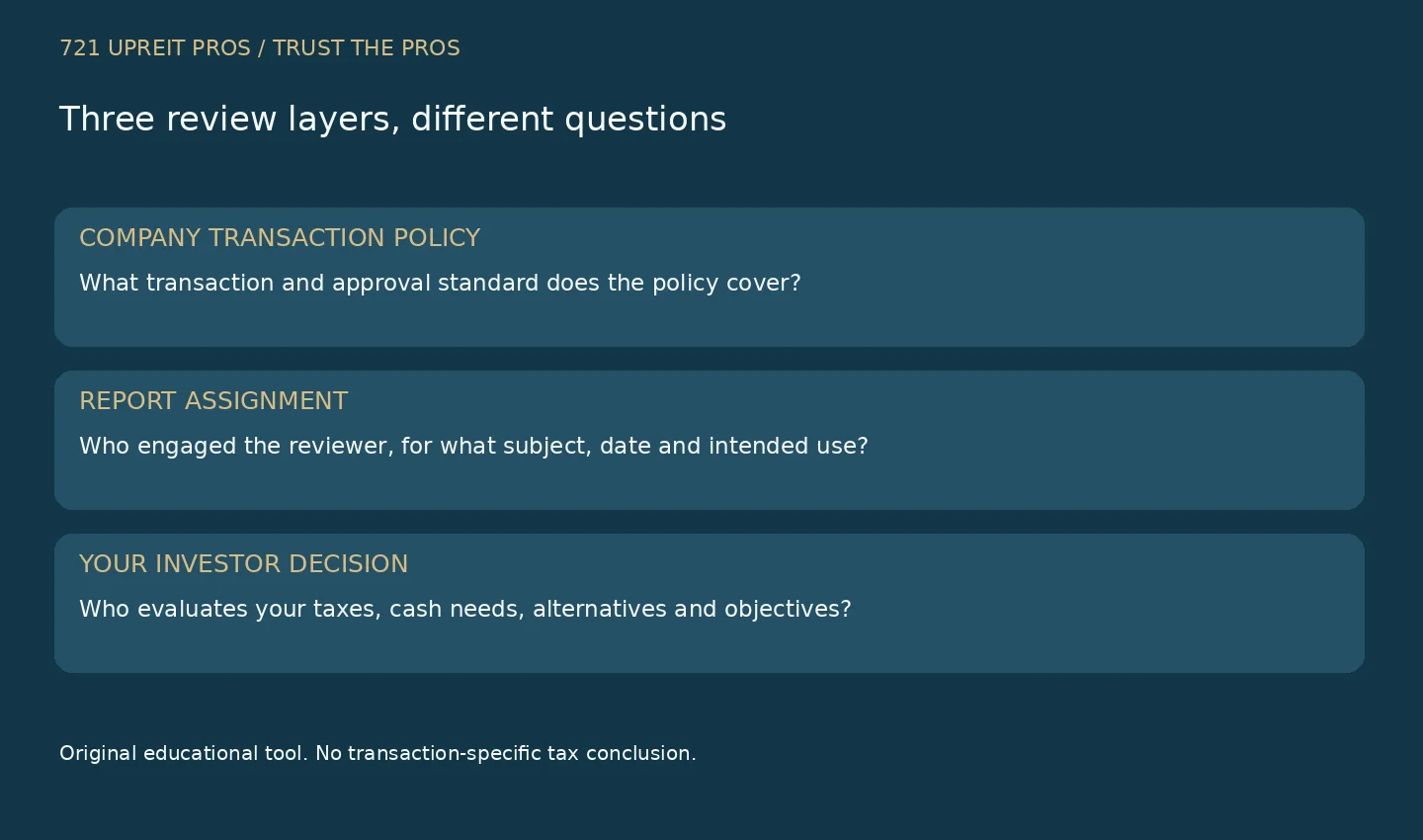
A review can examine a transaction for a particular company, board, lender or other party. That assignment should not be silently expanded into an opinion about your household. Ask the provider to identify the client, intended use, effective date, assumptions, limitations and any restrictions on relying on the result. If the full report is unavailable, request a written explanation of what the summary establishes and what remains outside its scope.
Keep the language precise. Independent directors, an independent valuation firm and your separately engaged attorney are different descriptions. Do not infer that they owe the same duties, reviewed the same materials or reached the same conclusion. Ask counsel to explain legal duties and reliance provisions where they matter. This worksheet organizes questions; it does not decide anyone's legal obligations or allege misconduct.
What does dated primary disclosure illustrate?
Hines Global Income Trust's April 10, 2026 filing describes a conflicts committee made up of independent directors and an affiliate-transaction policy. Subject to stated exceptions, specified transactions require approval as fair and reasonable to the company on terms no less favorable than available from unaffiliated parties. The filing also describes related roles in its DST program. Read those qualifications and the named beneficiary carefully.
This is a dated illustration of how a policy can be framed, not confirmation that a particular investor's contribution has been reviewed or that the same policy governs another program. A company-level approval description does not establish that someone examined your outside basis, required spending, need for control or alternative investments. Request the policy and review materials applicable to the actual proposal and have the appropriate professional identify what they mean for you.
FINRA Regulatory Notice 23-08 discusses member-firm investigation of private placements, including conflicts and related-party transactions. Its audience and duties differ from those of a company's board. Do not present a firm's investigation, a filing on EDGAR or a committee process as a government endorsement or an assurance against loss. Ask what work was done for this security and what unresolved concerns remain. The notice also explains that disclosing conflicts alone does not satisfy the obligation to act in a retail customer's best interest; scope questions do not remove a firm's applicable responsibilities.
Which questions belong in the review-scope matrix?
| Review described | Evidence to request | Question left open |
|---|---|---|
| Conflicts committee or board approval | Applicable policy, transaction covered and stated standard | Whose interests and which terms were considered? |
| Property appraisal or valuation | Assignment, effective date, assumptions and intended users | Does it address the property, interest, unit price or another subject? |
| Legal or tax opinion | Question addressed, assumptions, qualifications and reliance terms | Does it cover your actual facts and proposed documents? |
| Distributing firm's investigation | Firm's role, process and unresolved findings | Which risks or affiliate terms require further explanation? |
| Your individual planning review | Engagement scope and your documented objectives | Who evaluates personal liquidity, taxes, alternatives and implementation? |
For each row, add the document date, responsible contact and answer received. An empty cell is an unresolved question, not a failing score or proof of wrongdoing. If a reviewer cannot release confidential materials, ask what information can be provided and whether your own professional can evaluate the remaining uncertainty. Do not invent access rights, approval requirements or a personal veto because they would make the worksheet easier to complete.
How could three independent reviews answer different questions?
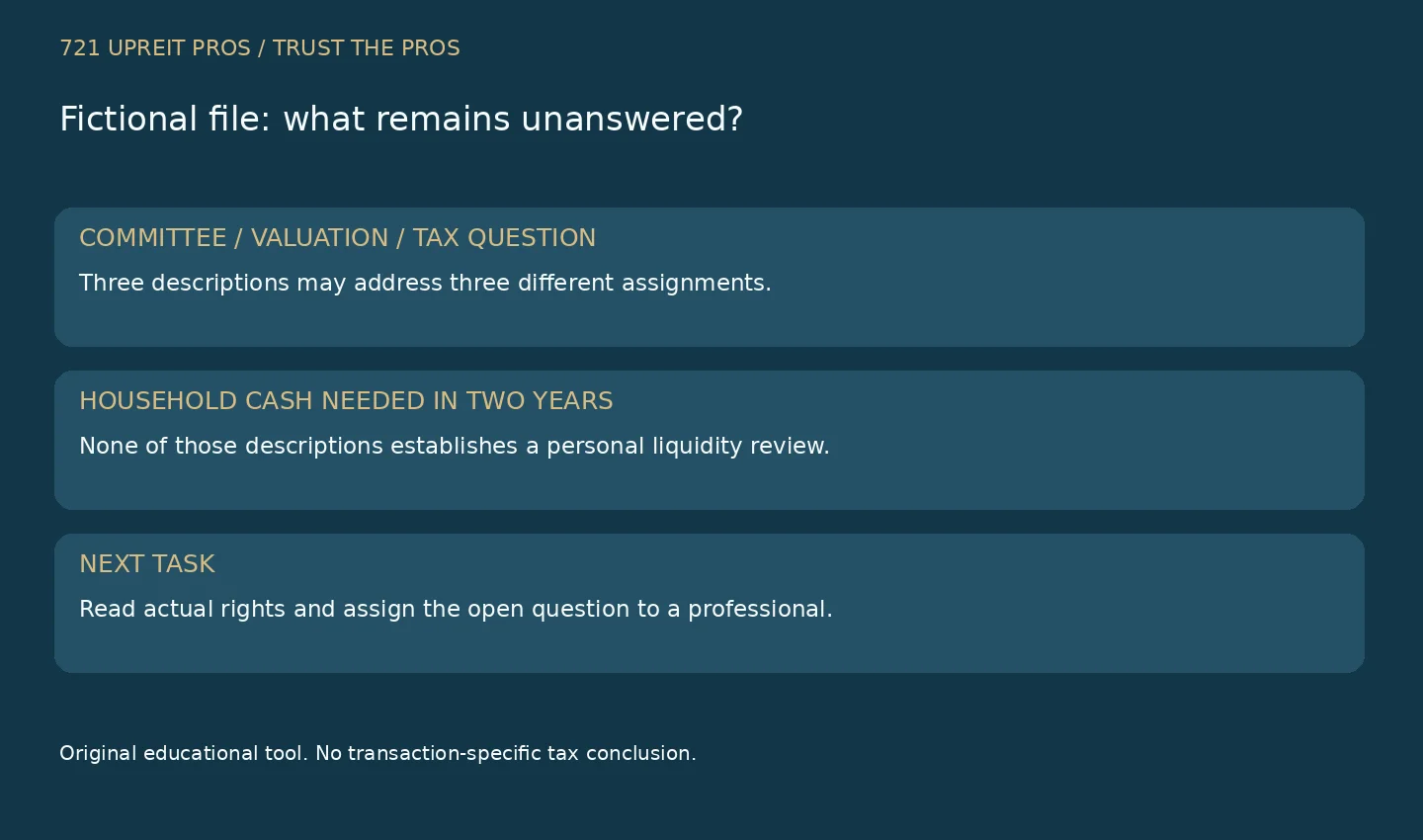
Consider a fictional contribution proposal involving an affiliated property vehicle and operating partnership. The investor receives three descriptions: a committee approved an affiliate transaction, a valuation firm reviewed property value, and counsel issued an opinion on a stated tax question. No actual sponsor or transaction is represented. The useful exercise is to assign each description to a task before deciding what it proves.
First, the investor asks which transaction the committee considered and the standard it applied. Next, the investor checks the valuation's subject and date, then asks how its conclusion connects to the contribution value and OP-unit issue price. Finally, the investor asks their tax professional whether the opinion's assumptions match their facts. A report about one property is not automatically a report about every term of the investor's exchange.
Suppose the only remaining blank concerns the investor's need for accessible cash within two years. None of the three descriptions establishes that this need was reviewed. The next task is a documented personal liquidity discussion using the actual unit agreements. The example does not show that the proposal is good or bad; it shows why several completed reviews can coexist with an unanswered investor decision.
How should you connect incentives to the actual decision?
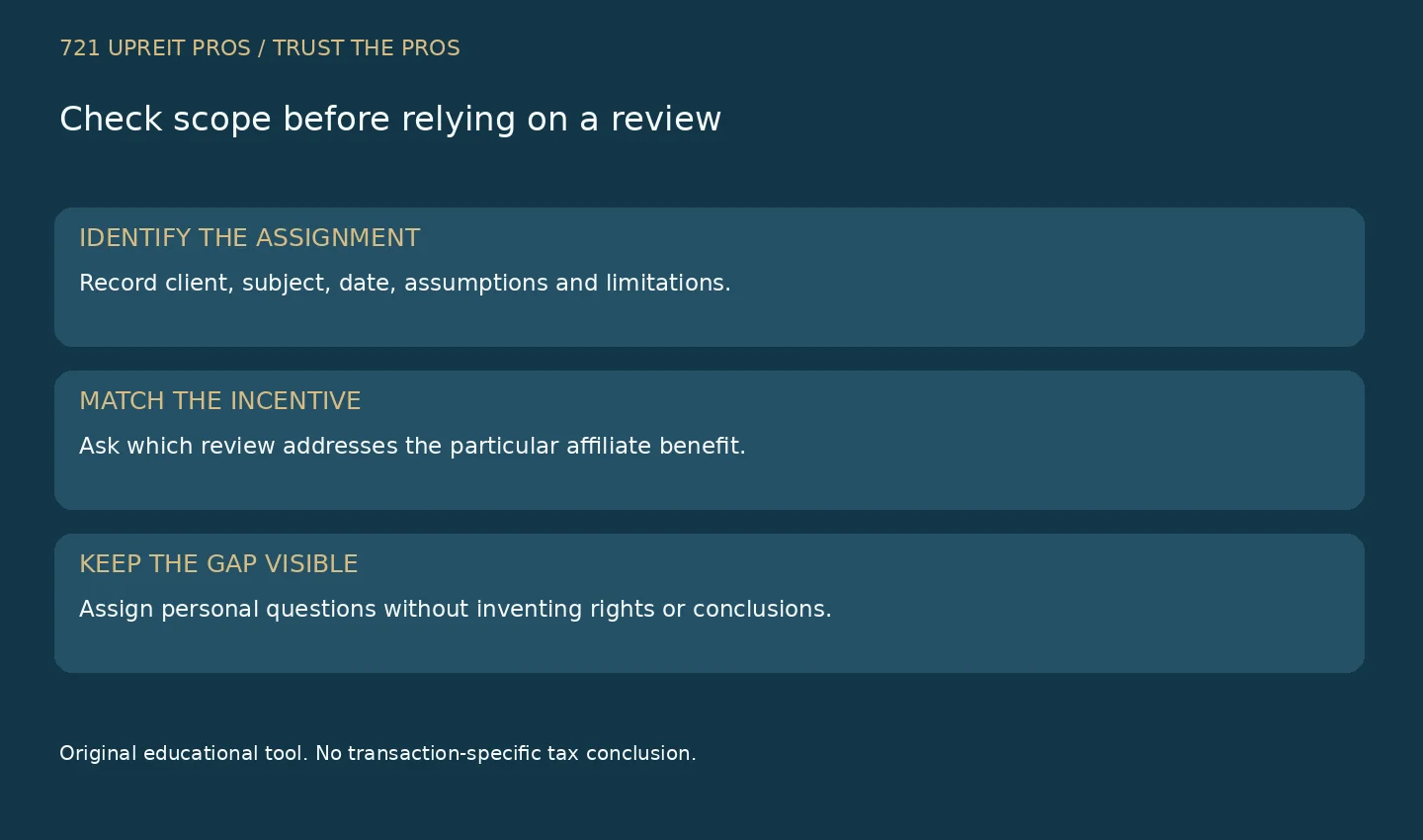
List the entity setting the proposed terms, the related party receiving an economic benefit and the decision that triggers that benefit. Ask for the relevant agreement and a written explanation of the relationship. Then ask which review, if any, addresses that specific issue. A disclosed affiliation is a reason for clear questions, not an automatic conclusion about misconduct or an instruction to reject the investment.
Keep the cost calculation in the full-life fee ledger. Here, the additional question is whether the review considered that payment or incentive and for whose benefit. Distinguish identifying a charge, reconciling its calculation and evaluating how it affects your choice. Do not presume that a reference to reasonable fees answers all three tasks.
What changes between a DST purchase and a later 721 proposal?
A qualifying Section 1031 DST acquisition and a possible later Section 721 contribution are separate decisions. The legal parties, terms and information available may differ. Before a property closing, coordinate any contemplated exchange with the appropriate professionals. At a later proposal, obtain the current contribution and partnership documents instead of assuming the initial DST review covers every future transaction.
The related DST conflict-of-interest questions address the initial trust-stage review. DST Experts' PPM reading guide helps organize offering disclosures. This article's separate task is determining the scope of an approval or report for the proposed 721 decision. Return to the canonical 721 UPREIT guide if the ownership stages are unclear.
What should you resolve before accepting the proposal?
- Identify the exact transaction, legal parties and interests received.
- List each review, its client, subject, date and stated limitations.
- Match each affiliate incentive to the review that addresses it.
- Separate documented conclusions from assumptions and missing answers.
- Assign personal tax, liquidity and alternative-investment questions to an appropriate professional.
- Record the answer, source and responsible person before relying on it.
Use the open questions when you talk through a 721 UPREIT proposal with an advisor or request a callback. Describe the question briefly. Keep confidential reports, tax returns and account identifiers out of public forms; use verified secure channels when documents are necessary. No expert review of an individual proposal is claimed here.
Watch the one-minute review-scope walkthrough
This original silent video includes English captions and the complete matching transcript below.
Read video transcript
0:00 · Whose question was reviewed?
Identify the client, subject and intended use of each review.
0:12 · Separate the review layers
Company policy, report assignment and personal planning differ.
0:24 · Read the stated limitations
Check date, assumptions, scope and permitted reliance.
0:36 · Keep unanswered needs visible
A fictional liquidity question can remain after three other reviews.
0:48 · Assign the next question
Use actual documents and the appropriate professional. No guarantees.
Download the review-scope checklist
Primary evidence checked October 28, 2026. The dated filing illustrates a policy, not current offering availability or individual approval. Investments can lose value and be illiquid; tax treatment, distributions and conversion are not guaranteed.
Frequently asked questions
Does independent committee approval mean the proposal suits me?
Not automatically. Identify the applicable standard and beneficiary, then separately evaluate your individual objectives and constraints with the appropriate professional.
Does a property appraisal establish all contribution terms?
Do not assume so. Check the assignment and connect the stated value to the proposed interest, contribution terms and unit-price calculation.
Can I rely on an opinion prepared for someone else?
Read the actual reliance and limitation language with counsel. This article does not establish a right to rely on or receive any particular report.
Does an affiliation prove misconduct?
No. Identify the specific incentive, decision and supporting agreement. Ask how the issue is reviewed without assuming that an affiliation alone establishes wrongdoing.
Does the initial DST review cover a later 721 proposal?
Treat the later proposal as a separate decision. Obtain current transaction documents and determine which earlier conclusions, assumptions or reports remain applicable.
What if the report or approval is unavailable?
Ask what explanation or supporting information can be provided. Record the limitation and have your professional assess the remaining uncertainty before treating the question as resolved.
TALK TO A 721 UPREIT ADVISOR
Ready to discuss your 721 options?
Request a callback to discuss the questions raised by this article, your timing and what to ask before you commit. Share your name, email and phone below to start the conversation.
No investment commitment or financial documents required. A callback request does not book an appointment or establish an advisory relationship.