
721 UPREIT PROS / TEXAS PROPERTY TRANSITIONS
Texas Land to an UPREIT: Does an Innocent Owner Certificate Transfer?
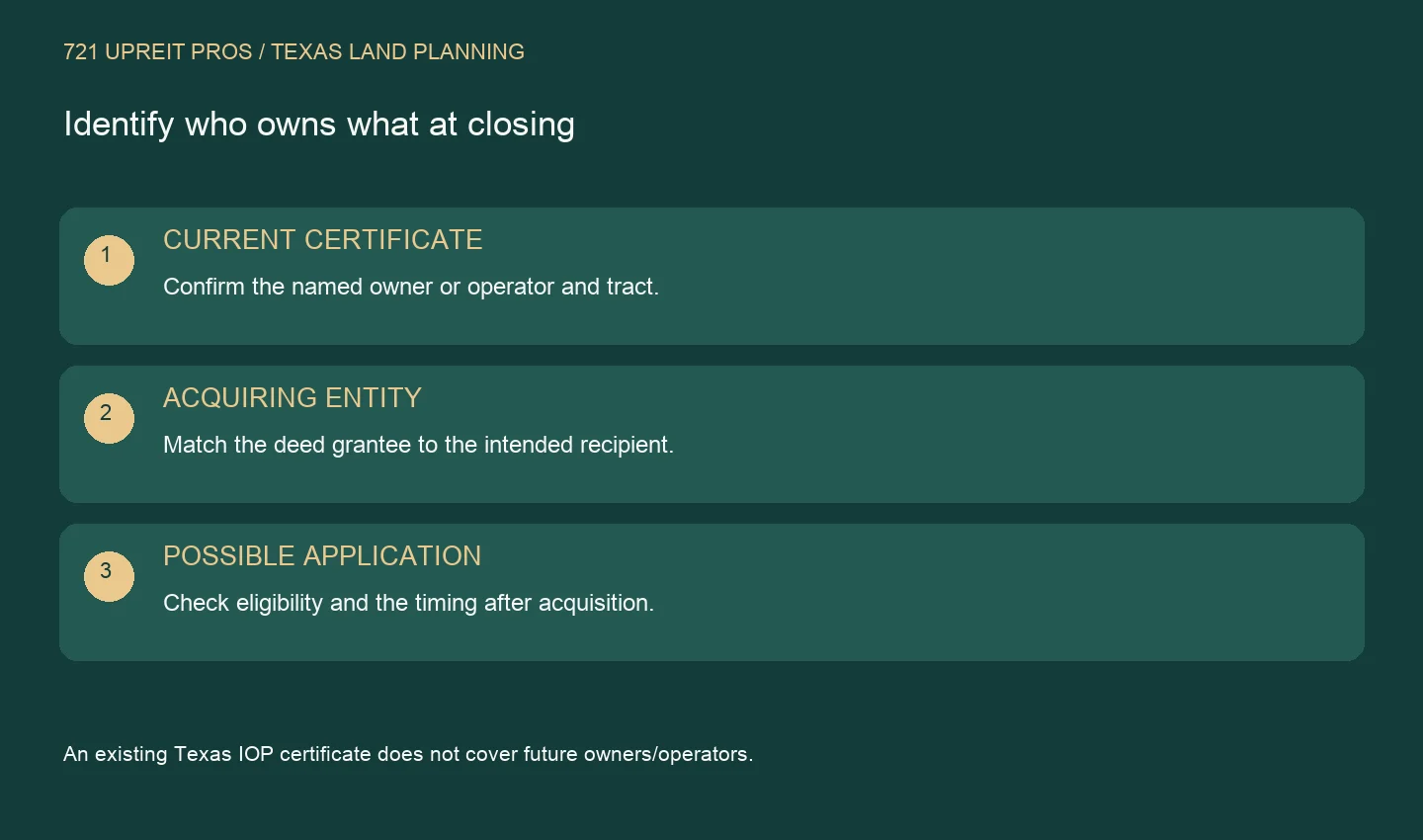
No. The Texas Commission on Environmental Quality says the immunity recognized by its Innocent Owner/Operator Certificate does not cover future owners or operators. An eligible successor may apply for its own certificate after it becomes an owner or operator. Before contributing land, ask counsel how the entity taking title will handle the gap between closing and any later approval.
Prepared by 721 UPREIT Pros · Published November 21, 2026 · General education

A landowner preparing to move may have a certificate issued to their current ownership entity and an operating partnership willing to review the property. Those facts do not answer who takes title, which legal protections that entity can rely on or who pays if the review changes. Use the Texas property-sale and relocation guide for the broader decision, then keep the narrow certificate question in the environmental closing file.
What does the existing certificate establish?
The Texas Innocent Owner/Operator Program addresses qualifying contamination from a source outside the property when the applicant did not cause or contribute to that source. Ask for the issued certificate, named owner or operator, attachments, legal description and any restrictions and agency correspondence. Compare those with the tract and rights the operating partnership, or its acquiring subsidiary, would actually take.
TALK TO A 721 UPREIT ADVISOR
Talk to a 721 UPREIT advisor
Request a callback to discuss the questions raised by this article, your timing and what to ask before you commit. Share your name, email and phone below to start the conversation.
No investment commitment or financial documents required. A callback request does not book an appointment or establish an advisory relationship.
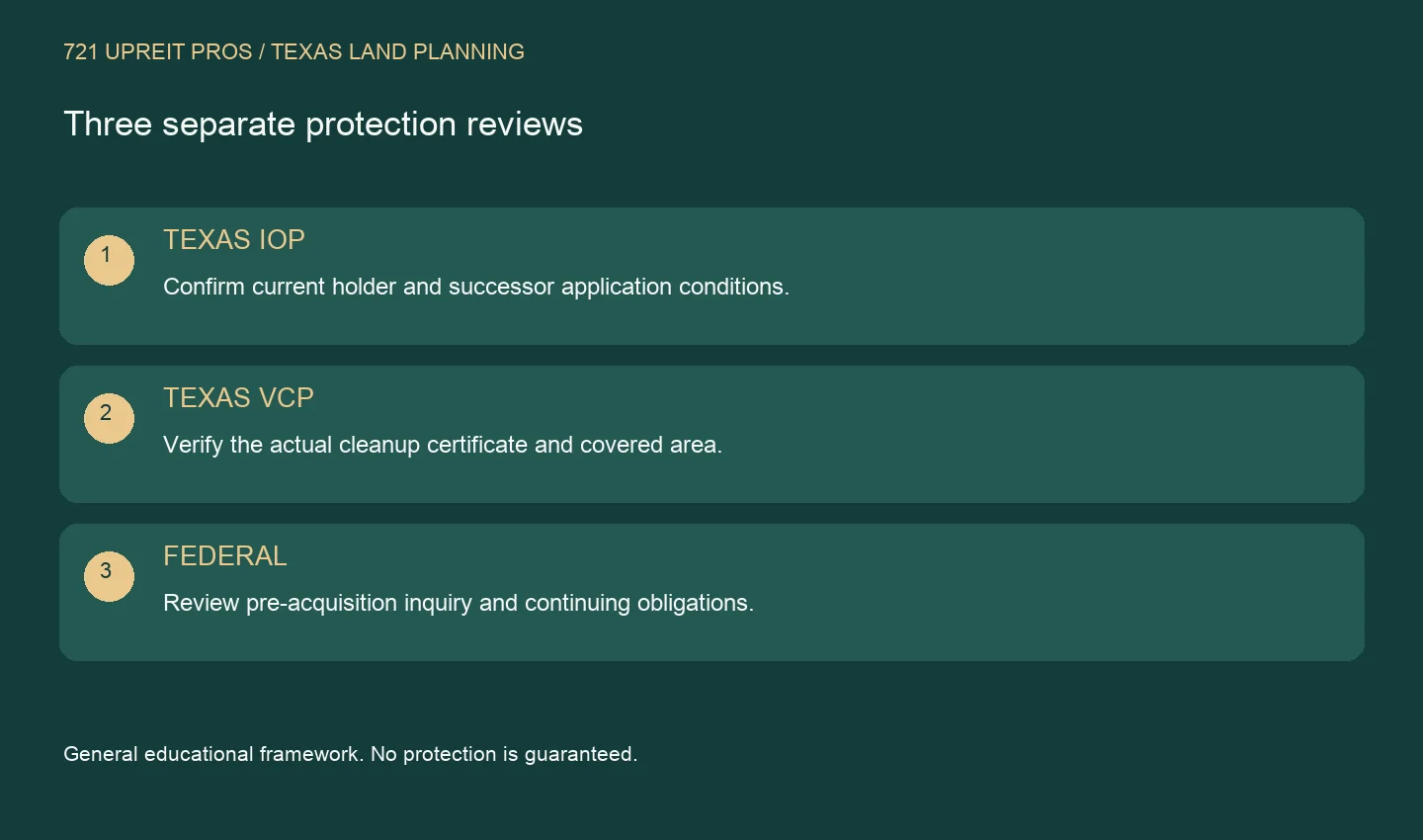
The agency distinguishes the current holder’s protection from the successor’s ability to seek a new certificate. A draft closing condition that assumes the buyer will already hold an issued certificate in its own name before it owns or operates the property needs legal review. Do not mistake an application, an indemnity or a seller assurance for agency approval.
How is a VCP certificate different?
The Texas Voluntary Cleanup Program describes a different certificate of completion. Qualifying non-responsible future owners and lenders may receive a release of liability to the state for cleanup of covered areas. Read the actual certificate, exhibits and limitations, including which acreage it covers and any continuing obligations. Do not substitute this rule for the IOP rule, or assume either document resolves federal, private-party or unexamined property claims.
The EPA All Appropriate Inquiries guidance addresses a separate pre-acquisition inquiry process. EPA lists ASTM E1527-21 and, for forestland or rural property, E2247-23 as recognized standards under the described rules. Ask an environmental professional which scope applies, whether the recipient can rely on the work and what gap remains. Federal prospective-purchaser protection has additional criteria and continuing obligations. A state certificate or a report title does not replace that analysis.
How should the closing team handle a gap?
Put a decision and an owner beside each item: counsel confirms the acquiring entity and possible legal protections; the environmental professional explains reliance and missing scope; the operating partnership determines its own acceptance; and lender counsel reviews applicable borrowing conditions. The direct-contribution acceptance guide covers other gates. A draft agreement should record who can defer or stop the closing and who pays for additional diligence, not assume each party has the same exposure.
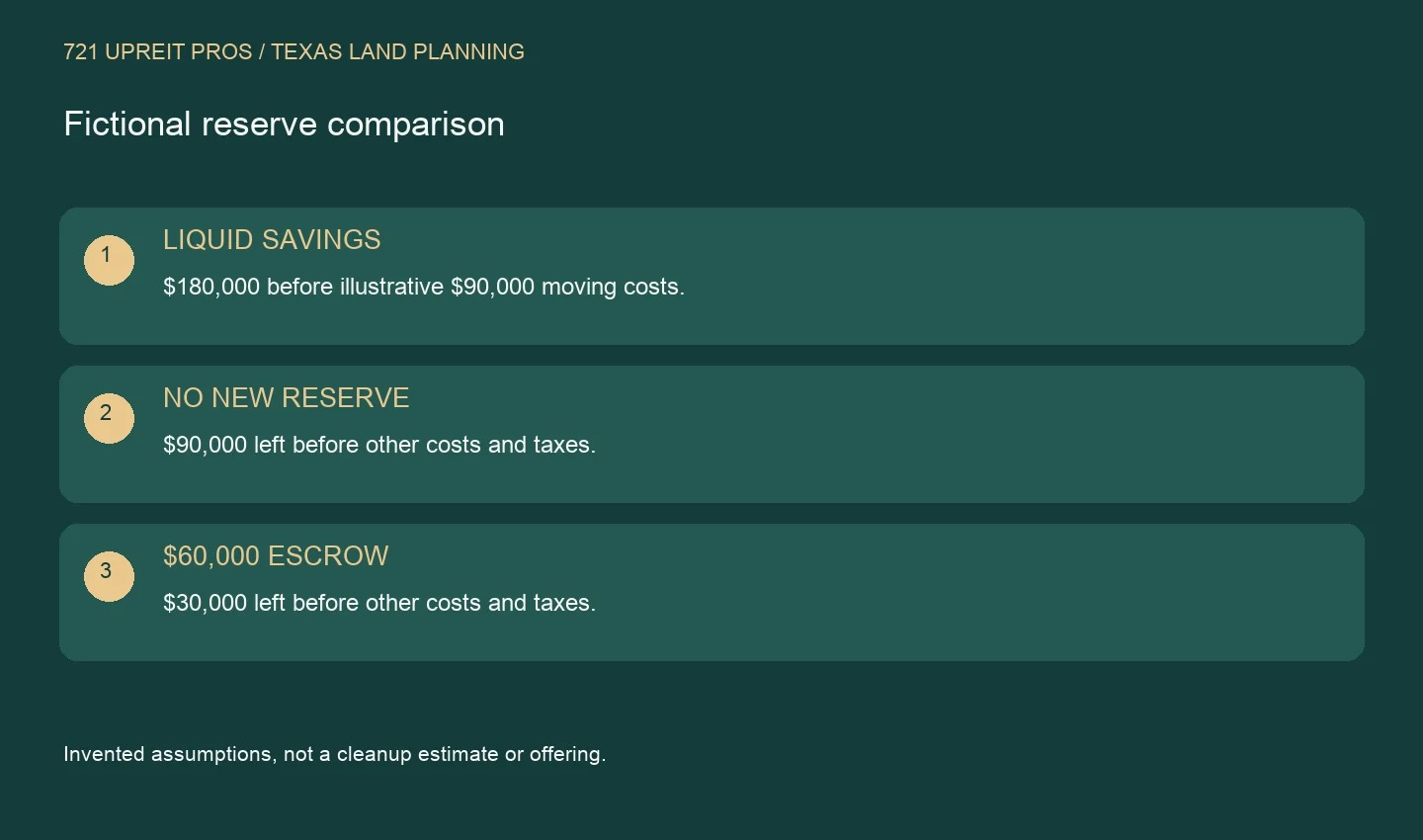
For a fictional example, assume a seller has $180,000 in liquid savings and expects $90,000 in moving costs. If counsel negotiates no seller-funded reserve, $90,000 remains before other costs. If the negotiated documents instead require a $60,000 seller-funded escrow, $30,000 remains before other costs. Those amounts are invented, not typical cleanup costs. Confirm who controls release and pays overruns. Neither reserve scenario substitutes for a liability determination or guarantees the transaction will close.
What remains a separate tax and investment decision?
A qualifying direct contribution to a partnership is distinct from a voluntary Section 1031 sale and replacement acquisition. See IRS Publication 541 and the transaction stages. Cash, debts and actual terms need separate tax review. Moving does not erase federal gain. Section 1031 generally applies to business or investment real estate rather than a personal-use home; the Section 121 home-sale exclusion has separate tests. A DST may serve as replacement real estate only in qualifying cases, not as a cure for proceeds already received. Neither an approval to take title nor a state certificate ensures tax deferral, future liquidity or a later conversion. Review fees, leverage, sponsor risk and whether enough cash remains available for the move.
Questions to ask before signing
- Which entity is on the current certificate, and which would take title?
- What off-site source and legal description were reviewed?
- Can the acquiring entity meet its own conditions at closing and afterward?
- Which exact parts of the parcel are covered or excluded from any separate VCP certificate?
- Who pays for new work and who controls release of any escrow?
Watch the one-minute document review
Read video transcript
0:00 · Name the current holder
Read the issued certificate and its tract description.
0:12 · Name the buyer
The old IOP certificate does not cover a successor.
0:24 · Compare the programs
A cleanup certificate is different. Read its scope.
0:36 · Check the cash plan
Compare any escrow against independent moving funds.
0:48 · Before signing
Ask counsel about protection at closing and afterward.
Primary sources checked November 21, 2026. General education, not an environmental opinion, cleanup estimate, individualized tax, investment or legal advice, or review of a specific offering.
BEFORE YOUR ADVISOR CONVERSATION
Three questions before you commit
This companion briefing covers the professional's identity, compensation and how restrictions fit your cash needs. Use it alongside this article's specific document checks.
Loading the video connects to YouTube. Watch on YouTube · 721 UPREIT Pros channel · Read the full advisor checklist.
Read video transcript
Before you hire a seven twenty-one UPREIT advisor, ask these three questions.
First: who exactly am I hiring? Get the professional's legal name, firm and registration information. Check the record through Investor dot gov and read the firm's relationship summary where applicable. Ask whether this conversation involves brokerage services, investment advice, or both. A marketing title alone does not answer that question.
Second: who gets paid, and how much? Request a written cost breakdown in dollars. Identify the payer, calculation base, payment timing and ongoing charges. Include product expenses and embedded compensation. No separate advisor invoice does not mean there are no costs.
Third: how does this fit my cash needs? Review the actual agreements. Ask who controls a possible conversion and what happens if it does not occur. Separate permission to request redemption from approval, pricing and payment. Do not assume a fixed cash-out date.
Then agree on responsibilities. Your investment professional, CPA, attorney and qualified intermediary can have different roles. Put continuing service and unresolved questions in writing.
Read the complete advisor checklist using the article link in the description. Seven twenty-one UPREIT Pros. Trust the Pros. Educational only. Investments involve risk and may be illiquid. Tax treatment depends on your circumstances.
Educational only. Investments involve risk and may be illiquid. Footage is illustrative; narration is synthetic.
TALK TO A 721 UPREIT ADVISOR
Ready to discuss your 721 options?
Request a callback to discuss the questions raised by this article, your timing and what to ask before you commit. Share your name, email and phone below to start the conversation.
No investment commitment or financial documents required. A callback request does not book an appointment or establish an advisory relationship.