
721 UPREIT PROS / INVESTOR TAX PLANNING
721 UPREIT: Do OP Units Get the REIT Dividend Deduction?
Cash from 721 UPREIT operating partnership units does not automatically qualify for the Section 199A REIT dividend deduction. Start with what you own and how the payment or income is reported. A REIT shareholder may have qualifying dividends, while an OP-unit holder needs the partnership’s Schedule K-1 and supporting Section 199A statement.
By 721 UPREIT Pros · Published November 4, 2026
Key takeaways
- Identify whether you hold a partnership interest or REIT stock before classifying cash payments.
- Check Form 1099-DIV box 5 or the K-1 Section 199A statement for the reported categories.
- Equal cash can lead to unequal preliminary deduction amounts.
- Have the preparer confirm the applicable limits and run a cash budget without unsupported deductions.
Two investors can receive the same cash from the same real estate platform and have different tax inputs. A payment from a partnership and a dividend on stock can look alike on a bank statement. The distinction matters when a projected deduction is part of an after-tax income comparison or a budget for retirement spending.
Use this guide to test the assumptions in that comparison before relying on it. It supports the main 721 UPREIT investor guide. The decision here is narrower: which documents establish potential Section 199A amounts, and what should you do if the income illustration does not distinguish the securities?
TALK TO A 721 UPREIT ADVISOR
Talk to a 721 UPREIT advisor
Request a callback to discuss the questions raised by this article, your timing and what to ask before you commit. Share your name, email and phone below to start the conversation.
No investment commitment or financial documents required. A callback request does not book an appointment or establish an advisory relationship.

Why can the same real estate platform produce different tax documents?
In a 721 UPREIT, an operating partnership, or OP, can own properties, and the REIT can hold an interest in that partnership. An outside investor may hold units of the partnership instead of shares of the REIT. Start by matching the legal issuer and exact security on the executed agreement to the account statement. A parent brand or a shared distribution rate does not identify the holder’s tax classification.
Section 721 generally addresses whether gain or loss is recognized on a qualifying property contribution to a partnership, subject to exceptions. Section 199A addresses certain income reported for the tax year. The IRS partnership guide explains the contribution framework. Keep the projected contribution tax treatment separate from annual ownership and any later exchange or redemption.
If you are still evaluating a property sale, coordinate with your qualified intermediary and tax team before closing if a Section 1031 exchange is contemplated. A qualifying DST interest can be evaluated as replacement real property under its own rules; a later Section 721 contribution is a separate transaction and may never occur. The transaction sequence guide explains when those choices arise. None of those steps alone establishes a Section 199A amount.
What supports a qualified REIT dividend?
The IRS overview of Section 199A describes a deduction for eligible taxpayers that can include 20% of qualified REIT dividends and qualified publicly traded partnership income, subject to applicable limits. Qualified business income from eligible trades or businesses is a separate component. Neither component is calculated as a percentage of all cash paid by an investment.
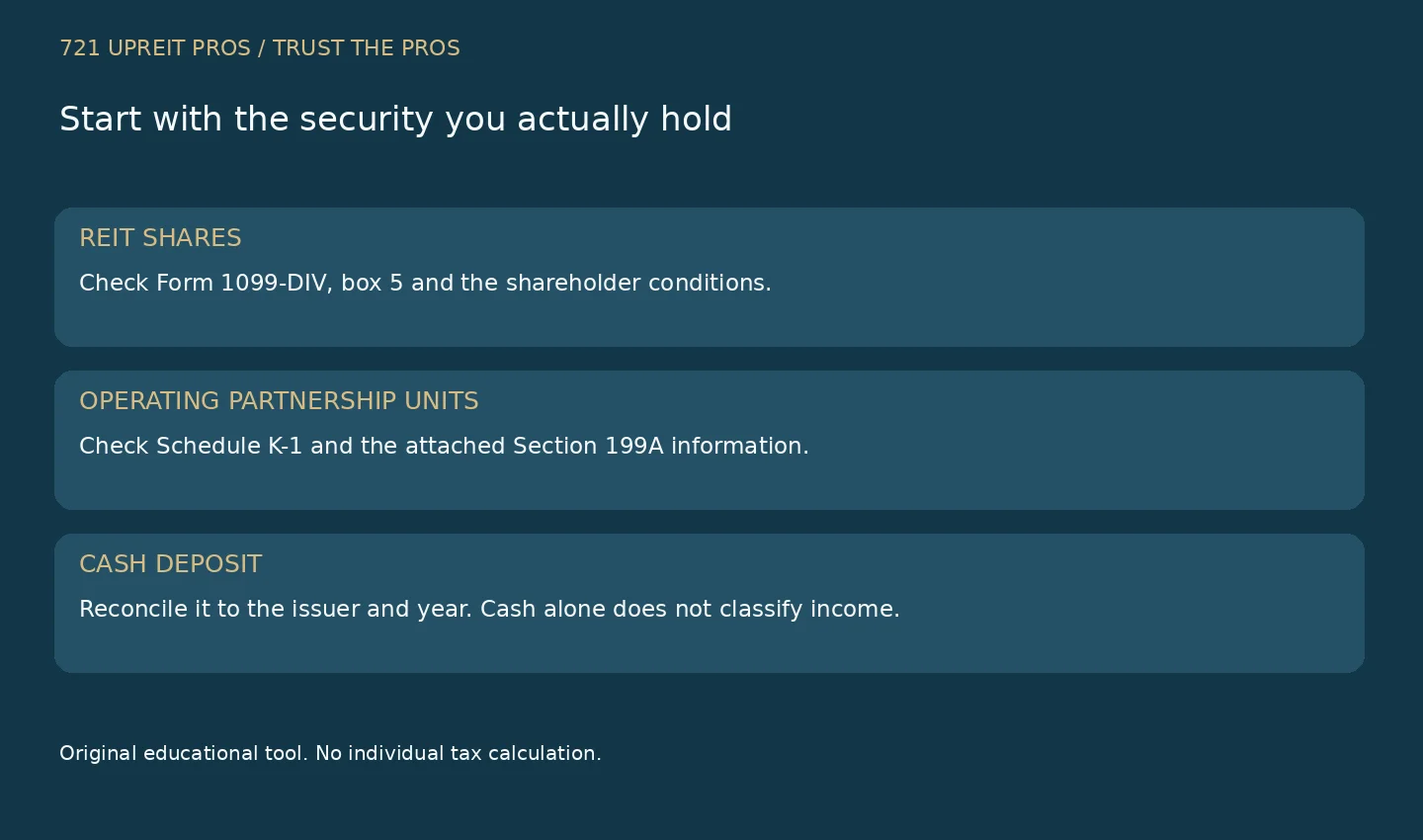
For a direct REIT shareholder, begin with Form 1099-DIV, box 5. Amounts in box 5 are also included in box 1a. Do not count the same dollars twice. Qualified REIT dividends for this purpose exclude capital gain dividends and qualified dividend income under the separate preferential dividend tax rules. The holding period and any obligation to make related payments can also affect whether an amount qualifies. A reported amount is a starting point for the preparer’s review.
For an OP-unit holder, get the full Schedule K-1 package. The partnership instructions distinguish Section 199A information in box 20, code Z and its attached statement, from cash distributions. The attachment can separately report qualified business items or Section 199A dividends that actually pass through. Receiving a K-1 does not establish either amount, and it does not rule out a properly reported pass-through dividend. Ask the issuer for the missing statement rather than substituting a cash figure or assuming a zero is final.
| What you have | What to verify | What remains open |
|---|---|---|
| REIT share statement and Form 1099-DIV | Identify box 5, share dates and any applicable holding-period issues. | Eligible amount after taxpayer-level limits. |
| OP-unit statement and Schedule K-1 | Read code Z and the supporting statement by category. | Whether any qualified business income or pass-through REIT dividends enter the calculation. |
| Cash ledger or projected yield only | Reconcile deposits to the issuer and tax year. | No supported deduction amount from the cash ledger alone. |
What if two investors both receive $12,000?
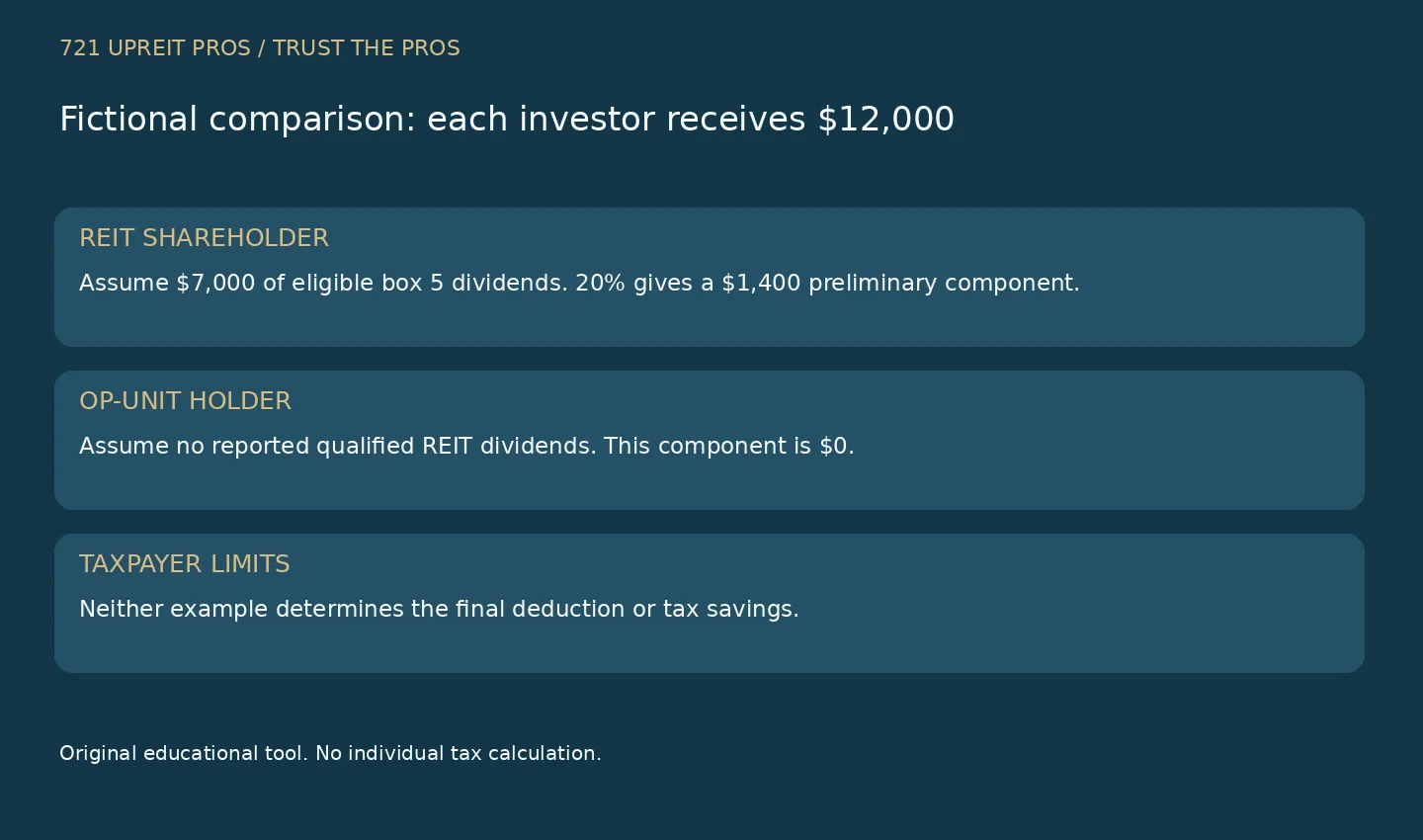
Assume two fictional individuals each receive $12,000 cash from their respective holdings in a year. Investor A owns REIT shares. Assume $12,000 is in box 1a, including $7,000 reported in box 5, and the entire $7,000 meets the shareholder-level conditions. The preliminary qualified REIT dividend component is $1,400, or 20% of $7,000. The remaining $5,000 is outside that box 5 calculation.
Investor B owns OP units. Assume the complete partnership statement reports no pass-through qualified REIT dividends. The $12,000 cash payment generates no qualified REIT dividend component in this example. If the statement separately reports a qualified business item, that item needs its own calculation and limits. A missing statement would instead make the evidence incomplete. Neither example estimates the investor’s final deduction or the tax on their holdings.
Investor A’s $1,400 is an amount considered in computing a deduction, not $1,400 of savings or a tax credit. The taxpayer’s complete calculation can be limited, including by taxable income reduced by net capital gain. The IRS Form 8995 instructions and Form 8995-A instructions describe the computation paths. Use the applicable year’s form and instructions; the examples here do not assume a filing threshold or other household income.
What should you compare before relying on an after-tax projection?
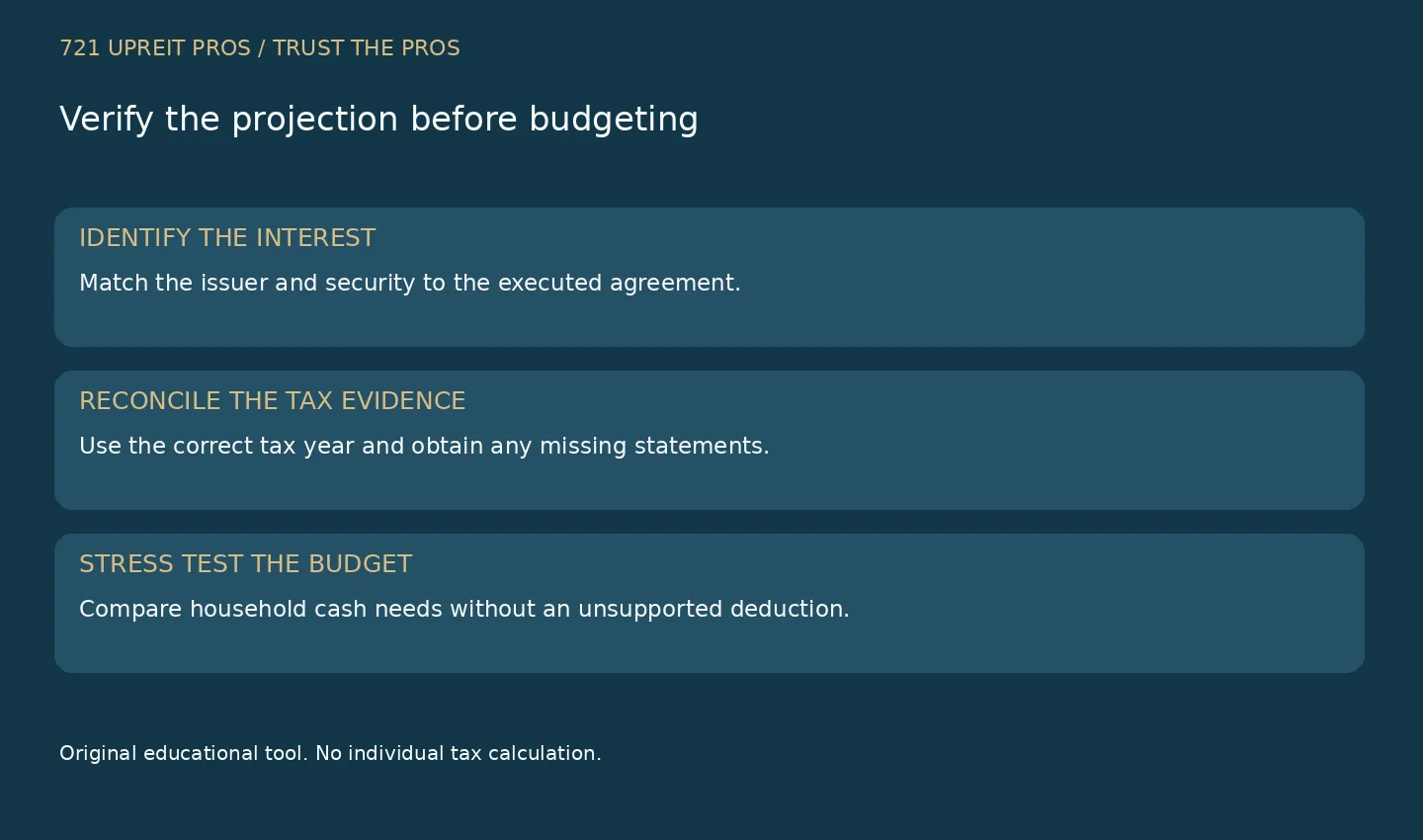
Ask for a written breakdown by issuer, instrument and year. For a proposed investment, request a representative tax package with private information removed and ask who prepares the estimate. Mark each number as actual, illustrated or unresolved. A prior-year example helps identify which documents to expect but cannot establish what will be reported next year.
If an illustration applies a fixed deduction to every projected distribution, ask which dollars are expected to qualify and on what evidence. Run a second budget without the unverified deduction. Keep that budget separate from the worksheet for funding tax when investment cash is short. A possible reduction in taxable income does not increase the cash the investment pays or make it redeemable.
If you may move from units to shares, ask for separate records for the period of partnership ownership, the transaction itself and subsequent stock ownership. The OP-unit conversion checklist explains what to verify before requesting that move. For the earlier stage of a DST investment, see how DST tax records differ after a 1031 exchange and which records to organize for a DST tax preparer.
Which questions should go to your advisor and CPA?
- What exact entity and security will I hold at each stage?
- Which tax documents and attachments should I expect, and from whom?
- What amounts in the projection are supported by actual reporting?
- What conditions and taxpayer limits should the CPA check?
- How does the household cash plan work if the deduction is smaller or unavailable?
Talk to a 721 UPREIT advisor about what the investment documents promise and what remains an assumption, or request a callback. Have your tax preparer reconcile the actual return inputs. Use a verified secure channel for tax forms and account records.
Watch the one-minute tax document walkthrough
This original silent video includes English captions and a complete transcript of the on-screen text.
Read video transcript
0:00 · Same cash, different tax inputs
Start with the issuer and security on the executed agreement.
0:12 · Check the reporting source
REIT shares: 1099-DIV box 5. OP units: K-1 and its attachment.
0:24 · Compare equal cash
Both receive $12,000. Only the fictional shareholder has $7,000 in qualifying dividends.
0:36 · Apply the right limits
$1,400 is a preliminary component, not the final deduction or tax savings.
0:48 · Review the projection
Get the full documents and budget without unsupported deductions.
Download the Section 199A document checklist
Primary sources checked November 4, 2026. This educational article does not determine any taxpayer’s deduction. No independent expert review is established. The investment can lose value or remain illiquid; conversion, distributions, returns and tax outcomes are not guaranteed.
Frequently asked questions
Can I multiply my OP-unit distributions by 20%?
No. Cash received does not determine qualified REIT dividends or qualified business income. Use the relevant tax statements and have your preparer calculate any deduction.
Does box 5 add taxable dividends on top of box 1a?
No. Box 5 amounts are already included in box 1a. It identifies a subset relevant to Section 199A.
Does a blank or missing K-1 attachment establish zero?
A missing attachment is incomplete evidence. Ask the issuer whether it should have provided a Section 199A statement and get the complete or corrected package before treating any amount as final.
Can a K-1 ever report qualified REIT dividends?
Yes. A partnership can report its share of qualifying REIT dividends passed through to a partner. That category comes from the statement and applicable rules, independently of how much cash the OP paid.
Does switching to REIT shares settle the deduction question for the whole year?
No. The preparer should distinguish the unit period, the transaction and the share period, and check applicable holding requirements on later dividends.
Will a $1,400 preliminary component lower my tax bill by $1,400?
No. A deduction generally reduces the income subject to tax. The final deduction and tax effect depend on the rest of the return and applicable limits.
TALK TO A 721 UPREIT ADVISOR
Ready to discuss your 721 options?
Request a callback to discuss the questions raised by this article, your timing and what to ask before you commit. Share your name, email and phone below to start the conversation.
No investment commitment or financial documents required. A callback request does not book an appointment or establish an advisory relationship.