
721 UPREIT PROS / LOSS DEDUCTION REVIEW
721 UPREIT Tax Losses: Can You Deduct a K-1 Loss?
A loss reported on a 721 UPREIT operating partnership's Schedule K-1 is not automatically deductible on your return. Your tax professional must review your basis, amount at risk, passive activity treatment and other applicable limits. Keep unallowed amounts identified by reason, and do not budget a refund from the reported loss alone.
By 721 UPREIT Pros · Published October 30, 2026 · Original loss-review worksheet
Key takeaways
- A reported K-1 loss is not automatically a usable deduction.
- Separate basis, at-risk, passive and other applicable reviews.
- Keep unallowed amounts traceable by activity, year and limiting rule.
- Do not budget an assumed refund or trade solely to release losses.
The investor decision is whether an expected tax deduction belongs in your spending or investment plan. You may already own OP units and have received a loss estimate or annual tax package. Start with the actual partnership, activity and tax year. The 721 UPREIT risk framework provides the broader investment context; a tax estimate does not remove illiquidity or loss of principal.
This article addresses the path from a reported partnership loss to an individually reviewed deduction. The cash-tax reserve worksheet answers the different question of funding taxes when cash is insufficient. Neither tool replaces your preparer's return calculations, and neither assumes that every OP-unit holder has the same tax position.
TALK TO A 721 UPREIT ADVISOR
Talk to a 721 UPREIT advisor
Request a callback to discuss the questions raised by this article, your timing and what to ask before you commit. Share your name, email and phone below to start the conversation.
No investment commitment or financial documents required. A callback request does not book an appointment or establish an advisory relationship.

What does a reported loss establish?
The IRS Partner's Instructions for Schedule K-1, Form 1065 explain that an individually deductible loss can be smaller than the reported amount. They list basis, at-risk, passive activity and excess business loss limitations in that order, while noting that specific deduction limits may also apply. The investor's capital account is not a substitute for outside basis.
Use that distinction when reading a sponsor estimate. Ask whether the number describes property operations, partnership tax reporting or a conclusion about your own return. A negative number in one document does not answer all three questions. Preserve the document date and assumptions, and replace preliminary inputs with the final tax package when it arrives.
Identify whether the information describes one activity or several. Ask the preparer which items need separate treatment and what additional statements are missing. Avoid combining every negative amount into one planning number. A complete package can still require individual calculations, but an incomplete package makes it harder to explain how the result was reached.
Which review questions belong in separate columns?
| Review layer | Evidence to organize | Question for the preparer |
|---|---|---|
| Reported partnership item | Complete K-1, activity statements and corrections | What amount, activity and year are being evaluated? |
| Outside basis | Prior basis schedule and current changes | What loss can proceed past this limitation? |
| Amount at risk | Financing and protection information | Does a separate restriction apply? |
| Passive activity treatment | Activity classification and prior carryforward schedules | What amount is usable under the applicable rules? |
| Other return limits | Current taxpayer-level calculation and instructions | What further review remains before a final deduction? |
Give each row an owner, a source date and a status such as complete, estimated or awaiting information. This is an organizational aid, not a formula for calculating basis or an instruction to select a favorable classification. If the answer changes, preserve the prior version and the reason for the revision rather than silently overwriting the file.
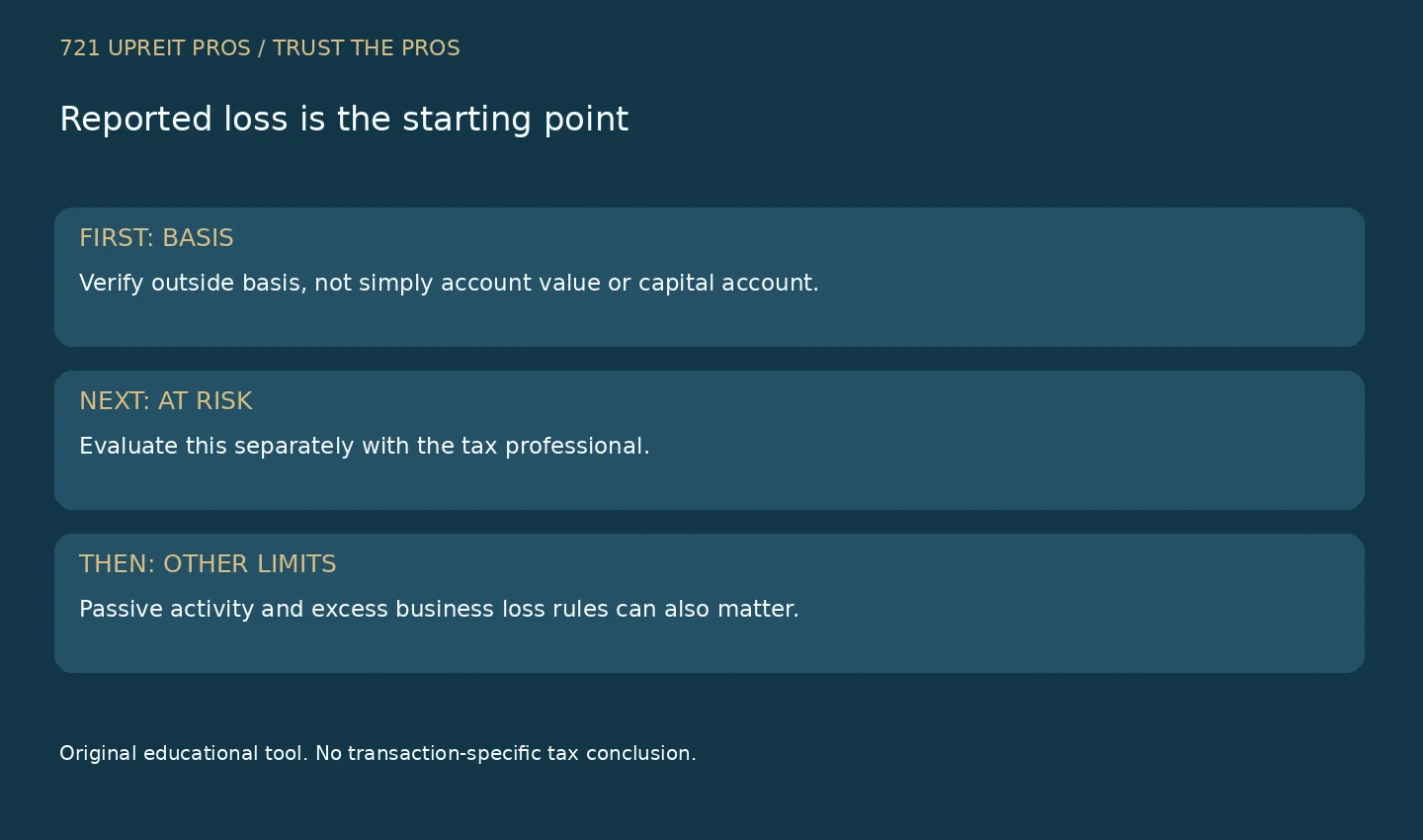
How could one reported loss create several different balances?
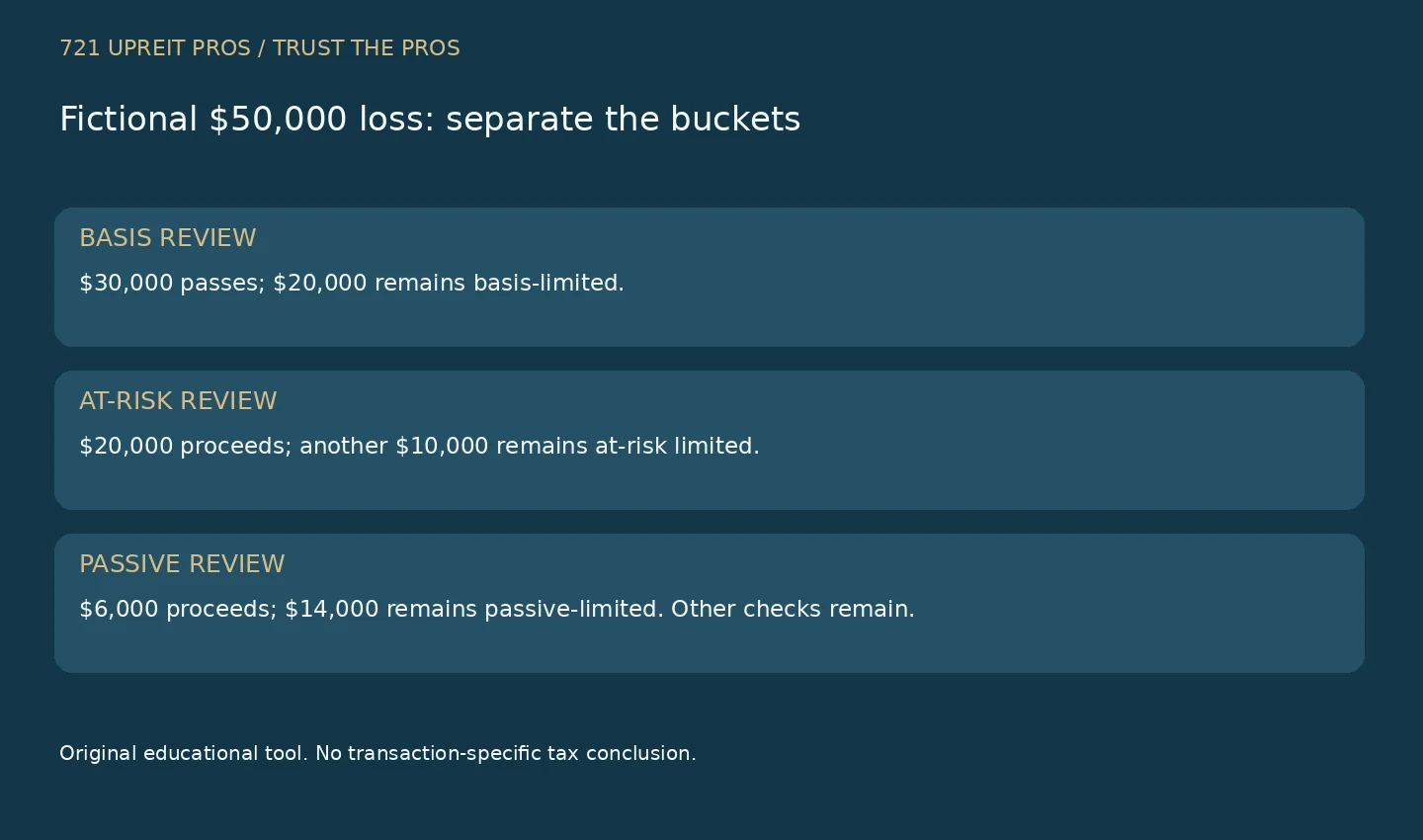
Consider a fictional $50,000 partnership loss. Assume a preparer has already determined that only $30,000 passes the basis limitation. Of that amount, assume $20,000 passes the at-risk review. Finally, assume $6,000 proceeds through the passive activity review. These invented review results illustrate recordkeeping; they are not formulas, forecasts or actual taxpayer facts.
| Result at this stage | Amount | Record to preserve |
|---|---|---|
| Restricted at basis review | $20,000 | Basis-limited balance and schedule |
| Restricted at at-risk review | $10,000 | Separate at-risk balance and calculation |
| Restricted at passive review | $14,000 | Activity-specific passive balance |
| Proceeds to remaining return checks | $6,000 | Further taxpayer-level review |
The four amounts total $50,000, so the same dollars have not been counted in two restriction categories. Only $6,000 has reached the final row, and even that is not labeled a completed deduction or tax saving. Other applicable checks remain. The example deliberately avoids multiplying a reported loss by a marginal tax rate to imply a guaranteed refund.
Now compare two hypothetical investors holding the same kind of units. One has complete historical schedules; the other has only the current K-1. Identical reported losses would not justify identical planning conclusions. The second investor's next task is to reconstruct missing evidence with the preparer, rather than copy the first investor's result or assume a deduction is available.
Can passive losses automatically offset salary?
IRS Publication 925 explains that passive activity losses are generally limited against passive activity income, with exceptions and special rules. It also discusses at-risk limits and carryovers. Do not assume that owning real estate, having a professional title or receiving a K-1 establishes an exception. Ask the preparer to apply the rules to the actual activity and taxpayer.
The useful planning question is which documented facts support the treatment used on your return. Request an explanation in terms you can retain with the file: the activity evaluated, the applicable limitation, the amount affected and the next information needed. Avoid presenting a promotional tax illustration as an individual return conclusion.
What should happen to amounts that are not currently usable?
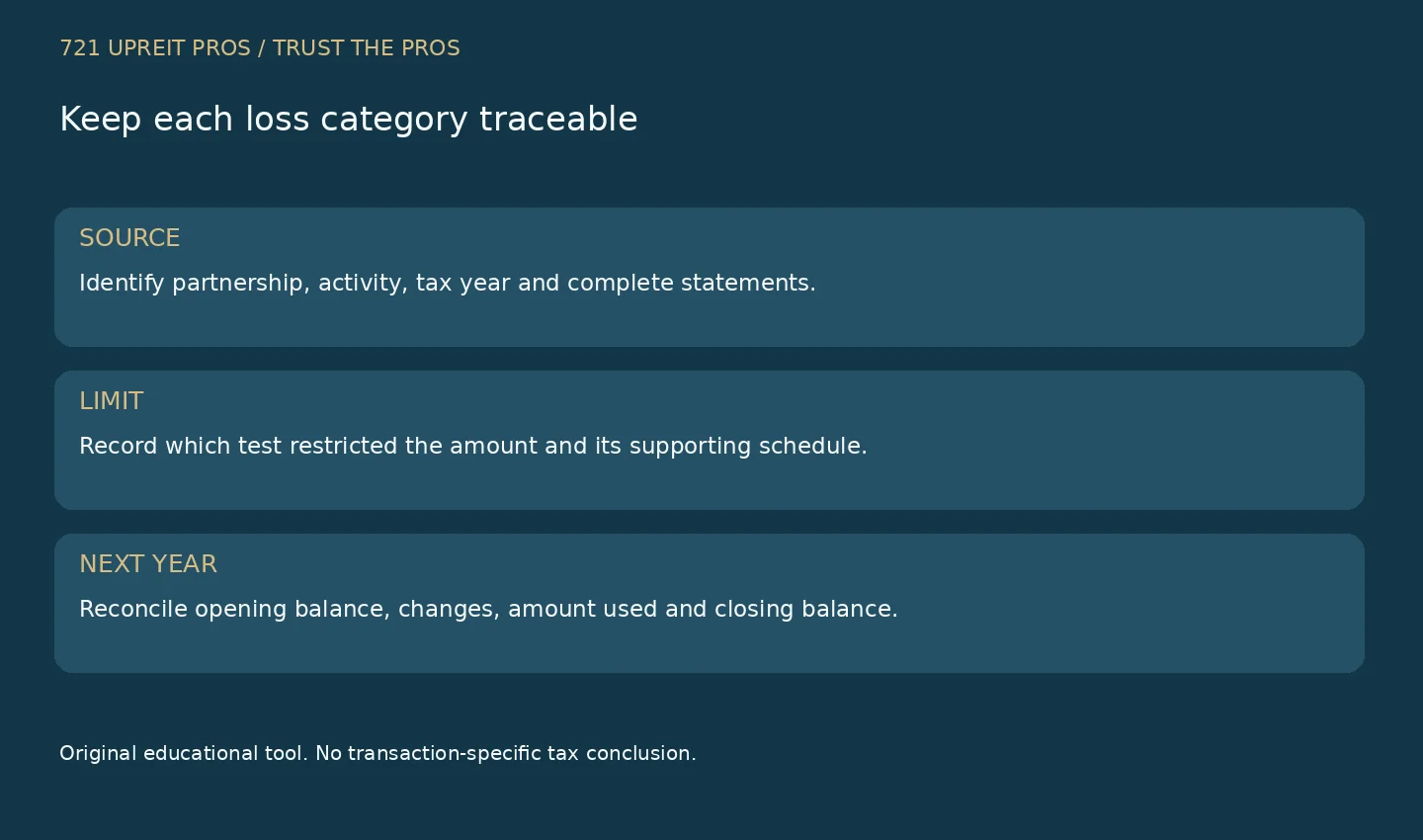
Maintain separate records instead of a single undifferentiated suspended-loss total. For each category, show the opening balance, current addition, any amount used, supporting calculation and closing balance. Ask the preparer how the applicable rule controls future use. A change in basis, financing or activity results deserves review, but does not by itself establish that every prior restriction disappears.
Publication 925 also gives conditions for loss treatment when an activity is disposed of. Do not assume a partial redemption, tax-deferred contribution or unit-to-share transaction releases every unused amount. Obtain an event-specific analysis before using a possible release in a decision. The unit-to-share conversion checklist organizes the separate security and transaction questions.
How does this differ from the earlier DST stage?
A qualifying Section 1031 exchange into a DST and a separate Section 721 contribution are different transactions. Do not assume the trust-stage tax package and later partnership reporting use the same documents. Keep the earlier basis and depreciation history available, then ask the preparer what changes at the actual contribution. The 721 UPREIT investor guide explains the ownership stages.
The related DST tax-reporting guide addresses the earlier exchange and annual trust package. DST Experts' cost-segregation discussion addresses a potential source of depreciation deductions. This article's separate task is reviewing whether a reported OP-partnership loss is currently usable by the individual investor.
What should you gather before making a tax-driven decision?
- Collect the complete current K-1, all statements and any corrected versions.
- Match the legal partnership, activity and tax year across every schedule.
- Bring forward outside-basis, at-risk and passive-loss records separately.
- List missing financing, contribution, distribution or transaction evidence.
- Ask the preparer to distinguish reported loss, currently usable amount and amounts remaining restricted.
- Revisit the household plan using confirmed results rather than an assumed refund.
Keep the tax question connected to fees, investment risk and cash needs when you discuss a 721 UPREIT planning decision with an advisor or request a callback. Use a verified secure channel for tax documents. Public forms should contain a brief question, not K-1 attachments, account numbers or confidential taxpayer information.
Watch the one-minute loss-review walkthrough
This original silent video includes English captions and the complete matching transcript below.
Read video transcript
0:00 · A loss is not a promised tax saving
A reported K-1 amount needs individual deduction review.
0:12 · Separate the limitations
Basis, at-risk and passive tests answer different questions.
0:24 · Keep separate carryforward buckets
The fictional $50,000 example does not calculate a tax refund.
0:36 · Preserve the source and reason
Record activity, year and the specific limitation schedule.
0:48 · Ask before changing your plan
Use current tax advice, not an assumed deduction or cash refund.
Download the loss-review checklist
Primary IRS guidance checked October 30, 2026; current pages identify 2025 instructions/publication. This is general education, not individual return preparation or expert review. Deductions, refunds, investment returns and liquidity are not guaranteed.
Frequently asked questions
Does a negative K-1 amount guarantee a tax refund?
No. The reported item requires individual limitation review, and a deduction is different from a refund. Your full return and payment position determine the final result.
Can I use the capital account as outside basis?
The IRS instructions say the capital account cannot be used to figure adjusted outside basis. Keep the preparer’s separate basis calculation and supporting history.
Is the amount at risk always the same as outside basis?
Do not treat those as interchangeable tests. Ask the preparer to evaluate both with the actual financing, guarantees and other relevant facts.
Can I combine all unused losses into one balance?
Keep the source, activity, year and limiting rule separately traceable. Different restrictions require different supporting calculations and follow-up information.
Will converting OP units into shares release all losses?
Do not assume that result. Obtain an event-specific review of the transaction and the applicable restrictions before relying on any release.
Should a projected loss change my cash budget immediately?
Use estimates cautiously. Confirm the currently usable amount and remaining checks with your preparer, then update the plan without assuming a refund or accessible investment proceeds.
TALK TO A 721 UPREIT ADVISOR
Ready to discuss your 721 options?
Request a callback to discuss the questions raised by this article, your timing and what to ask before you commit. Share your name, email and phone below to start the conversation.
No investment commitment or financial documents required. A callback request does not book an appointment or establish an advisory relationship.