
721 UPREIT PROS / DIRECT CONTRIBUTION DUE DILIGENCE
721 UPREIT: Can You Challenge the Property Appraisal?
You can ask for a correction or a different price before signing a 721 UPREIT contribution agreement. Once you sign, the agreement and applicable law determine what you can contest, when and how. A second appraisal can support your position, but it does not automatically change the contribution price or the units you receive.
By 721 UPREIT Pros · November 11, 2026 · Original appraisal objection worksheet
Key takeaways
- Identify whether you disagree with the appraisal, the agreed price or a settlement entry.
- A new opinion affects the price only if the applicable terms or a valid amendment give it that effect.
- Verify notice timing, who can object, the reviewer’s scope and who pays.
- Reconcile the final net consideration and unit count before relying on either.
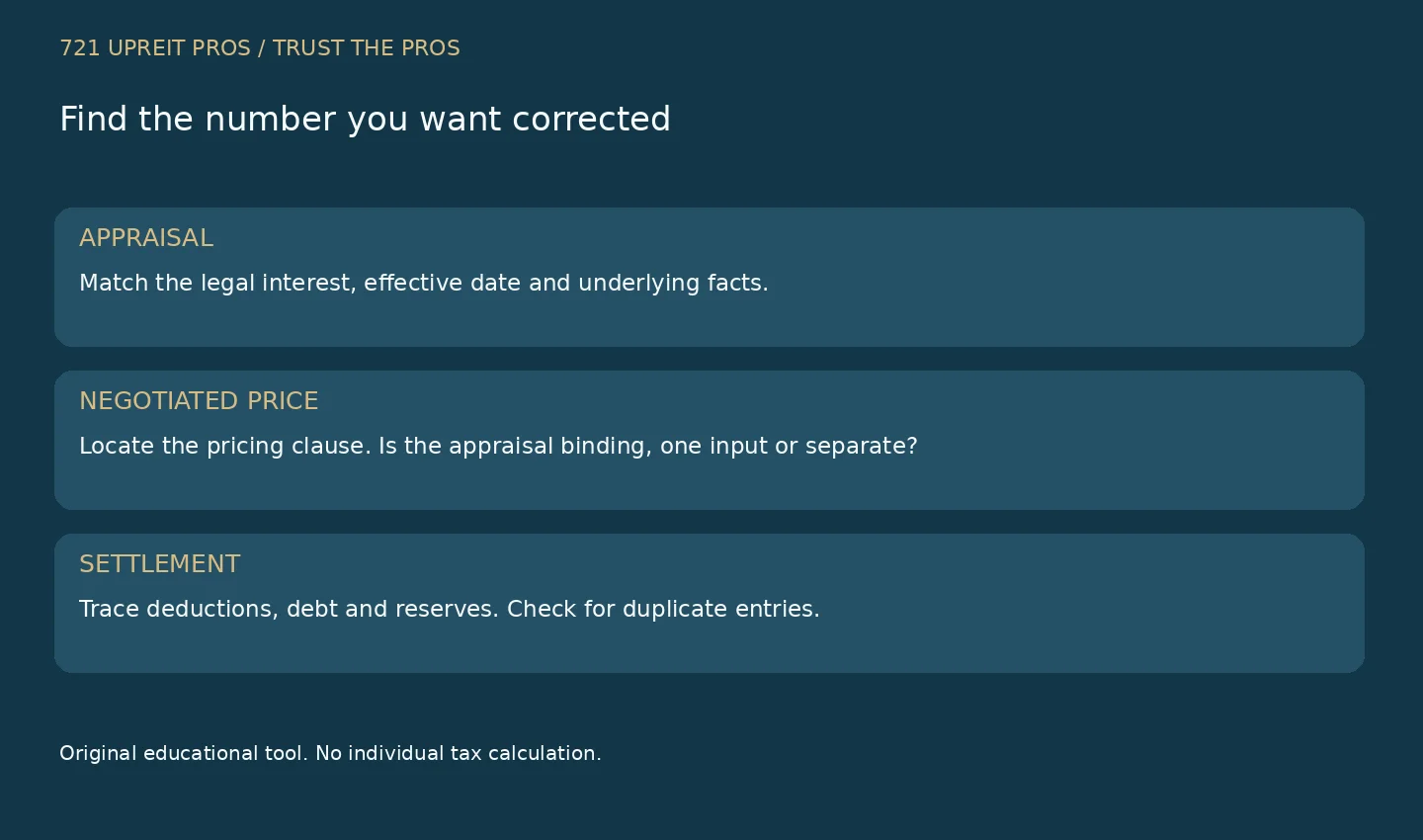
Start by identifying the number you disagree with. The appraiser's opinion of property value, the gross price the parties agree to and the net consideration after debt and adjustments can all differ. You may accept the appraisal and still disagree with the price. You may agree to the price and still find an error in the closing calculation.
Bring this question to the operating partnership while you still have time to compare a direct contribution with a sale or another path. Ask your broker for market evidence, ask your attorney which deadlines bind you, and ask your tax professional to compare the actual structures. A higher headline valuation alone does not make an illiquid investment suitable for your retirement plan.
TALK TO A 721 UPREIT ADVISOR
Talk to a 721 UPREIT advisor
Request a callback to discuss the questions raised by this article, your timing and what to ask before you commit. Share your name, email and phone below to start the conversation.
No investment commitment or financial documents required. A callback request does not book an appointment or establish an advisory relationship.

Which number are you disputing?
Request the appraisal or a valuation summary you are authorized to review, plus the agreement's pricing provision and a draft settlement statement. Put the three documents side by side. Identify the legal interest valued, the effective date and the line that carries that amount into the transaction. If a number was rounded, capped, adjusted or negotiated separately, write down where that happens.
| Disagreement | Evidence to compare | First question to ask |
|---|---|---|
| Appraisal uses a lease that has been replaced | Effective date, signed lease and appraisal rent assumptions | Was the amendment effective on the valuation date, and can the appraiser issue a correction? |
| The parties used different assumptions about future rents | Lease expirations, comparable transactions, vacancy and leasing costs | What would a comparable independent review cost, and who can use it under the agreement? |
| The offer is below the appraisal | Offer, signed pricing clause, adjustments and negotiation history | Is the offer tied to the appraisal, or is the gross price negotiated independently? |
| A reserve appears twice in the settlement calculation | Adjustment schedule, closing statement and reserve support | Which clause lets you object to that entry, and who needs written notice? |
What do the filed documents show about objection rights?
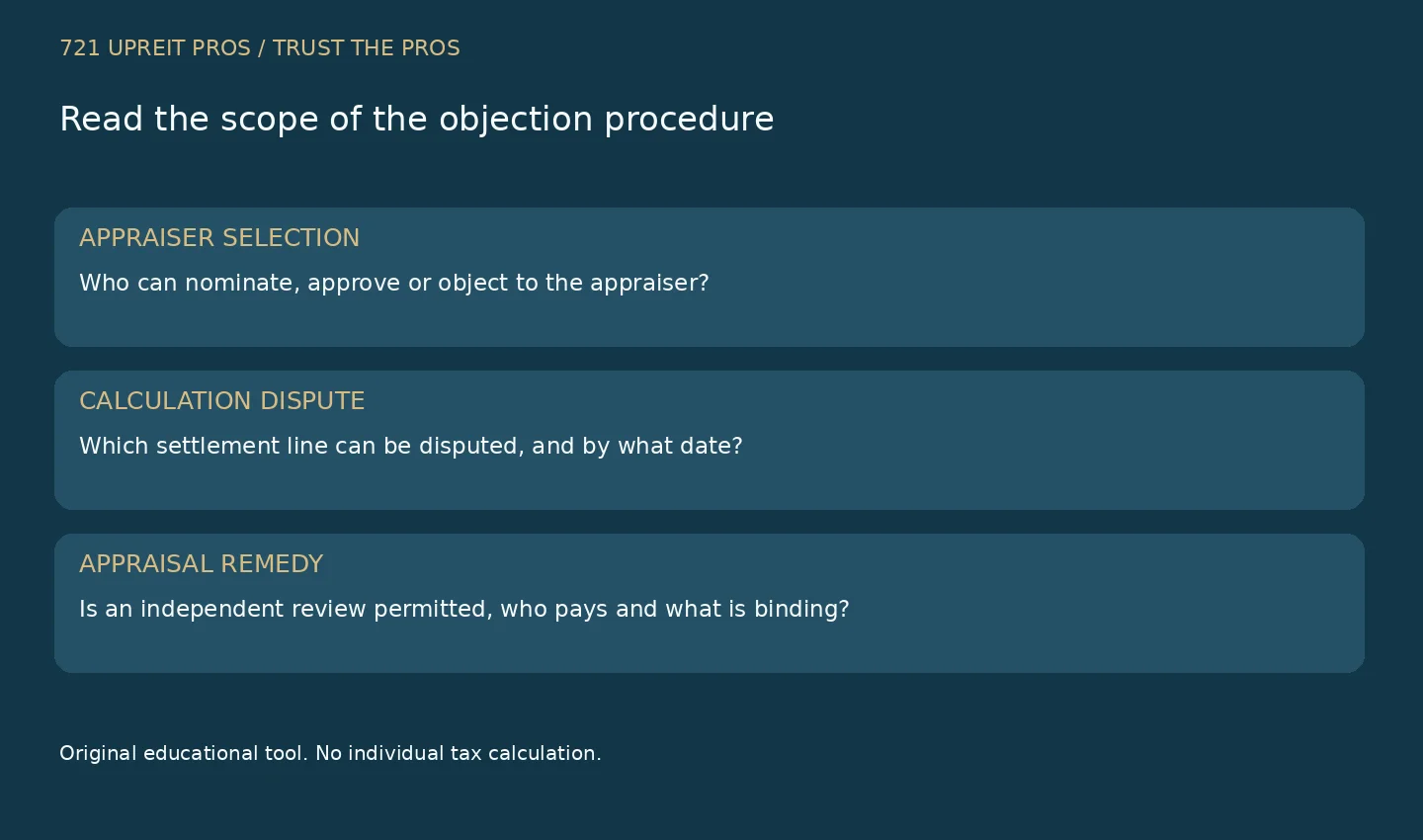
A STAG option agreement form filed in 2010 illustrates appraisal selection before a price is settled. Under the form, the fund proposes a qualified appraiser and the operating partnership has an approval role, with a five business day period to raise specific concerns before approval is deemed given. The form also describes a liquidation scenario in which a preliminary price can be amended once appraisals arrive. These are rights and steps for the identified parties to that option agreement. They do not establish an individual contributor's right to replace a completed appraisal.
A City Office REIT contribution agreement form filed in 2014 shows a narrower dispute: its post-closing adjustment provisions let contributors dispute a net working capital calculation and provide for independent accounting resolution of remaining disputed items. That mechanism addresses specified calculations, so it should not be read as an open right to reappraise the real estate. A separate 2006 Aimco proxy statement and prospectus amendment describes express contractual appraisal rights for limited partners in a specific proposed affiliated contribution. Those rights concerned their partnership interests, not an automatic right for every direct property owner. These dated examples illustrate different drafting choices; they are not current offers or model terms.
What difference could a correction make?
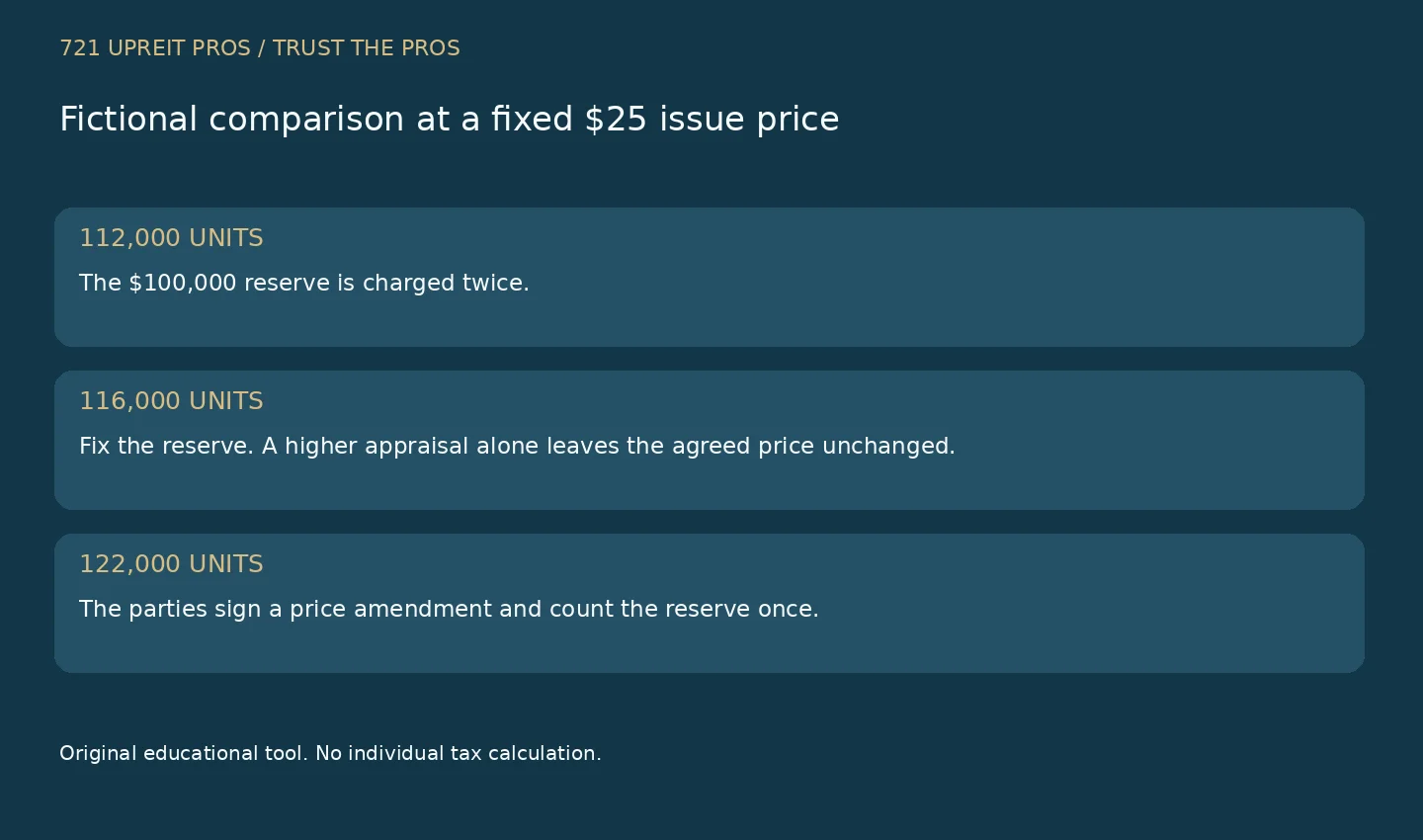
Suppose a warehouse owner sees a $4.8 million appraisal, a $4.6 million negotiated contribution price, $1.6 million of debt counted under the agreement and a $100,000 reserve. Assume the remainder is allocated entirely to operating partnership units at a fixed $25 issue price. These numbers are fictional and do not describe either a tax basis or future redemption proceeds.
| Outcome | Net allocated to units | Units at $25 |
|---|---|---|
| Written price stands; reserve charged once | $2,900,000 | 116,000 |
| Reserve mistakenly charged twice | $2,800,000 | 112,000 |
| Appraisal revised to $5 million; agreement price unchanged | $2,900,000 | 116,000 |
| Parties amend the price to $4.75 million; reserve charged once | $3,050,000 | 122,000 |
Fixing the duplicated reserve restores 4,000 units under the fictional terms. Correcting the appraisal alone adds none when the agreed price stands. Only the illustrated amendment adds 6,000 units relative to the original correct calculation. Use this distinction to decide where the evidence belongs. If the agreement instead uses a formula tied to a new appraisal or a changing unit price, rebuild the calculation from the written terms.
What should you verify before committing?
- Find the controlling documents. Collect the signed agreement or latest draft, amendments, appraisal instructions, pricing schedule and notice section.
- Describe the issue precisely. Name the disputed input or entry, its supporting evidence, and the change you seek. Keep the valuation date, contract date and notice deadline separate.
- Check authority and cost. Identify who can object or approve a change, who appoints and pays a reviewer, whether findings bind the parties, and what happens if the deadline is missed.
- Keep the closing decision open where the contract allows it. Confirm any diligence, termination or amendment rights with counsel. Do not assume that a request pauses closing or gives you permission to cancel.
- Reconcile the final numbers. Get the approved price, debt, expenses, reserves and units on one dated schedule. Reassess concentration, available cash and downside before relying on the new figures.
A direct contribution for partnership interests can fall under Section 721 subject to the facts and exceptions. A Section 1031 exchange follows a separate real-property framework; an eligible DST interest may be relevant to that route, and a later contribution is a separate event. The contribution price does not establish your tax basis; see Section 722. Ask your tax professional to review actual debt and any cash alongside the revised settlement terms.
Start with the direct property acceptance checklist, unit count reconciliation and 721 UPREIT guide. For related context, see how appraisal and price can differ in a DST and the DST Experts valuation and liquidity review. To discuss how an offer fits your plan, Talk to a 721 UPREIT advisor. Use a verified secure channel for confidential property records.
Watch: classify an appraisal or settlement dispute
This one-minute walkthrough follows the appraisal, agreed price and settlement entries separately.
Read video transcript
0:00 · Identify the disputed number
Check the appraisal, agreed price and settlement separately.
0:12 · Find the clause
An appraiser objection is not the same as a closing dispute.
0:24 · Correct the reserve
Fictional example: correct a duplicate reserve, restoring 4,000 units.
0:36 · Check the agreed price
A higher appraisal changes no units if the contract price stands.
0:48 · Verify before closing
Confirm the notice deadline, decision maker and final schedule.
Download the appraisal objection worksheet
Sources checked November 11, 2026. General investor education. No individual expert review is represented.
Frequently asked questions
Can I ask for the complete appraisal?
Ask what may be shared, who commissioned the report, who may rely on it and whether a valuation summary is available. Access and reliance are different questions. Review confidentiality provisions before forwarding a report.
Should my own appraiser value the same interest?
For a useful comparison, match the effective date, legal interest and valuation premise as closely as possible. A whole-property value and a value for a partial ownership interest can answer different questions.
Does a factual correction require a new independent appraisal?
Not necessarily. An appraiser may be able to review a documented factual error within the scope of the assignment. If opinions still differ, check whether the contract allows or requires another reviewer and what their findings would change.
Does sending an objection stop closing?
Do not assume it does. Check the notice, closing and dispute clauses together. Some disputes may be resolved separately after closing, while others may affect closing only if a written condition or extension applies.
Can the settlement reviewer change the original property price?
The reviewer’s authority depends on the agreement. A mandate limited to identified settlement entries does not necessarily let the reviewer reopen the price or value the whole asset again.
What if the seller and operating partnership cannot agree before signing?
Confirm which documents are already binding and whether another route remains available. Compare a revised proposal, keeping the property or a sale using realistic timing, costs, liquidity and tax advice. Do not assume any alternative is still available after signing or closing.
TALK TO A 721 UPREIT ADVISOR
Ready to discuss your 721 options?
Request a callback to discuss the questions raised by this article, your timing and what to ask before you commit. Share your name, email and phone below to start the conversation.
No investment commitment or financial documents required. A callback request does not book an appointment or establish an advisory relationship.