
721 UPREIT PROS / ACQUISITION COSTS
721 UPREIT Acquisition Fees: Who Pays in an Affiliate Deal?
A 721 UPREIT can pay an acquisition fee on one property deal and report none on another. Check the agreement for the fee trigger, payer and recipient. If a sponsor affiliate is involved, separately verify the purchase price, other costs and required approvals before deciding whether the economics work for you.
By 721 UPREIT Pros · November 9, 2026 · Original acquisition-cost worksheet
Key takeaways
- Identify the buyer, legal seller and fee recipient before applying the agreement.
- OP units can be part of transactions with different fee outcomes.
- Compare price, separate costs and debt to calculate how much equity is needed.
- Confirm the scope of any approval and reconcile your settlement separately.
Start with a practical question: is this fee coming out of your settlement, or is the operating partnership paying it as a buyer expense? Both can matter to an investor, but they belong in different calculations. A buyer expense is not automatically a dollar-for-dollar reduction in the operating partnership units a contributor receives.
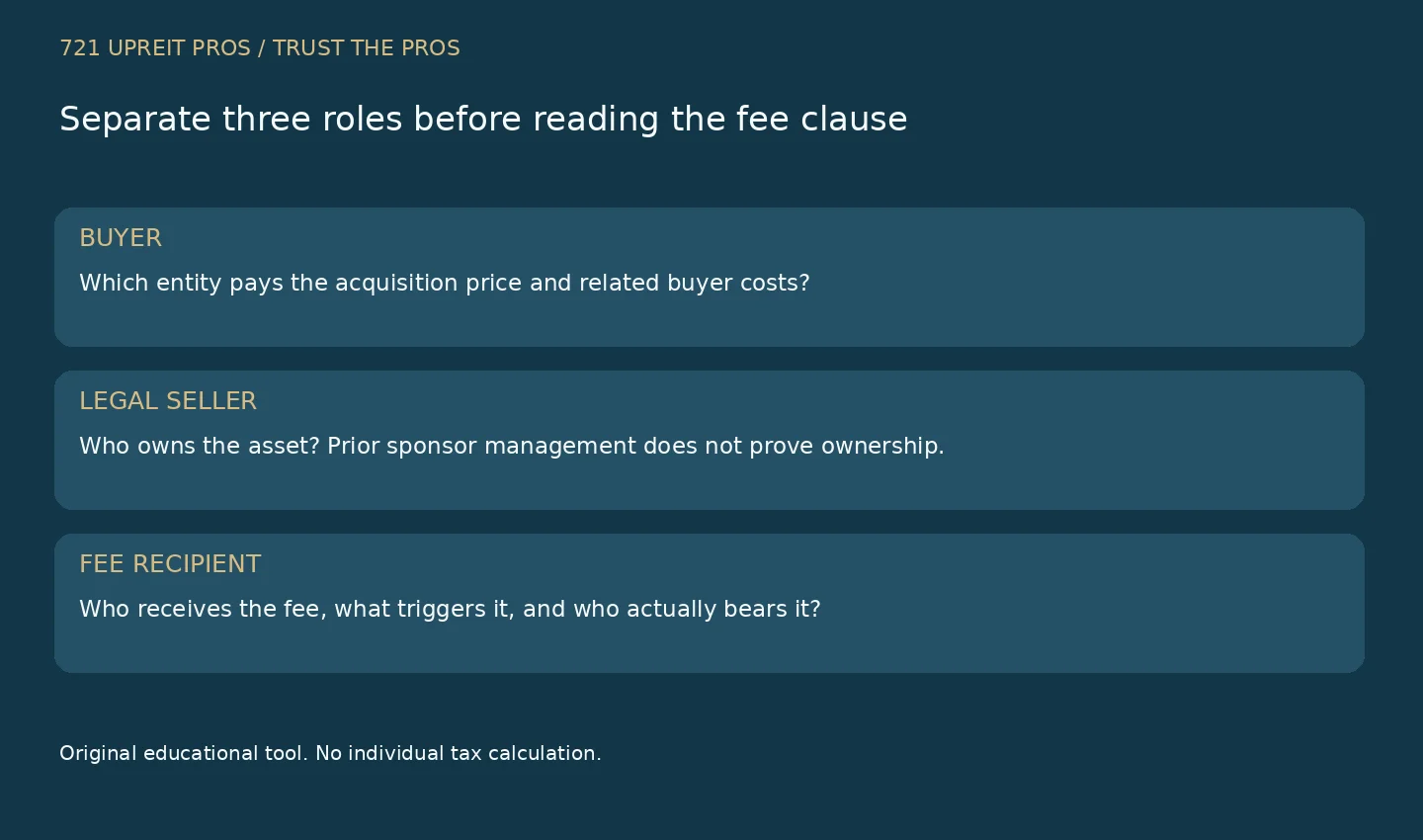
Next, identify the buyer, seller and fee recipient by legal name. A sponsor that previously managed a Delaware statutory trust (DST) is not necessarily the owner selling its property. A payment to a sponsor affiliate is also different from a purchase from that affiliate. Record those relationships separately so that you can apply the right fee and approval provisions.
TALK TO A 721 UPREIT ADVISOR
Talk to a 721 UPREIT advisor
Request a callback to discuss the questions raised by this article, your timing and what to ask before you commit. Share your name, email and phone below to start the conversation.
No investment commitment or financial documents required. A callback request does not book an appointment or establish an advisory relationship.

What did two transactions by the same operating partnership show?
ExchangeRight Income Fund, doing business as ExchangeRight Essential Income REIT, reported the following transactions under subsequent events in its Form 10-Q for the quarter ended September 30, 2026. Both transactions occurred after quarter-end. Both involved operating partnership (OP) units and mortgage assumptions.
| Date and transaction | What the issuer reported | Limit of the evidence |
|---|---|---|
| October 2, 2026: one property from an unrelated party | The operating partnership issued OP units and assumed mortgage debt. The company reported paying ExchangeRight a $1.9 million acquisition fee under its asset management agreement. | The filing identifies the company’s payment. It does not establish what a different investor would owe. |
| October 6, 2026: 25 properties via a merger with a DST previously managed by the sponsor | The operating partnership issued OP units and assumed mortgage debt. The company reported no acquisition fee for that portfolio acquisition. | The disclosure addresses that fee line. It does not prove that the portfolio had no other costs or that the sponsor owned the DST’s property. |
The filings show why the payment method is a poor shortcut. Seeing OP units in the consideration did not tell a reader whether the fee was charged. For your deal, ask whether the controlling agreement treats a third-party purchase, a sponsor-related purchase or a DST merger differently, and whether a waiver, cap or exception applies to the specific transaction.
What does an affiliate purchase approval actually answer?
Read the governing document for the approval standard and the scope of the approval. For example, Brookfield Real Estate Income Trust’s April 2026 filed registration amendment describes its charter’s review of certain affiliate transactions. The described test includes findings by disinterested directors, including a majority of independent directors, on fairness and terms relative to unaffiliated alternatives. For covered asset purchases, a price above the affiliate’s cost requires justification and the price cannot exceed the asset’s current appraised value under the described provision.
This is an example of a specific charter provision. It is not a standard for every UPREIT, a finding on a named acquisition, or a conclusion about any investor’s terms. Ask which version of the charter, partnership agreement or policy applies, what approval was required, and what dated evidence can be shared. An appraisal can inform a property price without evaluating a separate fee, the contributor’s unit price or the investor’s personal suitability.
Ask whether the approval covered the purchase price only or also the side arrangements. A brokerage payment, financing charge or reimbursement may appear in a different contract. If a committee reviewed only one item, keep the remaining items open rather than assuming the committee resolved them. Use the conflict review guide to record what was and was not examined, and the risks and due diligence guide for the broader investment decision.
Can a deal with a zero acquisition fee still require more equity?
Yes. The illustration below uses two fictional purchases with the same hypothetical $10 million appraised value and $6 million of debt financing. Both have $120,000 of separate closing costs, which exclude the acquisition fee. It assumes the stated price is the amount paid for the asset and that there are no other uses of funds. The second price is a hypothetical proposal, not a conclusion that a price above appraisal could be approved under the charter example above.
| Sources and uses | Deal A: fee charged | Deal B: no acquisition fee |
|---|---|---|
| Purchase price | $10,000,000 | $10,250,000 |
| Acquisition fee | $100,000 | $0 |
| Separate closing costs | $120,000 | $120,000 |
| Total uses | $10,220,000 | $10,370,000 |
| Assumed debt funding | $6,000,000 | $6,000,000 |
| Equity funding required | $4,220,000 | $4,370,000 |
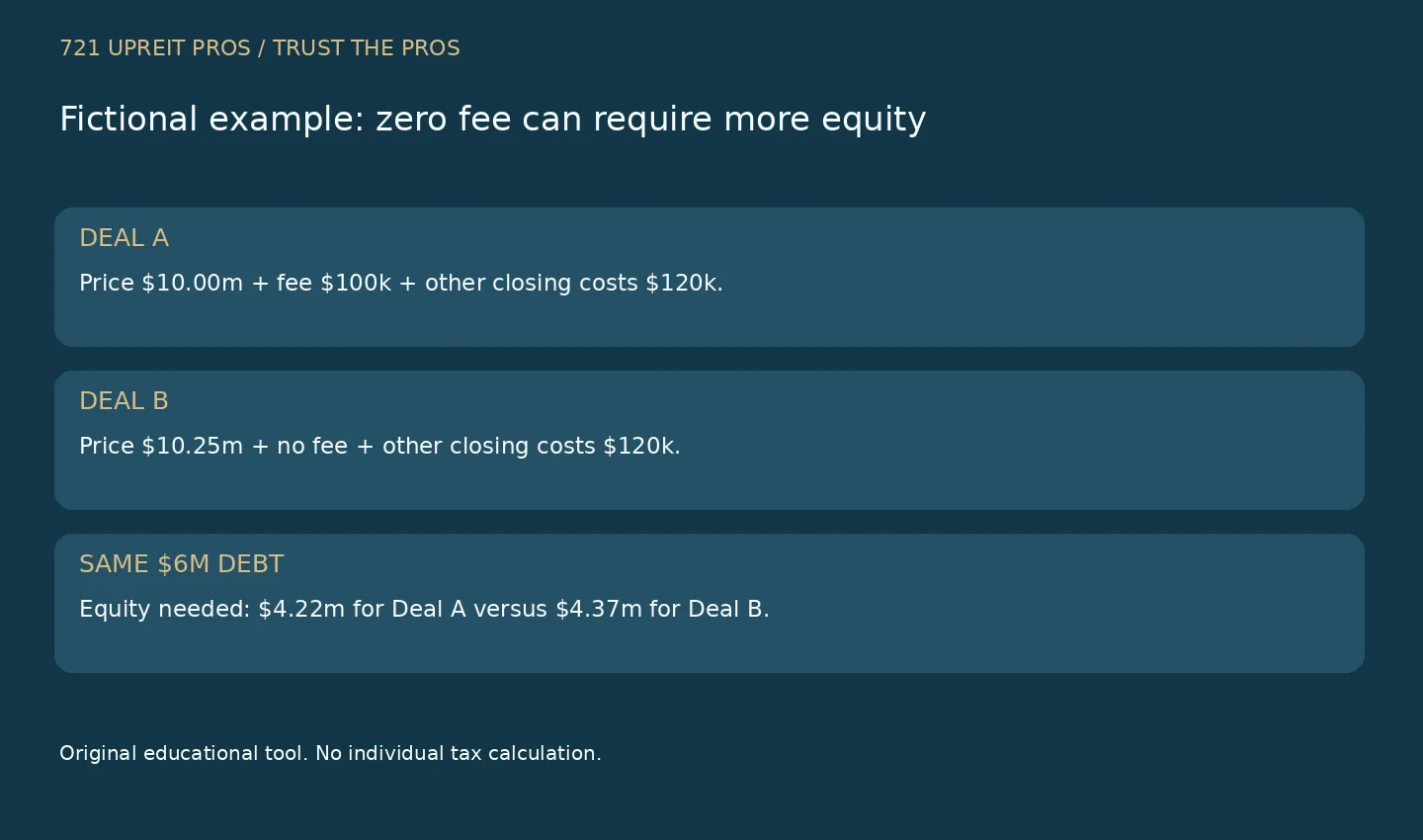
The $150,000 difference belongs in the buyer’s funding analysis. It does not tell you the amount of any tax, the effect on your specific unit balance, or whether either purchase is a good investment. If you are contributing property or a qualifying interest, ask for a separate bridge from the agreed value and adjustments to the consideration and the actual unit count. Review the agreement and closing statement to determine who bears each cost. Do not subtract a charge again if it is already included in the reported price or total.
Which documents should you request before committing?
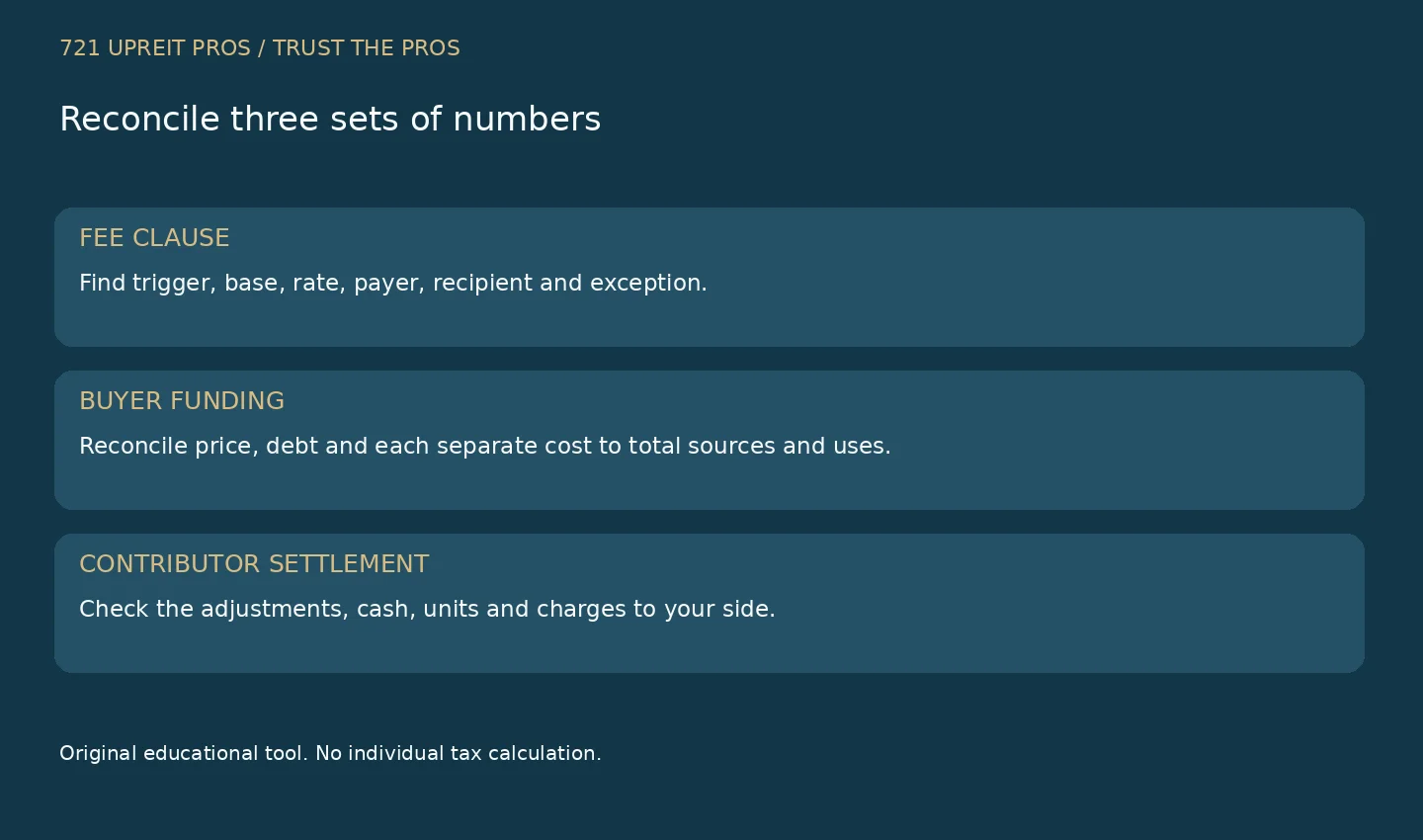
- Fee clause: find the trigger, base, rate, payer, recipient, caps and exceptions. Ask for the estimated dollars and the amount recorded at close when available.
- Acquisition sources and uses: reconcile price, fees, reimbursements, financing charges, reserves and debt to the full funding requirement.
- Conflict and valuation evidence: match the parties to the applicable approval provision, appraisal date and scope. Ask who approved which terms and what evidence can be shared.
- Contributor settlement: ask for a separate schedule showing adjustments, cash, units and amounts actually charged to your side of the transaction.
If you are still preparing to sell, review your options before closing. A qualifying Section 1031 exchange into replacement real property, potentially through a properly structured DST, is separate from a possible Section 721 contribution for a partnership interest. The tax rules and the fee contract answer different questions. See IRS Publication 544, the text of Section 721, and the 721 UPREIT guide. A planned contribution or later conversion is not assured.
Use the full-life fee ledger to compare other stages, and these guides to questions about DST offering expenses and upfront, ongoing and exit costs for the separate trust phase. To review the decision and request the right documents, Talk to a 721 UPREIT advisor or request a callback.
Watch: compare the entire funding requirement
This one-minute visual walkthrough explains why the fee line and the dollars needed to close may point in different directions.
Read video transcript
0:00 · Review more than the fee
Who pays it, who receives it, and what triggers it?
0:12 · Identify the parties
The buyer, seller, and fee recipient can be different.
0:24 · Compare two fictional deals
Deal A equity: $4.22 million. Deal B equity: $4.37 million.
0:36 · Why more equity?
A $250,000 higher price outweighs a $100,000 fee saving.
0:48 · Check the source records
Verify the approval and reconcile buyer funding and your settlement.
Download the acquisition-cost worksheet
Filings and tax references checked November 9, 2026. The examples are educational and do not constitute an offering, recommendation or independent expert review.
Frequently asked questions
Does paying with OP units eliminate an acquisition fee?
No. Two transactions by the same operating partnership used OP units but had different fee outcomes. Check the agreement for the actual trigger and exceptions.
Is a sponsor-managed DST the same as a sponsor-owned seller?
No. Prior management identifies a service relationship. Verify the legal owner and seller and how the applicable documents define affiliates.
Does a property appraisal verify my unit price?
No. Ask for the separate unit pricing rule, class, applicable date and adjustments. An appraisal of the asset does not do that work.
Is a higher purchase price an acquisition fee?
No. Keep the price and fee separate. Compare both in the total funding calculation and confirm that charges already included are not added twice.
Does board approval mean I should accept the investment?
No. Ask what the directors examined and whose interests they considered. Compare the actual terms with your own costs, liquidity needs and alternatives.
If the partnership pays, is the amount automatically deducted from my units?
No. Review your settlement and the agreement for any actual reduction. Track the partnership expense separately.
TALK TO A 721 UPREIT ADVISOR
Ready to discuss your 721 options?
Request a callback to discuss the questions raised by this article, your timing and what to ask before you commit. Share your name, email and phone below to start the conversation.
No investment commitment or financial documents required. A callback request does not book an appointment or establish an advisory relationship.