
721 UPREIT PROS / REDEMPTION FOLLOW-UP
721 UPREIT: Do Unfilled OP Unit Requests Carry Forward?
After a partial 721 UPREIT redemption, check whether the unfilled request is still active before submitting another one. Some OP unit programs expressly require resubmission. Your agreement, current program notice and written status confirmation determine what to do next. A balance still showing in your account does not establish that it is in a queue.
By 721 UPREIT Pros · November 12, 2026 · Original unfilled-unit worksheet
Key takeaways
- Confirm the status of the original request before sending a replacement.
- Separate the settled quantity, unfilled quantity and units you never requested.
- Read the clause for your OP unit class and check for current suspension notices.
- Use actual settlement and available cash when planning for a fixed expense.
If you requested 4,000 units and only 1,500 settled, your first task is to reconcile the other 2,500. They are the unfilled part of the request. They may not be the only units you still own. Record both the unfilled quantity and the total remaining holding before asking the administrator to confirm what happened.
Ask for the status of the specific request, including the class, registration, reference number and period. A screen that says pending might refer to an approved trade that has not paid yet, or to an unfilled balance awaiting a decision. Those situations require different follow-up. Do not count unfilled units as cash for an expense with a fixed date.
TALK TO A 721 UPREIT ADVISOR
Talk to a 721 UPREIT advisor
Request a callback to discuss the questions raised by this article, your timing and what to ask before you commit. Share your name, email and phone below to start the conversation.
No investment commitment or financial documents required. A callback request does not book an appointment or establish an advisory relationship.

What do the filed OP unit terms actually say?
The April 2026 StratCap Digital Infrastructure REIT filing describes a separate program for Class P and Class PX operating partnership units. The OP unit provision explains that when the partnership chooses to fulfill only part of the month's demand, units are repurchased proportionally. It expressly calls for unsatisfied requests to be submitted again after the applicable next period starts or when the program restarts. This language applies to the specified unit classes in that filing. A similar clause in a REIT share program is not enough evidence for your units.
The issuer's June 2026 quarterly report says the board approved a partial suspension on April 28, with qualifying disability and death exceptions. It separately reports outstanding and unfulfilled requests at June 30 and says those amounts were not recognized as redemptions payable because of the suspension. The figure does not show that a particular request retains priority or will be processed automatically. These are dated disclosures, not a statement about whether the program is open today.
Resubmission can also arise for a different reason. Section 8.06(c) of a partnership agreement attached to the 2024 Retail Opportunity Investments merger agreement describes a defined period after a drag along notice when redemption notices can become void and a holder seeking redemption afterward must deliver a new notice. That is a contractual event, not ordinary monthly proration. The comparison shows why you should ask what triggered the status before using another program's deadlines or forms.
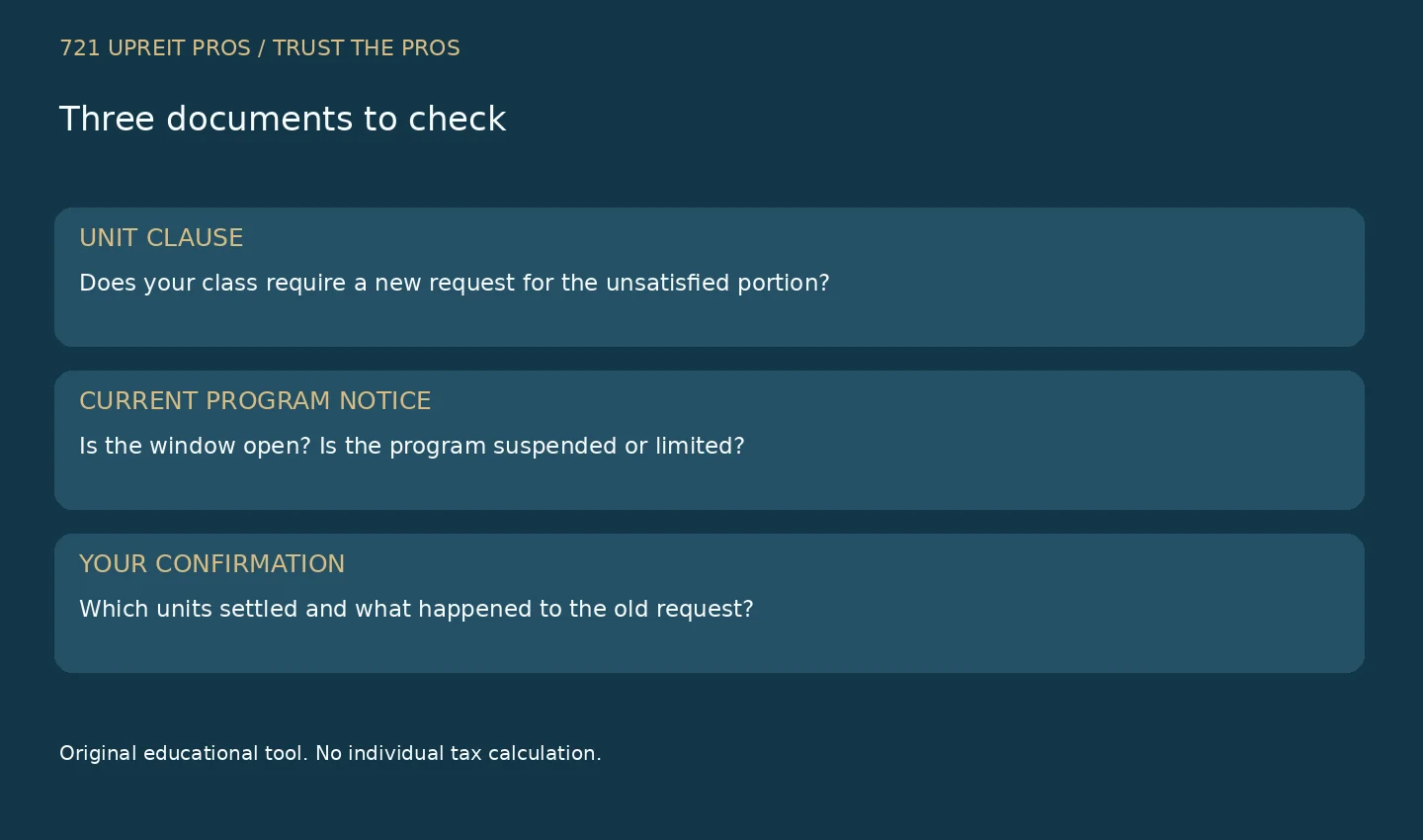
Which status calls for which action?
| Reported status | What to verify in writing | Next decision |
|---|---|---|
| Approved; settlement pending | Quantity approved, effective date, form of payment and any unresolved condition | Track settlement separately. Do not request the approved quantity again without instructions. |
| Unfilled; new request required | Applicable clause, opening date, cutoff and correct remaining quantity | Decide whether to submit a new instruction after checking current terms and liquidity needs. |
| Still active under current terms | Reference number, quantity kept active, next review period and whether priority is retained | Confirm whether action is needed. Avoid duplicate instructions. |
| Suspended, rejected or void | Reason, correction or restart procedure, applicable exceptions and notice requirements | Check whether the program can accept another request before relying on any next date. |
These are working categories, not a prediction about which option your program provides. Ask for a dated answer rather than relying on a generic support message. If the notice says rejected, find out whether the paperwork was incomplete, the unit class was ineligible, or the request was affected by a suspension. An incomplete notice may have a correction procedure; a closed program may have no available submission window.
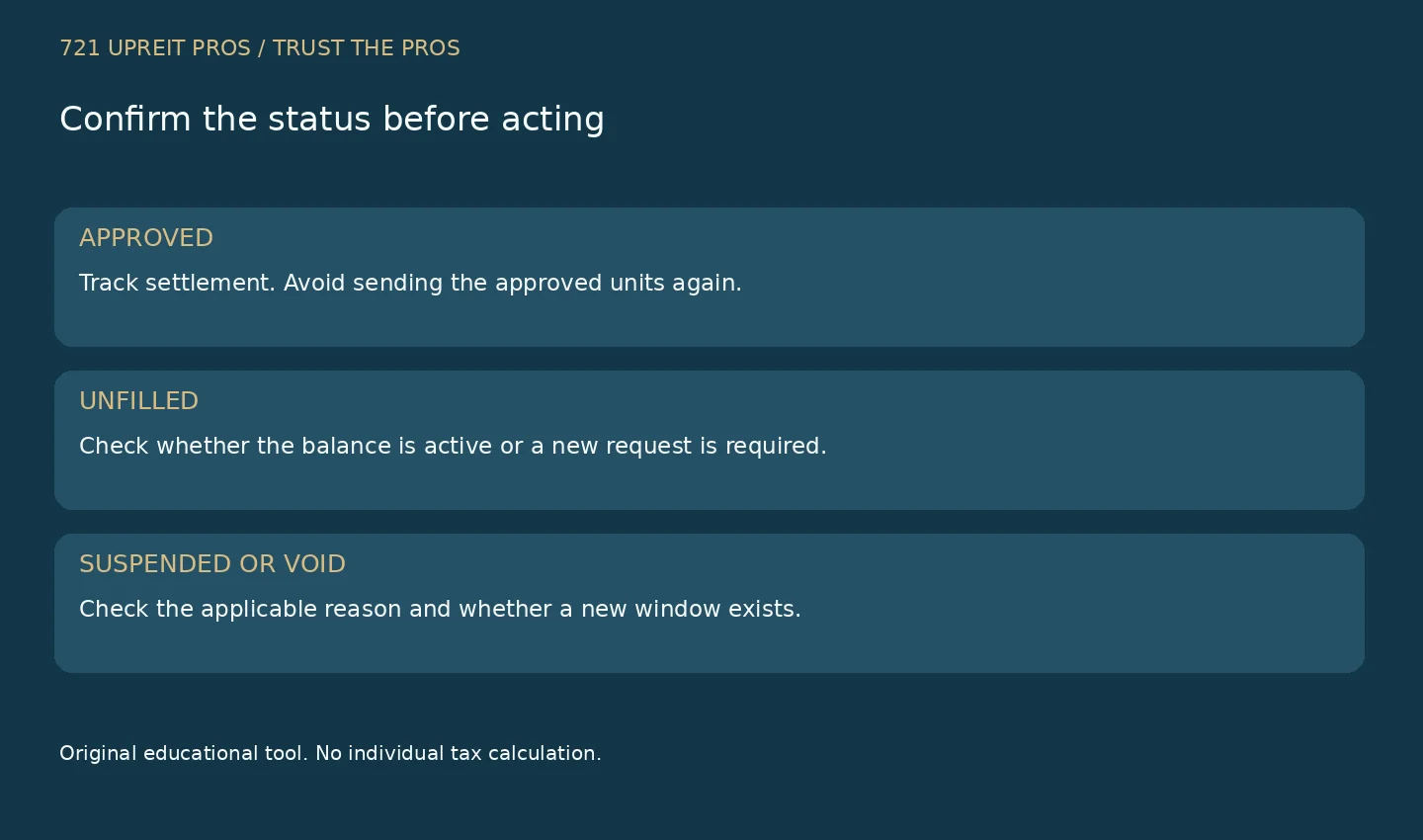
How can you reconcile a partial fill without counting the same units twice?
Consider a fictional holder who starts with 6,000 OP units, requests 4,000 and receives written confirmation that 1,500 units settled in cash at $20 each. Assume no fees, withholding or other movements. The gross cash is $30,000. The unfilled portion of the request is 2,500 units, while the holding after settlement is 4,500 units: 2,500 unfilled plus 2,000 never included in the request.
If the administrator confirms a new request is required and the holder wants the original plan to continue, the starting number to reconcile is 2,500, subject to current minimums and restrictions. Reusing the old 4,000-unit form would include 1,500 more units than intended. If the original balance is still active, a second request could also conflict with it. Confirm the exact quantity and reference number before signing either instruction.
Suppose the holder needs $60,000 on a fixed date and planned to cover it with the redemption. Even after the $30,000 hypothetical settlement, there is a $30,000 gap before any tax or costs. Do not value that gap at last month's unit price or assume it will disappear at the next window. Discuss a separate funding plan based on money already accessible and a realistic tax estimate.
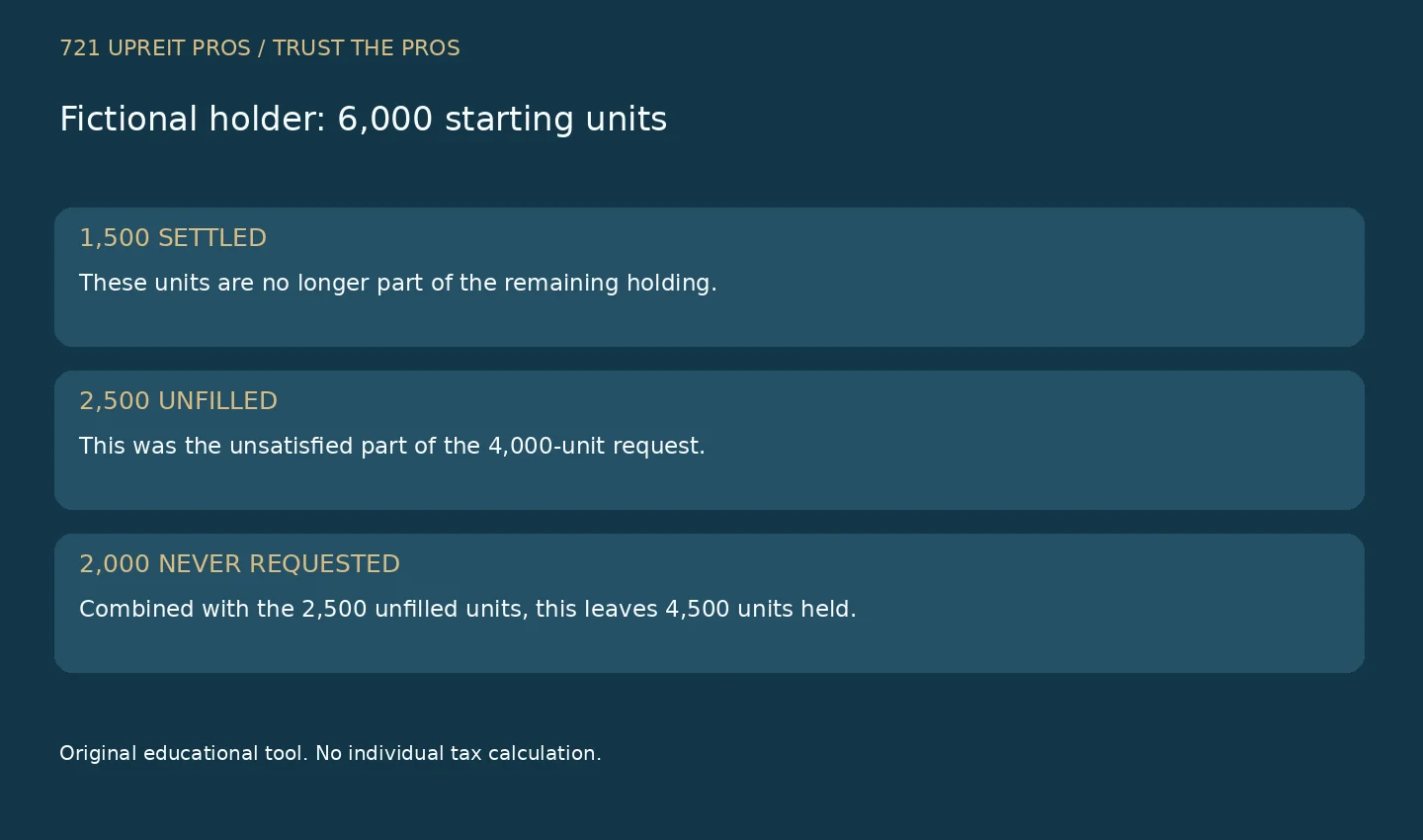
What should you confirm before the next request?
- Get the latest agreement and any notices specific to your class. Identify the transfer agent or other authorized recipient.
- Match the original request to the written result. Record the settled quantity and effective date, the unfilled quantity and the total units still held.
- Ask whether the old request is closed, active or invalidated. If a new notice is required, confirm the submission window, required documents, minimum and any frequency limit.
- Verify how the next price and form of settlement would be determined. Budget around available cash and ask your CPA to review only the actual and contemplated transactions.
Section 721 addresses qualifying contributions to partnerships. It does not prescribe a universal exit queue. A prior 1031 exchange into a qualifying DST is a separate event, and a later unit settlement needs its own review. See IRS Publication 541 and retain the actual settlement statement for your tax professional.
Use the full redemption checklist, the 721 UPREIT risk guide and the main 721 UPREIT guide to put the response in context. For follow-up, compare the different routes from units or shares to cash and how liquidity differs across DST and UPREIT structures. To discuss the implications for your cash plan, Talk to a 721 UPREIT advisor. Use your issuer's verified channel for actual redemption instructions.
Watch: reconcile what settled and what remains
The one-minute walkthrough separates settled units, the unfilled request and units you did not tender.
Read video transcript
0:00 · Confirm the old request
Ask whether it remains active before you send another.
0:12 · Check the class and notice
Read your OP unit terms and current program notices.
0:24 · Reconcile three quantities
1,500 settled, 2,500 unfilled, and 2,000 never requested.
0:36 · Know what you still hold
The 4,500 units held differ from the 2,500 unfilled request.
0:48 · Ask for the next step
Verify any new cutoff and avoid repeating settled quantities.
Download the unfilled-unit worksheet
Sources checked November 12, 2026. General investor education. No individual expert review is represented.
Frequently asked questions
Does seeing the units in my account mean I am still in line?
No. The holding balance shows units recorded to the account. Ask for a separate written confirmation of any active request, its remaining quantity, and whether it has priority.
Can I resend the same signed form?
Ask for the current form and instructions. The prior form may specify the wrong period or quantity, and some administrators may need a new signature or documents.
Is the next request priced the same as the first?
Verify the applicable pricing date and method. The original price or settlement confirmation does not establish the price for a subsequent request.
Does a partial fill count against a frequency limit?
The applicable agreement controls. Ask separately whether the limit counts notices, completed transactions or some other event, and whether an unfilled balance needs a new notice that counts.
Can unfilled units still pay distributions?
Check which units remained outstanding on the relevant record date and whether a distribution was declared. The request status alone does not establish an entitlement.
What if the issuer says a program is suspended?
Ask for the effective notice, whether exceptions apply to your holding, and what happens to prior requests if the program reopens. A suspension has no guaranteed end date.
TALK TO A 721 UPREIT ADVISOR
Ready to discuss your 721 options?
Request a callback to discuss the questions raised by this article, your timing and what to ask before you commit. Share your name, email and phone below to start the conversation.
No investment commitment or financial documents required. A callback request does not book an appointment or establish an advisory relationship.