
721 UPREIT PROS / INVESTOR TAX DUE DILIGENCE
721 UPREIT Tax Audits: Who May Bear the Cost?
A 721 UPREIT partnership audit can create a tax cost at the partnership level or adjustments pushed out to reviewed-year partners. Before investing, check the applicable audit regime, the partnership representative’s authority and the agreement’s cost-allocation terms. Your ownership dates and tax documents matter; a redemption does not automatically settle every prior-year obligation.
By 721 UPREIT Pros · Published November 5, 2026
Key takeaways
- Verify the entity and tax year before assuming which audit procedure applies.
- The partnership representative has a specific IRS role distinct from your advisor.
- A partnership payment and a push-out adjustment follow different paths.
- Review ownership dates and surviving contract terms before assuming redemption ends exposure.
The investor decision is whether the proposed investment gives you enough information about tax control and potential economic exposure. The tax-deferred contribution label does not answer who handles a later IRS examination. Ask about this before signing, when you can compare the actual agreement with the sponsor’s explanation and identify unresolved responsibilities.
This guide provides an original three-year ownership example and a four-question review matrix. It supports the 721 UPREIT risk and due-diligence guide. It is distinct from the late or corrected K-1 decision log: organizing a revised document is different from determining the procedure and who bears an audit adjustment.
TALK TO A 721 UPREIT ADVISOR
Talk to a 721 UPREIT advisor
Request a callback to discuss the questions raised by this article, your timing and what to ask before you commit. Share your name, email and phone below to start the conversation.
No investment commitment or financial documents required. A callback request does not book an appointment or establish an advisory relationship.

What does the centralized partnership audit regime change?
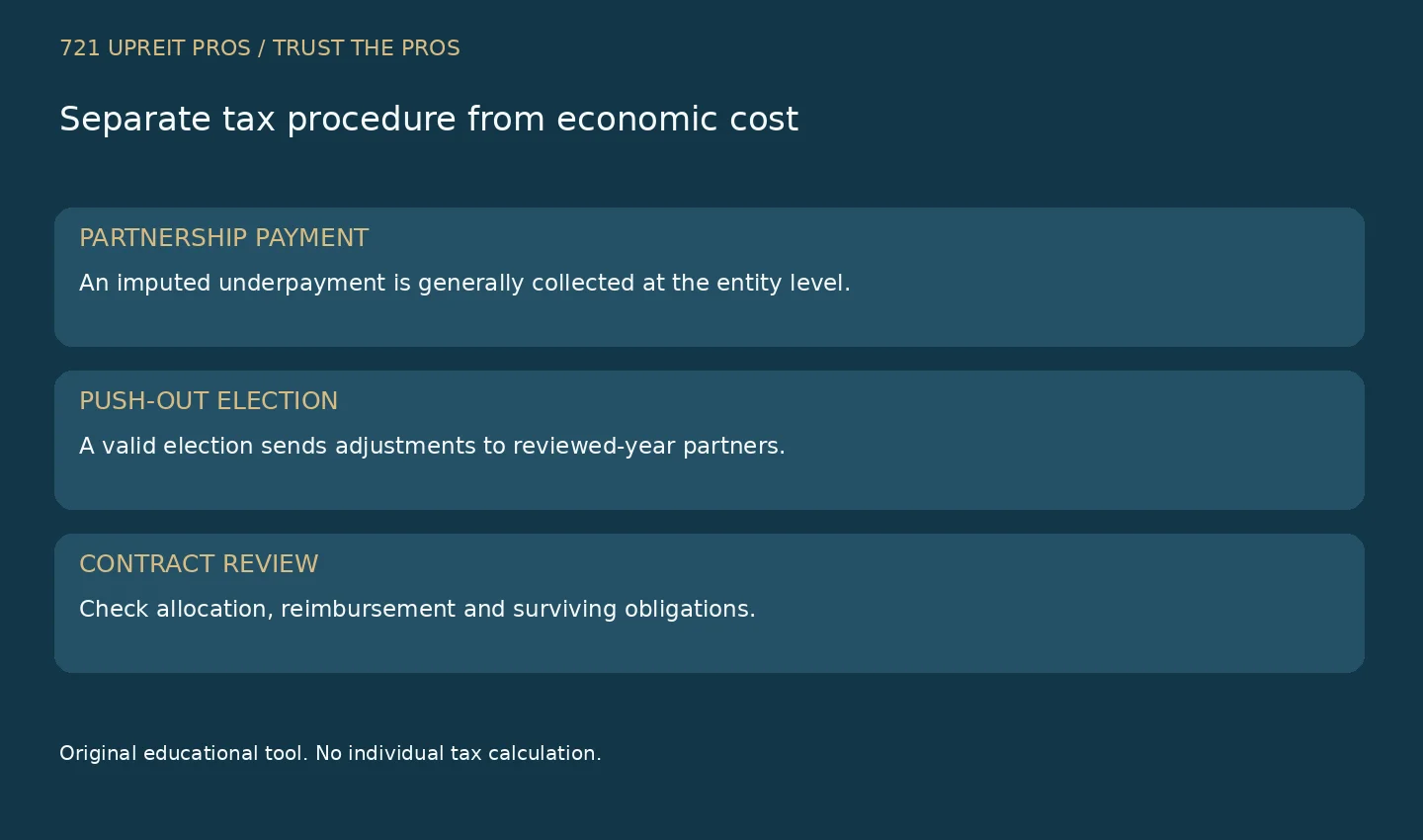
The IRS BBA audit overview explains that an understatement of tax is generally assessed and collected at the partnership level as an imputed underpayment. A partnership may request modifications and may elect to push out the underlying adjustments instead of paying that underpayment itself. Those are procedural alternatives with requirements, not interchangeable marketing choices.
First establish whether the partnership is subject to that regime for the year being examined. The IRS describes an election out for eligible partnerships; eligibility and a valid election must be verified. Do not assume an investment is outside BBA because it has relatively few investors, uses a familiar sponsor or describes its annual reporting as simple. Ask which entity filed the return and what procedure applies to that year.
A partnership payment and an investor payment are different events. If the partnership pays a liability, that uses partnership resources. How the economic burden is allocated among investors, reimbursed or otherwise addressed requires the actual agreement and facts. A risk disclosure does not establish that every current holder pays an equal share, nor that a particular investor will receive an individual bill.
Who can make decisions during the examination?
The IRS partnership representative guidance states that the representative has sole authority to act for the partnership in BBA audit procedures and that the partnership and partners are bound by those actions. The designation is made for a taxable year. This tax-procedure role is not necessarily the same person as your financial advisor, account contact or property manager.
Request the provisions governing designation, replacement, notices, consultation and any internal approvals. Ask whether limited partners receive information before a settlement or election, and who maintains their contact details. Internal contractual promises should be reviewed separately from the representative’s authority before the IRS. Do not interpret a consultation right as an individual power to stop an IRS proceeding.
For your review file, identify the responsible role and a communication channel rather than publishing a person’s private contact details. Ask what happens if the representative or administrator changes. You need a route for notices after a unit transfer or redemption as well as during ownership. A portal closure should not cause historical tax correspondence to disappear from your records.
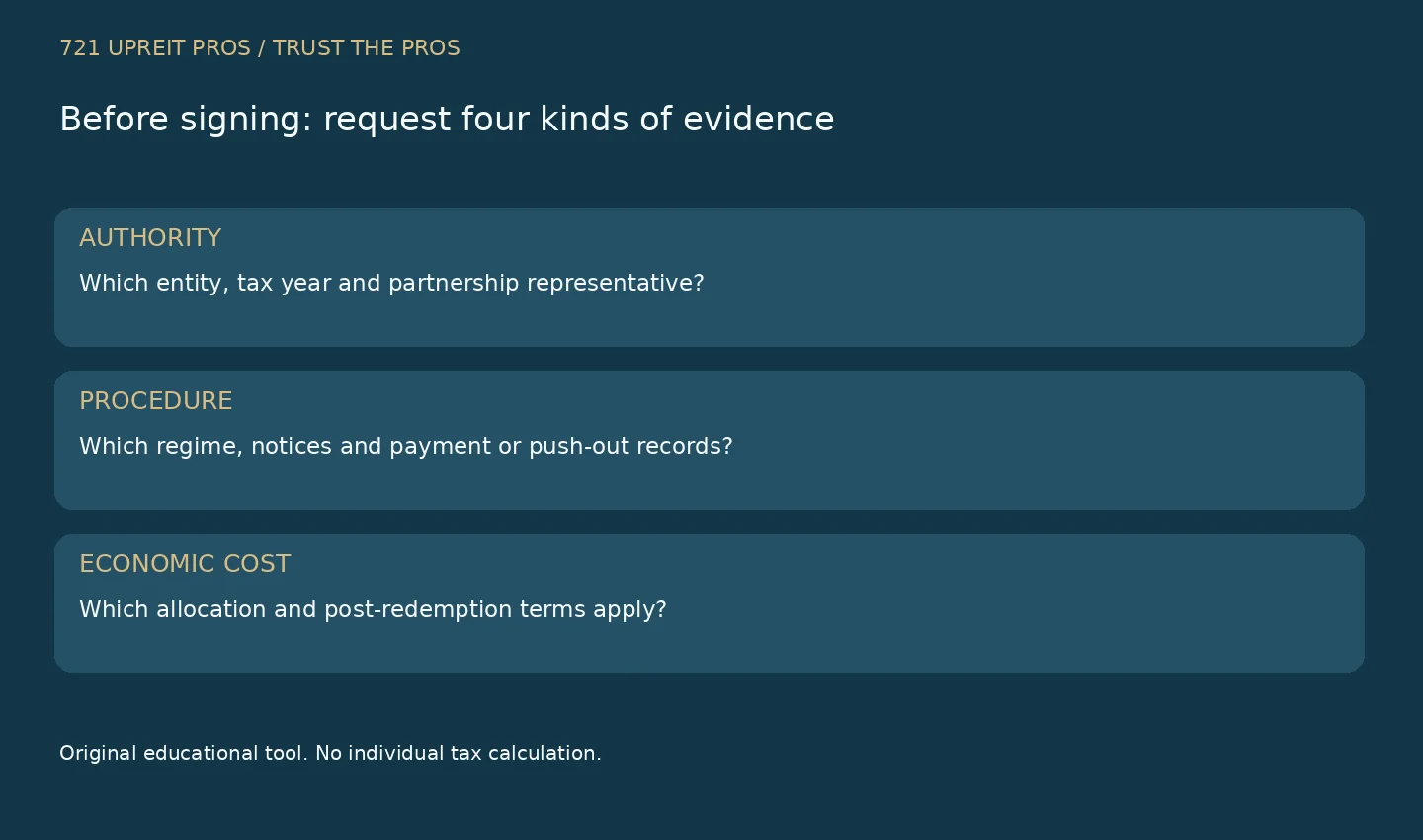
| Question | Evidence to request | Do not assume |
|---|---|---|
| Which regime applies? | Entity identity, tax year and applicable election explanation | Every partnership follows the same amendment procedure. |
| Who controls the response? | Representative and agreement provisions on notices and decisions | Your advisor can personally veto a settlement. |
| Which payment path is used? | Actual IRS notices and election or payment record | A push-out election is automatic. |
| Who bears the economic cost? | Allocation, indemnity, reimbursement and survival provisions | Redemption ends all historical obligations. |
How does a push-out differ from a corrected K-1?
The IRS audit-process guidance describes an election after the notice of final partnership adjustment. It gives the representative 45 days from that notice to make the push-out election and says that period cannot be extended. This is an entity-level procedural deadline, not a deadline an investor should attempt to manage from a general article.
Under that process, the audited partnership furnishes Form 8986 to reviewed-year partners. The IRS defines a reviewed-year partner as someone who held an interest at any time during the examined year. The Form 8986 instructions explain different handling for pass-through partners and other recipients. Other partners generally use Form 8978 with their reporting-year return; an intervening partnership or certain other entities can have additional obligations.
Keep an audit adjustment separate from an administrative adjustment request, or AAR, initiated by the partnership to correct a prior return. BBA partnerships can use an AAR rather than an amended return. Forms 8986 can arise in that context too. The IRS filing-requirements overview distinguishes those procedures. The document’s exact title, year and source determine what the preparer needs to investigate.
What does an ownership change show?
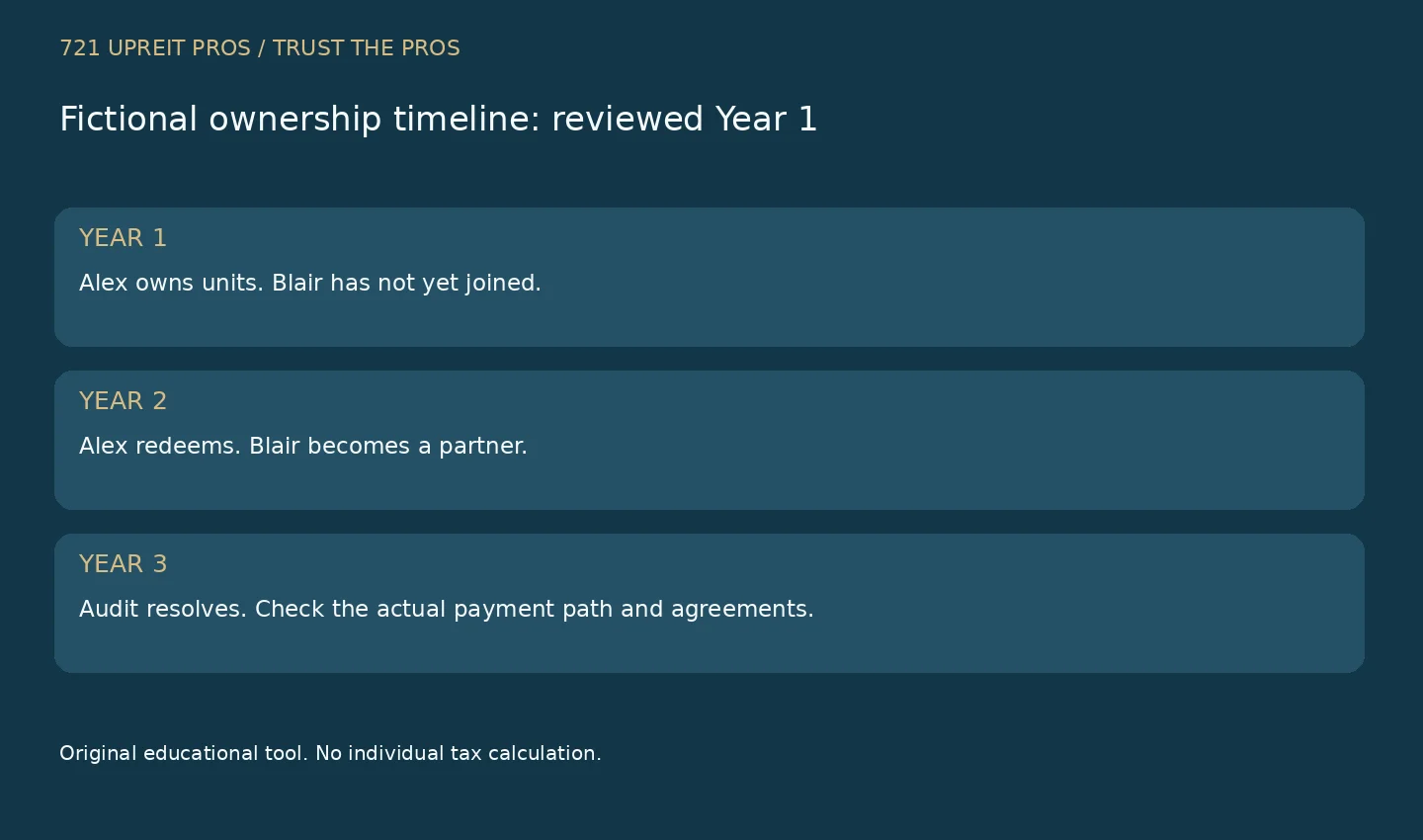
Consider a fictional partnership with an examination of Year 1 resolved in Year 3. Alex held units throughout Year 1 and redeemed in Year 2. Blair first acquired units in Year 2 and still holds them in Year 3. Assume the partnership is subject to BBA. This example supplies no tax amount, allocation percentage or actual program terms.
If the partnership makes a valid push-out election for the Year 1 examination, Alex’s former ownership does not remove Alex from the reviewed-year partner analysis. Blair’s current ownership alone does not make Blair a Year 1 partner. The actual reviewed-year records, election, furnished statements and any additional ownership facts must be reconciled. Neither holder should infer the result from who receives current distributions.
If the partnership instead pays an imputed underpayment in Year 3, the investor review turns to the partnership’s use of resources and contractual allocation or recovery terms. Ask whether the agreement addresses former partners and whether any obligation survives redemption. This is why the payment path and economic burden need separate columns. The example does not establish that Blair personally owes the payment or that Alex has been released.
What should you ask before contributing property?
Request the current executed-form partnership agreement and relevant tax disclosures, then ask counsel to locate the actual audit-cost provisions. Have your CPA identify the reporting process that could affect your household or holding entity. Keep questions about investment authority, tax procedure and funding separate. A sponsor’s general answer cannot replace a missing provision in the candidate documents.
For a seller, preserve the sequence: planning before closing, any qualifying Section 1031 exchange or DST stage, and a separate Section 721 contribution if actually available and accepted. The 721 investor guide retains the broad comparison. For prior DST records, use the DST reporting explanation and the CPA preparation checklist. OP partnership reporting should not be retroactively attributed to every earlier DST holding.
- Identify the taxpayer entity, year and audit regime.
- Locate representative, notice and decision provisions.
- Separate partnership payment from pushed-out adjustments.
- Read who can bear costs after entry, transfer or redemption.
- Retain statements and keep a secure route for future notices.
Talk to a 721 UPREIT advisor about obtaining the candidate documents, or request a callback. Give tax notices and private agreements to your legal and tax professionals through a verified secure channel.
Watch the one-minute audit review
This original silent video includes English captions and a complete matching transcript of the on-screen text.
Read video transcript
0:00 · Who may bear an audit cost?
Separate authority, tax procedure and economic allocation.
0:12 · Identify the payment path
Partnership payment and push-out are different procedures.
0:24 · Track ownership dates
Reviewed Year 1 and resolution Year 3 can involve different holders.
0:36 · Read the actual agreement
Do not assume a redemption ends every historical obligation.
0:48 · Prepare the review file
Obtain notices and terms. Use your CPA and legal counsel.
Download the partnership audit review checklist
Primary IRS sources checked November 5, 2026. No specific investment is represented as under examination. No individual tax advice or independent expert review is established. Investments can lose value and remain illiquid; conversion, returns and tax outcomes are not guaranteed.
Frequently asked questions
Does contributing under Section 721 prevent a partnership audit?
No. The contribution treatment and later examination of partnership returns are different issues. Verify the reporting regime and agreement terms.
Can my advisor veto the partnership representative’s settlement?
Do not assume that. The IRS describes the representative’s sole authority in BBA procedures. Have counsel review any separate contractual consultation or approval rights.
Does a redemption erase reviewed-year partner status?
Not automatically. The IRS definition includes anyone who held an interest during the examined year. Reconcile the actual ownership dates and adjustment documents.
Is Form 8986 just a replacement K-1?
No. It reports adjustments under specified partnership procedures. Preserve the complete form and notices and have your preparer identify the reporting-year consequences.
Do all recipients of Form 8986 use the same process?
No. Pass-through partners and certain other entity recipients can have different obligations from individual recipients. The preparer must identify the actual recipient and applicable instructions.
Does the fictional example show what a particular program charges?
No. It compares timing and payment paths without assuming an actual allocation formula, agreement provision or tax bill. Obtain the current candidate documents.
TALK TO A 721 UPREIT ADVISOR
Ready to discuss your 721 options?
Request a callback to discuss the questions raised by this article, your timing and what to ask before you commit. Share your name, email and phone below to start the conversation.
No investment commitment or financial documents required. A callback request does not book an appointment or establish an advisory relationship.