
721 UPREIT PROS / LIQUIDITY DECISIONS
721 UPREIT: Can You Use a REIT Share Tender to Exit OP Units?
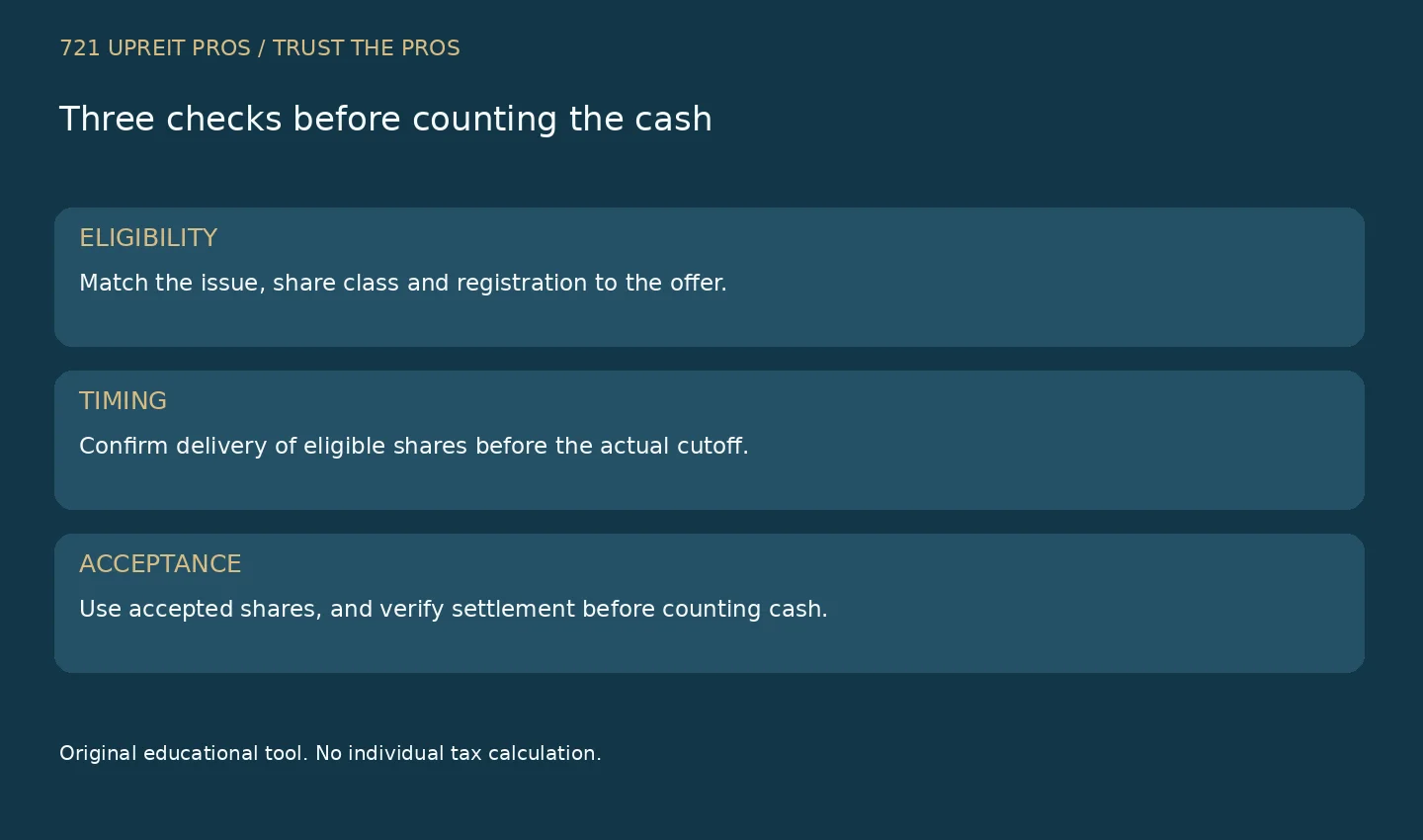
A fixed-price REIT share tender does not automatically accept your 721 UPREIT operating partnership units. Match the exact security in the offer to your account statement. If you hold OP units, check whether redemption could deliver the eligible shares before the cutoff, who controls that choice and how many shares the offer might actually buy.
By 721 UPREIT Pros · November 13, 2026 · Original tender eligibility worksheet
Key takeaways
- Match the offer to the exact security you hold.
- A request for unit redemption may not produce the eligible shares before the tender expires.
- Estimate cash using accepted shares and account for possible withholding and costs.
- Keep any unit redemption and later share sale in separate records.
Start with the holding you actually own. A REIT common share and an operating partnership unit may be linked economically, but they are issued by different entities. Even two securities with the same class letter may be different. On the offer and the account statement, compare the issuer, full security name, class and registration before comparing any prices.
Then put two timelines side by side. The first covers your right to request a redemption and the likely form and date of settlement. The second covers delivery of an eligible security and the tender's expiration. If the first cannot finish in time for the second, the advertised cash price is not an available planning assumption.
TALK TO A 721 UPREIT ADVISOR
Talk to a 721 UPREIT advisor
Request a callback to discuss the questions raised by this article, your timing and what to ask before you commit. Share your name, email and phone below to start the conversation.
No investment commitment or financial documents required. A callback request does not book an appointment or establish an advisory relationship.

What did one issuer actually offer to buy?
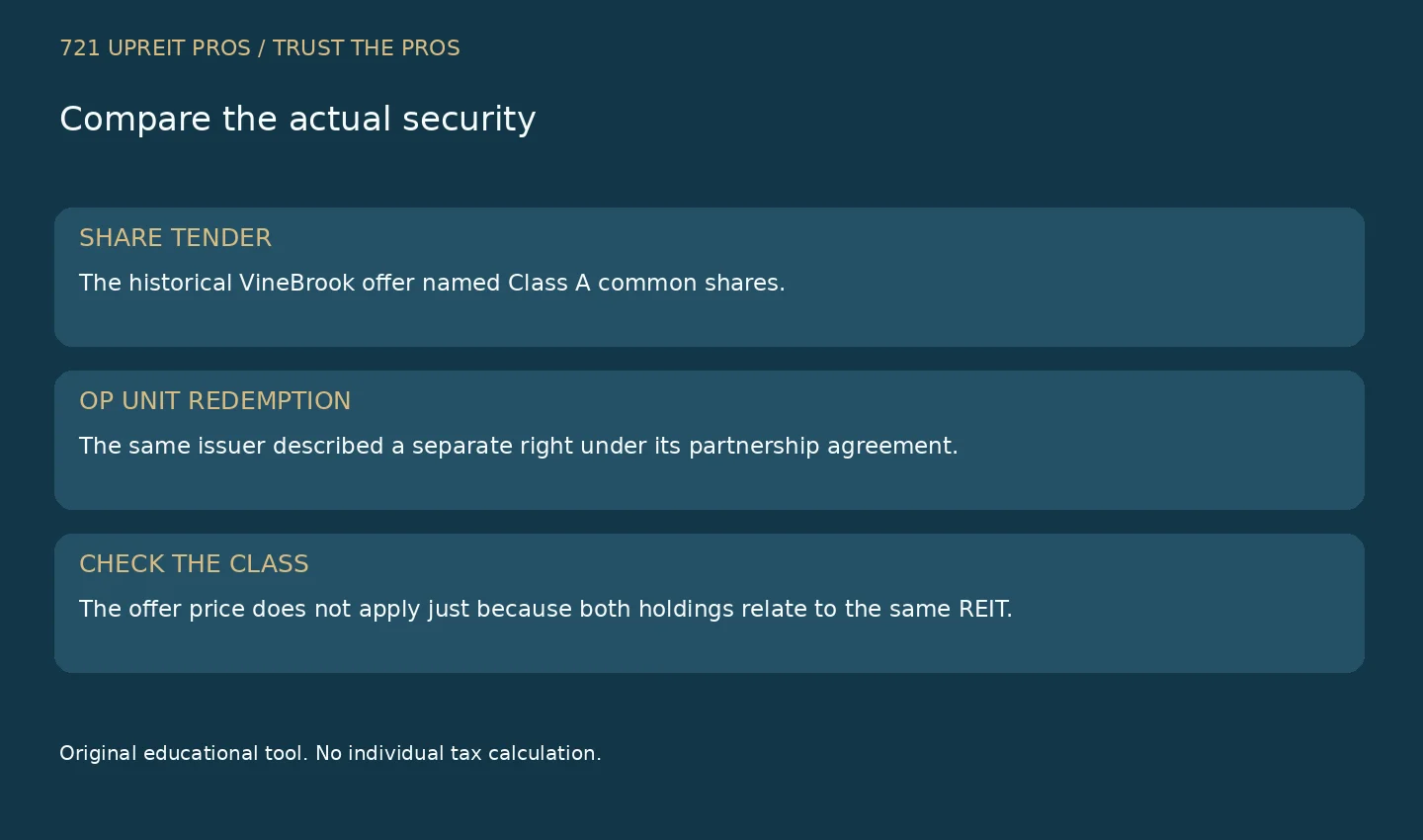
In September 2026, VineBrook Homes Trust's Schedule TO identified Class A common shares as the securities sought. It offered $33 in cash per accepted share, subject to the conditions of the offer and applicable withholding, with a maximum of 909,090 shares. The final results say it expired October 5, was oversubscribed and accepted approximately 33.02% on a prorated basis. The company purchased 909,090 shares. That was a completed, dated offer, and its reported fill rate is not a forecast for another tender.
The same company's 2025 Form 10-K describes a separate OP-unit redemption right subject to the partnership agreement and charter. It describes a minimum one-year period and settlement in cash or, at the company's election, common shares on a one-for-one basis subject to adjustment. The share tender did not itself provide a right to redeem units at $33. The two public disclosures also do not show that any particular unit holder could obtain and deliver eligible shares in time. The current signed documents and offer materials would control an actual decision.
Which conditions must line up?
| Decision | OP unit redemption evidence | Share tender evidence |
|---|---|---|
| What is eligible? | Exact unit class, holding period and any supplemental terms | Exact share class, registration and any offer restrictions |
| What can I receive? | Cash, shares or another permitted settlement; identify who chooses | Price per accepted share, withholding and conditions |
| Can I meet the deadline? | Confirmed notice dates, processing time and delivery of any shares | Expiration, any intermediary cutoff and valid delivery instructions |
| What remains afterward? | Units held or shares delivered; any tax and distribution records | Accepted quantity, returned shares and payment confirmation |
If you already hold the eligible shares, read the offer to purchase, letter of transmittal and subsequent amendments together. If you hold units, first read the partnership agreement and any class or contribution terms that apply to you. Ask the authorized administrator whether the REIT chooses the settlement, which share class could be delivered, and whether those shares would be unrestricted and in the correct account before the actual cutoff. A conversion ratio alone supplies none of those answers.
Check whether an intermediary has its own earlier deadline. Confirm what counts as delivery, what signatures or guarantees are needed, and whether a late or incomplete submission can be corrected. A pending unit redemption request, an acknowledgment from an intermediary and acceptance by the tender agent are three different records. Keep the dates separate and do not assume an issuer will extend a deadline.
How much cash would a fixed price actually deliver?
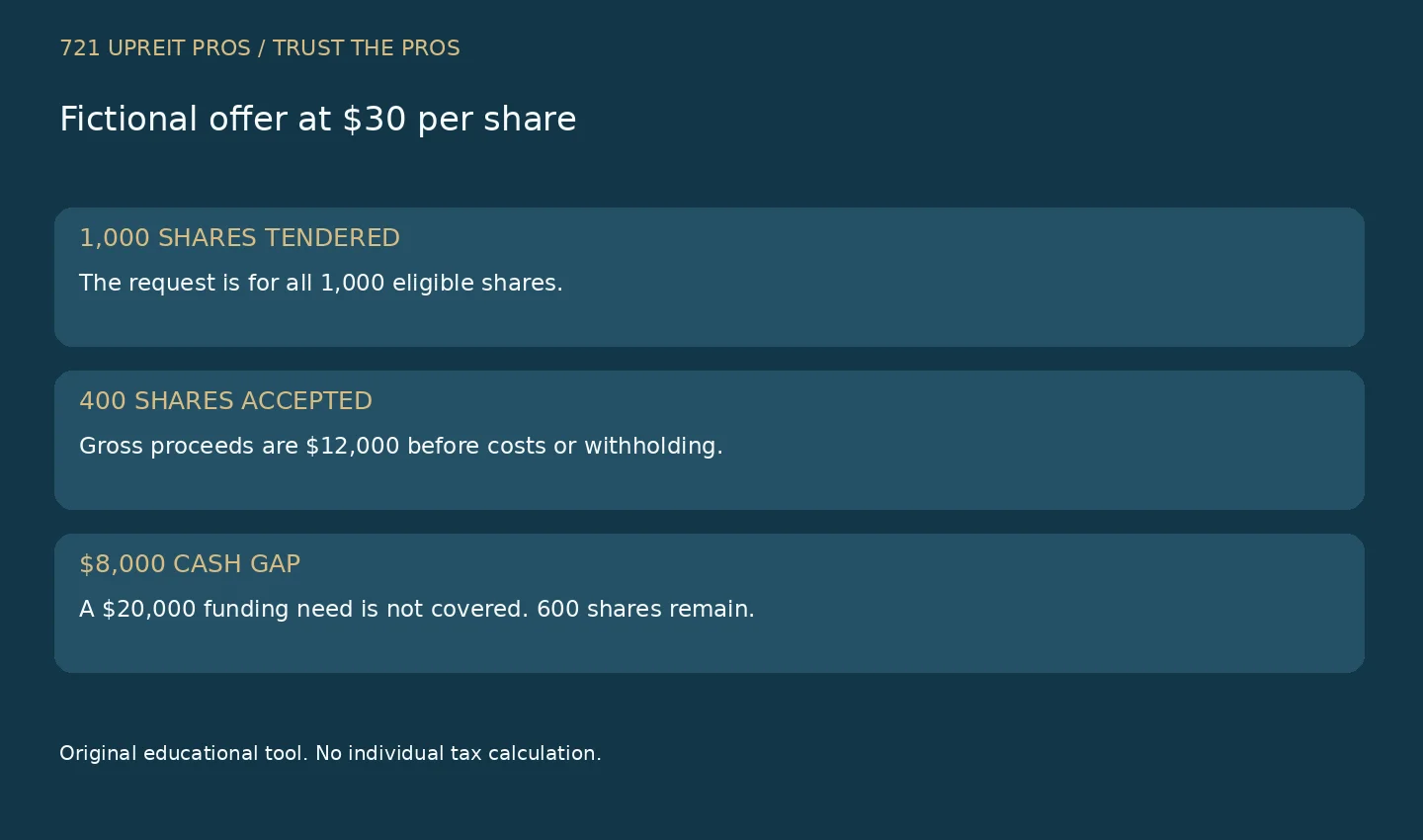
In a fictional offer, assume the holder already owns 1,000 eligible shares, offers all of them at $30, and has a $20,000 cash need. For illustration assume 40% acceptance, no costs or withholding and no unusual allocation rule. The holder receives $12,000 gross for the 400 shares accepted, retains 600 shares and still has an $8,000 cash gap. Even though the price was fixed, the quantity was uncertain. The 40% assumption is invented and is unrelated to the historical VineBrook result.
Now change one fact: the holder owns 1,000 OP units instead. If the offer accepts shares only and the holder cannot deliver eligible shares, this tender supplies no proceeds. If a separate redemption could settle in cash instead, model that as its own transaction using the actual price rule, payment date and restrictions. Do not add tender proceeds onto that cash path. If it could settle in shares, compare delivery timing and the possible number accepted before budgeting for cash.
What should you verify before acting?
- Match the security. Save the current offer and your statement. Record each issuing entity, class and any restrictions.
- Test delivery timing. Obtain written dates and identify who controls the form of any unit settlement. Read any tender amendment before relying on the deadline.
- Stress-test the cash. Compare zero, partial and full acceptance using the amount you can actually spend after estimated tax and costs.
- Follow the settlement separately. Save the confirmation of units redeemed, shares delivered or returned, and cash actually paid. Ask your tax professional to review each event.
Section 721 can apply to a qualifying partnership contribution. An earlier real property exchange under Section 1031, including one into a qualifying DST interest, and a subsequent exit from units or shares are separate events. Review Section 721 and IRS Publication 541 for general background. Keep a separate cash plan if a dated obligation cannot wait.
Use the redemption request checklist for the original unit instruction, the risk guide and the 721 UPREIT guide for the broader decision. Compare liquidity options for units and shares and how the DST and UPREIT paths differ. To discuss the implications for a cash plan, Talk to a 721 UPREIT advisor. Use the verified issuer or agent channel to act on any offer.
Watch: check eligibility before counting tender proceeds
This original one-minute example separates the holding, deadline and actual cash received.
Read video transcript
0:00 · Verify the security
A share tender may exclude your partnership units.
0:12 · Read both sets of terms
Check the share offer and the unit redemption terms.
0:24 · Check whether shares arrive
Confirm class, registration and cutoff before relying on it.
0:36 · Model partial acceptance
400 shares at $30 each produce $12,000 gross.
0:48 · Plan for a shortfall
A $20,000 need leaves an $8,000 gap before costs.
Download the tender eligibility worksheet
Sources checked November 13, 2026. General investor education. No individual expert review is represented.
Frequently asked questions
Does the same class letter mean the tender accepts my units?
No. Compare the issuing entity and full instrument name. A common share and a partnership unit with similar labels can have different rights.
Can the issuer use the tender price to value my OP units?
Check the price formula in the unit documents. A price quoted for an accepted share does not automatically set the price for redemption of a different instrument.
Can I reserve the tender price while waiting for shares?
Ask the named agent what delivery is required and whether the actual terms permit any special delivery procedure. Do not assume a redemption request reserves a tender price.
What happens to shares that are not accepted?
Read the return provisions and reconcile the agent confirmation. In the historical example, the issuer said it would return the shares it did not purchase. Other offer terms must be checked separately.
Are all tender offers made by the issuer?
No. Identify who is buying. A third-party purchase proposal may use different terms, approvals and settlement procedures than an offer from the REIT itself.
Is the advertised amount the cash I can spend?
Use the accepted quantity, verify payment and estimate withholding, costs and any tax separately. Do not book proceeds before settlement.
TALK TO A 721 UPREIT ADVISOR
Ready to discuss your 721 options?
Request a callback to discuss the questions raised by this article, your timing and what to ask before you commit. Share your name, email and phone below to start the conversation.
No investment commitment or financial documents required. A callback request does not book an appointment or establish an advisory relationship.