INVESTOR PLANNING CHECKLIST
DST-to-721 UPREIT: 7 documents to review before you invest
Published September 12, 2026 · 721 UPREIT Pros · Educational article
Before choosing a DST with a potential 721 UPREIT exit, request the offering memorandum, trust agreement, conversion provisions, valuation terms, partnership agreement, debt analysis, and liquidity policy. Together, these documents explain what you would own and which decisions remain outside your control.
A brochure can introduce a strategy. It cannot answer every question about an investor's rights. This checklist helps property owners organize a more productive discussion with their advisor, CPA, attorney, and qualified intermediary before committing exchange proceeds.

How to use this checklist
Request the current version of each document group below. Record the section supporting each answer, and flag terms that are missing or subject to change. An unanswered question about control, valuation, or liquidity deserves a specific follow-up before you invest.
First, separate the two transactions
A qualifying 1031 exchange concerns real property held for investment or business use. IRS Revenue Ruling 2004-86 addresses a particular DST structure in which an interest can be treated as an interest in underlying real estate. The label DST alone does not establish qualification. See the IRS ruling and its factual conditions.
A later Section 721 contribution is a different transaction involving property contributed to a partnership for a partnership interest. That general nonrecognition rule has exceptions and does not itself promise a future conversion or cash exit. Read Section 721 alongside the actual agreements. Our transaction-stage guide explains the broader pathway.
1. Offering memorandum and current supplements
Ask for the full offering package and any amendments, not only the sales summary. Use it to identify the properties, financing, sponsor responsibilities, expenses, conflicts, and stated investment objectives. Write down where the offering discusses a possible 721 transaction and whether it describes an objective, an option, or an enforceable obligation.
Question to ask: Which statements in the presentation are binding terms, and which are forecasts or sponsor intentions?
2. Trust agreement and investor rights
The trust agreement helps establish who controls the DST and what the trustee may do. Request an explanation of investor consent rights, restrictions on transfers, and what happens if the structure encounters financial difficulty. Do not assume passive ownership gives you a vote over every major decision.
Question to ask: What actions can occur without my consent, and where are those powers documented?
3. Conversion, purchase-option, or contribution provisions
Identify the document that actually governs the proposed transition. Depending on the structure, relevant provisions may appear in an option agreement, the trust documents, a contribution agreement, or several documents together. Ask who can initiate the transaction, which conditions must be met, and whether an investor can decline.
Question to ask: If the contemplated 721 transaction never occurs, what investment do I continue to own and what exit process remains?
A stated waiting period is not the same thing as a promised conversion date. Section 721 does not establish a universal two-year holding requirement. Your tax professionals should evaluate the complete sequence and investment intent.
4. Valuation method and transaction expenses
Request the method used to value both the contributed interest and the operating partnership units received. Identify who selects any appraiser, how current the valuation must be, and how disputes are handled. If related parties influence both sides, ask how conflicts are addressed.
Have the advisor reconcile the full investment amount with acquisition costs, financing costs, ongoing charges, and any conversion expenses. A low charge at one stage does not establish a low total cost.
Question to ask: Can you show an illustrative reconciliation from my DST interest to the number and class of units I would receive, with every assumption labeled?

5. Operating partnership agreement
If a destination partnership has been identified, request its current agreement and relevant offering materials. If the final terms are not yet available, mark that uncertainty explicitly. Review unit classes, voting provisions, transfer restrictions, distribution policies, and amendment powers.
Question to ask: What can change between my initial DST investment and the time I receive partnership units?
Units in an operating partnership are different from publicly traded REIT shares. Do not assume a familiar sponsor name establishes public trading or immediate liquidity. Start with the 721 investor guide if those distinctions are unfamiliar.
6. Debt allocation analysis and any tax-protection agreement
Ask your CPA to review how liabilities and adjusted basis could change across the proposed transactions. Under Section 752, a decrease in a partner's share of liabilities can be treated as a distribution of money. Whether taxable gain results requires further basis and tax analysis.
Where a tax-protection agreement exists, ask counsel to identify the covered events, duration, exclusions, responsible party, and remedy. A contractual indemnity is not a blanket exemption from tax.
Question to ask: Which plausible events could leave me with a tax bill, and which of those events are actually covered?
7. Redemption and liquidity policy
Review the applicable policy for the interest you would actually own. Ask about waiting periods, request windows, capacity limits, pricing adjustments, suspension powers, and whether settlement could be cash or shares. The SEC's REIT overview explains why publicly traded and non-traded investments can have very different liquidity characteristics.
Question to ask: If I need cash during a period of heavy redemption requests, what rights do I have and what remains discretionary?

Watch: a 60-second document review checklist
This original silent explainer includes on-screen text. The full text is provided immediately below.
Read the video transcript
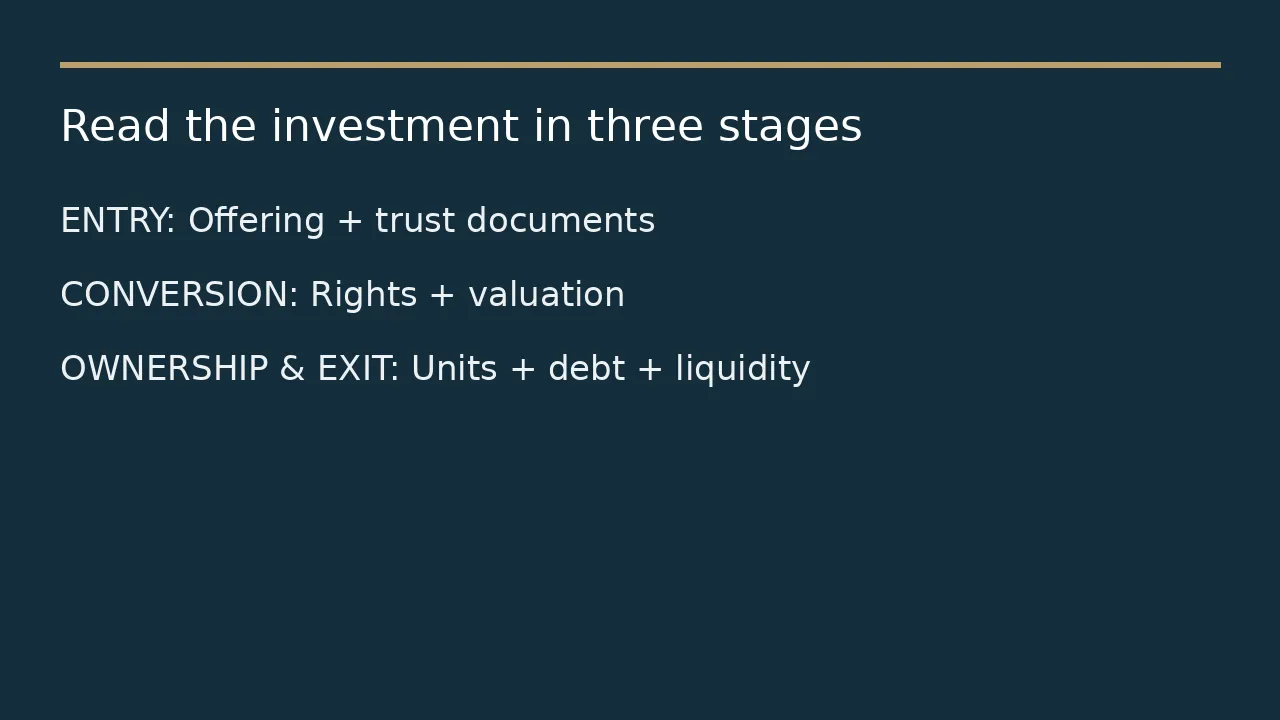
- Review the full documents before choosing a DST with a potential 721 exit. A brochure is only the starting point.
- Entry: request the offering memorandum and trust agreement. Identify the assets, costs, restrictions, and decision-maker.
- Conversion: locate the option or contribution terms and valuation method. Ask whether you can decline and what happens if conversion never occurs.
- Ownership: review the partnership agreement, debt analysis, and any tax-protection agreement. Identify rights and unresolved tax questions.
- Exit: review redemption limits, timing, pricing, and suspension rights. A request window is not a guaranteed cash payment.
- Bring the complete package to your advisor, CPA, and attorney. Learn more and request a conversation through the article's Winthco link.
Turn the paperwork into a decision record
Create a simple list with the document name, version date, relevant section, your question, and the written response. Keep unanswered questions visible. If different materials conflict, ask which document controls before signing.
For an active exchange, work within the deadlines confirmed by your qualified intermediary. Section 1031 generally requires identification within 45 days and receipt by the earlier of 180 days or the applicable tax-return due date, including extensions. A proposed later 721 transaction does not replace those initial exchange requirements.
The goal is to understand both the potential reduction in management responsibilities and the trade-offs in control, expenses, tax complexity, and liquidity. Review our risk questions alongside this checklist.
Talk to a 721 UPREIT advisor
Bring your sale timeline and unanswered document questions to Winthco Wealth Management's 721 UPREIT team. Explore whether the strategy deserves further review in light of your goals and need for access to cash.
721 UPREIT Pros is a Winthco educational resource. This article does not determine investment suitability or provide individualized tax or legal advice.
YOUR NEXT CHAPTER